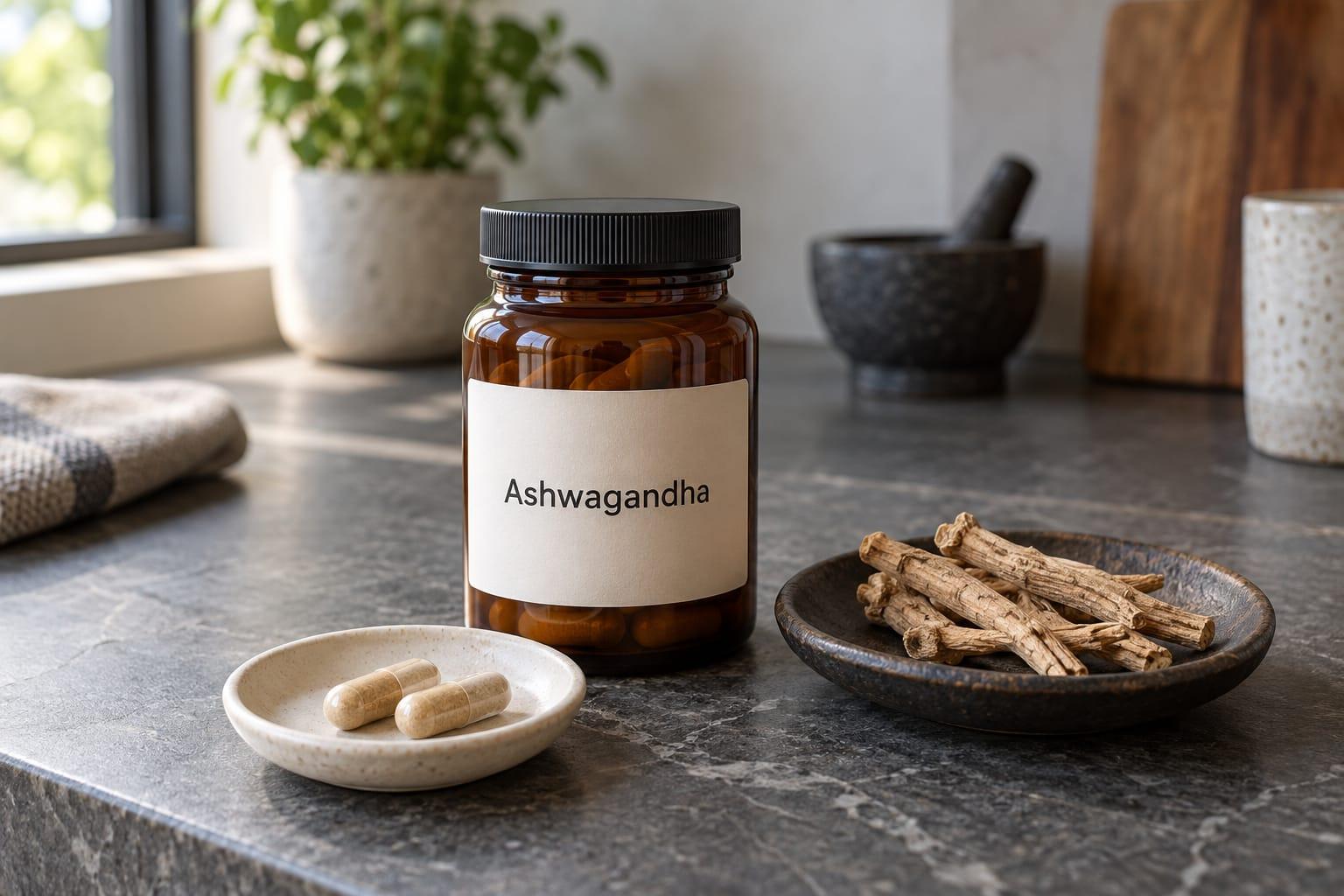
What ashwagandha is
Ashwagandha (Withania somnifera) is a shrub. Sleep supplements may contain powdered root, root extract, or root-and-leaf extract. These are not the same preparation: extracting and standardising a plant changes what is in each milligram. Some products list withanolides, a group of plant compounds, but that number alone does not establish that a product matches a sleep trial. [1, 2, 3]
This profile concerns adults weighing ashwagandha for sleep. A sleep problem that has lasted months deserves its own assessment; the main sleep guide explains how to separate insomnia, schedule problems and symptoms that need attention.
How much did sleep improve in a trial?
One small trial found a modest advantage in time to fall asleep after ten weeks. It randomised 60 adults with insomnia and anxiety to a named KSM-66 root extract or placebo; 58 completed. The group taking the extract received 300 mg twice daily. Their measured sleep-onset time at week ten averaged 29 minutes, compared with 33.95 minutes for placebo, a difference of about five minutes at that endpoint. [3]
Sleep was tracked by wrist movement, called actigraphy, rather than a sleep-laboratory brain recording. The study did not show a clear group separation for total time asleep or time awake after falling asleep at week ten. The participants' large improvements from their own starting point are not the ingredient's effect; placebo participants also changed. [3]
Average time to fall asleep at ten weeks
KSM-66 root extract300 mg twice daily
29minutes
PlaceboInactive comparison
33.95minutes
Lower is quicker. The endpoint difference was 4.95 minutes in this small trial. Wrist tracking estimated sleep; the groups did not clearly separate on total sleep time or wake time after sleep onset. Sixty were randomised and 58 completed. [3]
The extract was branded and the groups were unequal in size. The authors declared no financial support for the submitted work and no competing interests. They thanked Ixoreal Biomed for supplying the KSM-66 extract. These results belong to that extract and study population. They do not prove that any ashwagandha powder or tea has the same effect. [3]
What does the wider evidence add?
A 2021 review collected five trials involving 400 people and described a possible sleep benefit. It included different populations and both root and root-and-leaf preparations. Its “overall sleep” analysis appears to count repeated outcomes in a way that yields 1,764 analysis entries despite only 400 people across the trials. Until that unit issue is resolved, we do not use its pooled effect size as an answer to how much sleep improves. The trials themselves still provide useful, narrower findings. [2]
Keep the claim attached to the evidence
| Question | What is supported | What remains open |
|---|---|---|
| Falling asleep | About five minutes lower at the ten-week endpoint in one small KSM-66 trial. | The result may not apply to another extract or to someone without the trial's insomnia and anxiety. |
| Staying asleep | No clear group separation for total sleep time or wake time after sleep onset in that trial. | A longer night of sleep is not established by the sleep-onset result. |
| Overall benefit | Several small trials exist. | A reliable pooled magnitude needs the review's participant/outcome counting reconciled. |
The trial and review are connected evidence, not six independent confirmations. [2, 3]
The review reported no funding or conflicts for the review authors, while noting that one included trial had partial manufacturer funding. A claim that “research proves ashwagandha works for insomnia” loses the preparation, small-study and outcome limits. [2]
How much and when was it studied?
The detailed trial used 300 mg of KSM-66 root extract twice a day for ten weeks. That is a description of a research schedule, not a dose recommendation. The review combined different extracts and schedules, so it cannot establish a universal milligram amount or a best bedtime interval. A “600 mg ashwagandha” label is not necessarily the same as two 300 mg doses of the tested extract. [3, 2]
The study assessed sleep at ten weeks. It did not show how quickly an individual notices a meaningful change, whether taking the same product for years helps, or what happens after stopping. Products that mix ashwagandha with magnesium, melatonin or other ingredients raise separate questions about contribution and safety.
Safety can decide whether the ingredient is suitable
Ashwagandha may cause drowsiness, stomach upset, diarrhoea or vomiting. Rare cases of liver injury have been linked to supplements containing it; the available summary does not supply an individual risk rate. Short-term studies, usually up to three months, do not establish long-term safety. [1]
Those cautions are more important than choosing a particular extract by a “sleep” claim. A ten-week trial with 58 completers cannot rule out rare harms or justify use in people excluded from its study.
How it fits alongside other sleep help
The ashwagandha result is a modest sleep-onset signal for one root extract in a small group. If insomnia is persistent, CBT-I has first-line guideline support and addresses the patterns that maintain it. That is a different evidence base and purpose from buying a herb. [4, 5, 3]
The sleep supplements comparison explains how ashwagandha's preparation and safety questions compare with the other ingredients. If the difficulty is a late body clock, the melatonin profile explains why that is a different sleep question.