
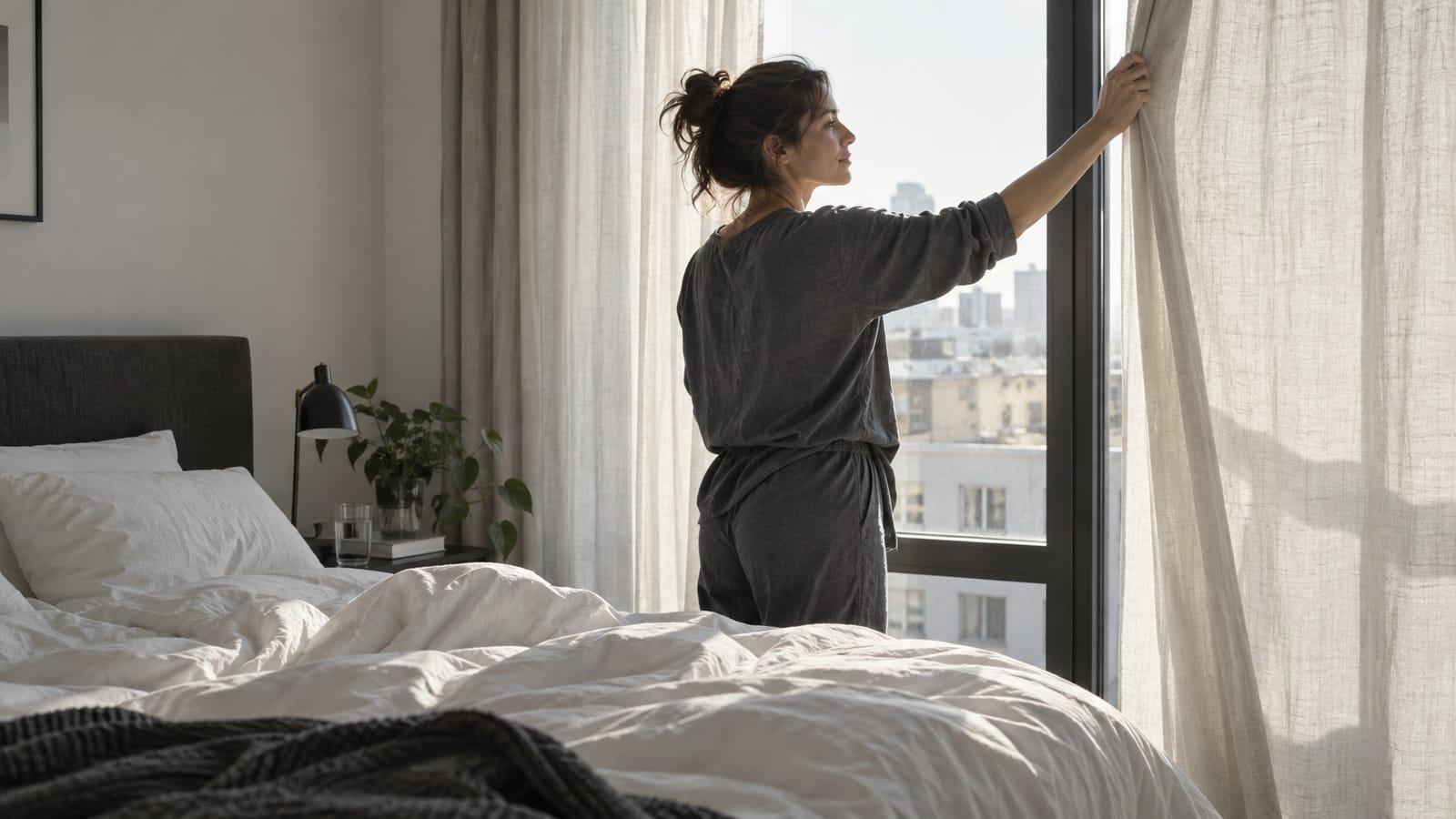
What does sleeping well actually mean?
Good sleep gives you enough rest to function during the day. It has several parts: enough time asleep, reasonably continuous sleep, and timing that fits your body clock and daily life. A long night can still feel unrefreshing; a brief awakening does not automatically mean the night has gone wrong. Sleep supports learning, attention, emotional regulation and physical health. Its most immediate value is often simple: being able to think clearly and stay awake when you need to. [1, 2, 3]
For healthy adults aged 18 to 60, the American Academy of Sleep Medicine and Sleep Research Society recommend seven or more hours regularly. That is guidance about sleep, not just time spent in bed, and individual needs vary. Eight hours is not a compulsory score. More sleep can be appropriate during recovery or illness. [4]
Look at the night and the following day
- Duration
- Enough sleepDoes your schedule leave enough time to meet your sleep needs?
- Continuity and timing
- A workable patternLong periods awake and a body clock out of step with your schedule need different explanations.
- Daytime function
- Rest and alertnessNotice concentration, mood and unwanted dozing, not just the number on a tracker.
These are useful things to observe, not a diagnostic score. [3, 4, 2]
This guide is for adults who want to understand their sleep and choose useful next steps. It brings together habits, bedroom conditions, supplements and the point at which treatment matters. Travel-related timing has its own jet lag guide. Children's sleep, pregnancy and complex medical conditions need more specific advice.
How sleep works: your body clock and sleep stages
Sleep is an active, changing process. Two influences help organise it. Sleep pressure builds as you stay awake and eases during sleep. Your circadian rhythm, or body clock, helps determine when you feel alert or ready for sleep across the day. Light is an important timing cue, and your body's melatonin signal helps prepare you for the night. Having plenty of sleep pressure does not always mean your clock is ready to sleep at the time you choose. [5]
This helps explain why the same advice does not fit every situation. A late nap, a repeatedly shifting schedule and a journey across time zones can create different timing problems. Moving bedtime earlier by force is not always enough. [5, 6, 7]
N1, N2, N3 and REM: the four stages
During the night you move through non-REM sleep, which has three stages, and REM sleep, named for rapid eye movements. N1 is the transition into sleep. N2 is a lighter established stage, with slower brain activity interrupted by brief bursts. N3 is deep, slow-wave sleep. In REM, the brain becomes more active, vivid dreams are common and most muscles are normally relaxed. [1, 8]
How sleep changes through the night
Illustrative pattern
The stages you move through
- N1Falling asleep
A light transition from wakefulness into sleep.
- N2Stable sleep
You are asleep, though this is still a lighter stage.
- N3Deep sleep
Slow-wave sleep. It tends to be more prominent earlier in the night.
- REMActive brain
Vivid dreams are common, while most muscles are relaxed.
Across a typical night
Earlier
More deep N3 sleep tends to occur here.
Later
REM periods tend to get longer.
Illustrative pattern, not a sleep recording or a target. Stages recur in changing cycles; their timing and length vary, and brief awakenings can occur.
The pattern above illustrates the stage changes described by NIH; it is not a measured night or a schedule to copy. Deep sleep tends to be more prominent earlier, while REM periods lengthen later. NIH describes cycles of roughly 80 to 100 minutes, usually four to six per night. Their length varies, so this is not a reason to set an alarm in exact 90-minute blocks. Brief awakenings between cycles can occur. [1, 8]
Does feeling tired mean you need more deep sleep?
Not necessarily. “I slept badly” is a description of how you feel, not a measurement of N3. Short sleep, long awakenings, mistimed sleep or a breathing disorder can all deserve attention. Deep sleep also changes with age. There is no personal deep-sleep quota in this guide that you need to reach. [1, 3]
A watch or ring estimates stages from its sensors; it does not directly record brain activity like a sleep laboratory. Sleep-medicine recommendations caution against using consumer trackers as diagnostic tests. Use a trend as a prompt to look at your nights and daytime functioning, rather than treating one low “deep sleep” score as a reason to add supplements. [9, 10]
Why you may sleep badly or wake up tired
The most useful first question is what is interrupting the opportunity or ability to sleep? Sometimes the answer is visible, such as a short sleep window or a hot bedroom. Sometimes it needs assessment, especially when sleep remains poor despite adequate opportunity. Several causes can coexist. [3, 11, 6]
Match the pattern to the next question
| What you notice | What to look at | A useful next step |
|---|---|---|
| You regularly leave only five or six hours for bed | Work, caring duties, late entertainment or an early alarm may be restricting sleep opportunity. | Make room for enough sleep before judging whether a supplement works. |
| You feel tired but cannot switch off | Stress, time spent awake in bed, caffeine and worry about sleep can all be relevant. | Review the routine; persistent difficulty warrants an insomnia assessment and access to CBT-I. |
| You sleep well, but only much later than required | The timing of the body clock may not match work or other obligations. | Examine the whole schedule and light timing. Travel and persistent timing problems need different plans. |
| You wake hot, cold, disturbed or uncomfortable | Bedding, room temperature, noise, light or a physical symptom may be interrupting sleep. | Change the identifiable disturbance; seek advice for ongoing symptoms. |
| You have enough time but remain very sleepy | Breathing problems, movement symptoms, medicines or another health condition may need review. | Ask for assessment, particularly with gasping, breathing pauses or unwanted dozing. |
An orientation table, not a diagnosis. Insomnia is difficulty falling or staying asleep, or waking too early, with daytime consequences despite adequate opportunity. [3, 11, 5, 6]
Pain, mood problems and medicines can also be part of the picture. A clinician can help untangle these rather than treating every complaint as a missing sleep ingredient. Do not stop a prescribed medicine on the basis of a sleep article. [3, 11]
What helps most: choose the right starting point
Start with a change that addresses your actual problem. The following priorities are a practical order of investigation, not a head-to-head ranking of treatment effects. Basic habits help create the conditions for sleep; established chronic insomnia has a different treatment priority. [6, 12]
| Priority | Try this when it fits the problem | What supports it |
|---|---|---|
| Protect sufficient sleep time | Work backwards from the time you must get up. Identify what repeatedly uses up the evening. | Adult sleep-duration guidance. [4] |
| Make the schedule more consistent | Anchor the day around a reasonably regular wake time and make space for a repeatable bedtime. | Sleep guidance and regularity consensus. [13, 6] |
| Change day and evening light | Make room for daylight; reduce unnecessary brightness near bedtime and during sleep. | Light-exposure consensus for adults with daytime schedules. [14] |
| Review caffeine and alcohol | Move caffeine earlier or reduce it if it may be contributing. Avoid using alcohol to induce sleep. | Controlled-study reviews show sleep disruption. [15, 16] |
| Fix a bedroom disturbance | Adjust bedding, block unwanted light and address avoidable noise. | General guidance plus environment-specific research. [6, 17, 18] |
| Seek effective insomnia care | Ask about CBT-I if difficulty persists despite enough opportunity. | First-line treatment in major clinical guidelines. [3, 11, 12] |
Exercise and a calmer transition to bed can support this foundation. Supplements come later in the decision: the useful question is which ingredient addresses which problem, not how many can fit into a bedtime stack. The sections below explain the practical choices and the studies behind them.
Build a consistent schedule and useful light cues
For a normal daytime schedule, a repeatable wake time and sufficient opportunity for sleep are a useful starting pair. If an evening activity regularly pushes bedtime back while the alarm stays fixed, shortening that activity gives sleep more room. Regularity guidance does not establish a universal requirement to stay within exactly 30 minutes every day. [13, 19, 6]
Daylight and darkness provide contrasting signals to the body clock. A 2022 expert consensus recommends brighter daytime exposure, lower evening exposure and a dark sleep environment for healthy adults with daytime schedules. A practical application is to open curtains on getting up, spend some of the day outside when possible, and lower unnecessary room lighting towards bedtime. These examples do not require a special lamp or a light meter. [14]
Light cues over a regular day
Daytime
Outdoor daylight
A regular daytime light cue, ideally reaching the eyes while you are outside.
Evening
Dimmer light
As bedtime approaches, lower the brightness of light around you.
Sleep time
Dark setting
Keep the sleeping space dark enough to limit light reaching the eyes.
Brightness and colour are different
A warm or red lamp can still be bright, especially at eye level. This pattern does not call for a special lamp or red-light therapy.
Illustrative routine, not a brightness prescription. The useful pattern depends on when light reaches the eyes and how bright it is.
The diagram translates the light consensus into a regular-day example. It is not a jet lag or night-shift prescription: in those situations, whether light should move the body clock earlier or later changes the plan. [14, 7]
What about blue light, LED strips and red lamps?
LED describes a light source, not whether it will help or harm sleep. Timing, brightness, duration and the light reaching your eyes matter alongside colour. Daylight naturally contains blue light; avoiding that colour all day misses the point. In the evening, consider the whole room, including a bright ceiling lamp, decorative LED strips and the screen close to your face. [14]
For a dimmer evening, try lower task lighting instead of lighting the whole room brightly. During sleep, switch off unnecessary displays or position indicator lights away from your eyes. A warm or red setting can still be bright, so colour alone is not a sleep treatment. These are applications of the light guidance, not proof that every small indicator causes a measurable sleep loss. [14]
A screen filter does not solve a late bedtime
If scrolling keeps extending your evening, set a stopping point or put the phone aside before beginning your wind-down. A colour filter changes the display, but not the time spent using it.
In a seven-night randomised trial of 167 young adults, iPhone Night Shift on, Night Shift off and no phone in the final hour produced no clear differences in the full sample's measured sleep outcomes. The result does not prove that these habits are equivalent, but it does not support relying on night mode for sleep protection. Funding details were unavailable in the accessed abstract. Evidence for blue-light blocking glasses is also mixed and uncertain. The light and screens guide compares the interventions and results. [20, 21, 22]
Make your bedroom work for sleep
Aim for a room that is comfortably cool, dark and quiet enough for you to sleep. Begin with the disturbance you actually notice. A different mattress, cooling system or noise machine is not automatically an improvement over a small change to the room you have. [6, 23, 24]
Temperature: adjust comfort, not a magic number
There is no single bedroom temperature established as best for every adult. Bedding, clothing and individual circumstances change the experience of the same room. If you wake hot under a heavy duvet, try a lighter layer; if you wake cold, adjust your layers or room setting. A fan or ventilation may help comfort when appropriate for the room, but neither guarantees better sleep. [18, 25]
One study followed 50 older adults, with a mean age around 79, in their own homes. Sleep was most efficient and restful within an observed room-temperature range of 20 to 25°C. That was an association in a specific population, not a trial proving that everyone should set the thermostat there. A 2025 review of cooling bedding also found that changing temperature did not consistently improve sleep outcomes. Read the bedroom temperature guide for the data and practical bedding choices. [18, 23]
Light and noise: remove the disturbance first
Curtains or a comfortable eye mask are practical ways to reduce unwanted light. For noise, start with controllable sources, then consider whether earplugs suit the situation. Being able to hear alarms or someone who needs you remains a practical constraint. Quieting a room and adding continuous sound are different approaches. [6, 14, 17]
A seven-night laboratory study in 25 healthy adults found that earplugs mitigated most effects of intermittent environmental noise. Pink noise was not consistently protective and reduced REM sleep in one tested condition. This short laboratory result is not proof that every sound machine harms sleep, but “more background sound” is not an evidence-based upgrade for everyone. The study was supported by the US Federal Aviation Administration and reported a relevant sleep-measurement patent interest. [17]
| Problem | A reasonable first change | What a product should actually solve |
|---|---|---|
| Waking too hot or cold | Adjust covers, clothing or the room setting | Thermal discomfort, rather than an unverified promise of more deep sleep |
| Streetlight or early daylight | Close effective curtains or try a comfortable mask | Unwanted light reaching the eyes |
| External noise | Reduce the source where possible; consider suitable earplugs | An identifiable noise disturbance |
| Worry about tracker scores | Look at trends and daytime functioning | A wearable is an estimate, not a diagnosis or a nightly grade |
These are practical applications of the evidence, not a tested product bundle. Consumer sleep trackers can help describe a pattern, but device validation and clinical recommendations do not support treating their stage estimates as definitive. [18, 14, 17, 9, 10]
Check caffeine, alcohol and naps
Caffeine: the dose matters as much as the last cup
Caffeine can mean less sleep even if you do not feel particularly stimulated at bedtime. A 2023 systematic review included 24 controlled crossover studies in healthy adults. In this type of study, participants experience different conditions on separate occasions. Across the varied doses and timings studied, caffeine reduced total sleep and increased time spent trying to fall asleep or awake during the night. [15]
Caffeine compared with control: measured sleep differences
Total time asleep
20 studies, 340 participants
−45.3 (−61.5 to −29)
Time taken to fall asleep
19 studies, 280 participants
+9.1 (+3.8 to +14.4)
Awake after first falling asleep
13 studies, 148 participants
+11.8 (+2.5 to +21)
Points show averages; lines show 95% confidence intervals, the uncertainty around them. Less total sleep and more time awake both indicate worse sleep. Each outcome uses a different subset of the review's 24 studies; do not add their participant counts. Doses and timing varied. No conflicts were declared; funding was not identified in the accessed paper. [15]
This is an average 45-minute reduction in total sleep across study conditions, not a prediction for one cup of coffee. The review's often-quoted 8.8-hour coffee cutoff was calculated from a statistical model. It is not a deadline after which everyone is affected or before which everyone is protected. [15]
A later trial in 23 healthy young men tested additional 100 mg or 400 mg caffeine doses at different intervals before bed. It detected no clear effect from the 100 mg conditions, while 400 mg disrupted aspects of sleep even when taken well before bedtime. The participants did not always notice disruption that appeared in measurements. The study reported no disclosures; funding was not identified in the accessed paper. [26]
Try this: list the amount and time of coffee, tea, energy drinks and any caffeinated pre-workout. If caffeine looks relevant, move it earlier or reduce the amount and observe the pattern over several nights. This is a practical observation exercise, not a test that proves caffeine is or is not your cause.
Alcohol: sedation is not better sleep
Alcohol can make you feel sleepy while disrupting sleep structure. A 2025 review of 27 studies found REM disruption even at lower study doses. Faster sleep onset appeared at higher doses alongside greater disruption; several other outcomes remained uncertain. Alcohol should not be treated as a sleep aid. Choosing an alcohol-free evening is one practical way to see whether your usual evening drinking is part of the pattern. [16]
Naps: consider why and when you need them
A nap can support alertness, but if you struggle to fall asleep at night, examine daytime sleep as well. NIH guidance suggests limiting naps or taking them earlier in the afternoon and advises adult naps of no more than 20 minutes. That is practical guidance, not a biological cliff at minute 21. Travel and shift-work naps serve different purposes. Persistent unwanted daytime sleepiness deserves assessment, rather than simply trying to suppress every nap. [6, 3, 7]
Move during the day and make bedtime less demanding
Regular physical activity can improve how people rate their sleep. A 2024 review of 19 randomised trials found benefits across some sleep measures, but the pooled change in objectively measured total sleep time was uncertain. Exercise is a useful supporting option, not a guaranteed way to add a set number of minutes or a substitute for insomnia care. Walking or another sustainable activity is a practical place to begin. [27, 28]
The transition to bed matters too. Choose an activity that is easy to finish and does not keep extending the evening: reading, a quiet hobby or a relaxation practice can fit. NIH advises quiet time before bed and avoiding large late meals. These are examples of a manageable routine, not a requirement to perform a long ritual perfectly. [6, 12]
A warm bath or shower can be an optional comfort choice. Research on pre-bed warming and newer water-immersion trials has mixed results across sleep outcomes. It does not justify making the water as hot as possible or treating a precise bath duration as necessary. The temperature guide explains the distinction. [29, 30]
What should you do if you wake in the night?
A brief awakening can be part of normal sleep. If you are awake for a prolonged period or becoming frustrated, behavioural insomnia guidance advises leaving the bed for a quiet, relaxing activity and returning when sleepy. Turning the clock out of view can help avoid repeatedly calculating the remaining night. This is different from getting up after every brief awakening. [1, 31, 8]
These ideas belong to stimulus control, which helps reconnect the bed with sleep rather than prolonged wakefulness. A full CBT-I programme adapts several strategies to the person; deliberately restricting your time in bed is not a do-it-yourself instruction from this guide. [12, 31]
Which sleep supplements are worth considering?
The best-supported use of an ingredient depends on the problem. Melatonin has a role in some body-clock problems; magnesium and several other ingredients have limited or mixed sleep evidence. No supplement below is established as the best option for everyone or as a replacement for CBT-I in chronic insomnia. [32, 33, 3, 11]
This is a shortlist of commonly discussed ingredients, not a proven order of effectiveness. Each row is one ingredient; formulations and uses remain attached to the evidence.
| Ingredient | What the evidence suggests | What changes the decision |
|---|---|---|
| Melatonin | Useful in some timing problems, including jet lag. Some European insomnia guidance supports a limited prolonged-release option for adults aged 55 and over. | Timing, release form, age and purpose matter. US and European insomnia guidelines differ; drowsiness and medicine interactions need attention. [32, 11, 3, 34] |
| Magnesium | Possible small improvements in reported symptoms, with inconsistent results across preparations and outcomes. | Check elemental magnesium, kidney health and medicine interactions. A “deep sleep” claim is stronger than the studies establish. [35, 36, 37] |
| L-theanine | Some small studies report improvements in parts of sleep-quality questionnaires. | A small standalone trial did not clearly improve the total sleep-quality score compared with placebo. A blend is a different intervention. [38, 39, 40] |
| Ashwagandha | Some extract-specific sleep-onset benefits in small trials. | Liver injury reports, thyroid and autoimmune conditions, pregnancy and interactions matter. Findings cannot be transferred to every extract. [41, 42] |
| Glycine | Preliminary signals in small, short studies. | The reviewed research does not establish reliable long-term insomnia benefit or a routine sleep dose. [43] |
| Valerian | Some perceived-quality signals, but inconsistent quantitative evidence. | Preparations differ, and guidelines advise against routine use for chronic insomnia. [44, 3, 34] |
How big is a “promising” benefit?
One four-week magnesium bisglycinate trial randomised 155 adults with poor sleep. The studied daily preparation contained 250 mg elemental magnesium alongside about 1.5 g glycine. Insomnia symptom scores fell by 3.9 points with the preparation and 2.3 with placebo, a small difference on a questionnaire. This does not demonstrate a large change in sleep stages, prove that every magnesium form works, or isolate magnesium from the accompanying glycine. The Institute of Food and One Health at Leibniz University Hannover funded the study; Biogena manufactured the capsules. [35]
The practical implication is to read the actual benefit, not just the ingredient name. For magnesium, elemental amount and formulation matter. For melatonin, using it for a clock-timing problem differs from taking a prolonged-release medicine for a labelled insomnia indication. There is no single dose-and-time instruction suitable for every sleep complaint. [36, 45, 32]
Should you combine them into a sleep stack?
More ingredients do not establish more benefit. In one six-week trial, a drink combining L-theanine, lemon balm, valerian and saffron did not clearly outperform placebo on the reported sleep-quality comparison. The study randomised 64 adults with poor sleep; 58 completed it, and people with diagnosed sleep disorders were excluded. Team Foods Colombia funded the study. The result cannot tell us that every combination fails, but it gives no reason to assume a blend is superior. [46]
Start with the problem, review medicines and existing supplements, and avoid adding several new ingredients at once. Our sleep-supplement comparison covers more ingredients, study use, risks and why a commercial blend is not interchangeable with its separate components.
When habits are not enough: CBT-I and insomnia treatment
CBT-I is the first-line treatment for chronic insomnia in major US and European guidelines. Cognitive behavioural therapy for insomnia is a structured programme that addresses behaviours and thoughts maintaining sleep difficulty. It can include stimulus control, relaxation, work on worry about sleep and an individually adjusted sleep schedule. It is more than a list of sleep-hygiene tips. [3, 11, 12]
An AASM review provides a more useful measure of benefit than simply asking how many minutes faster someone fell asleep. Across 25 randomised trials with 1,775 participants, CBT-I increased the proportion of people reaching the studies' thresholds for insomnia remission compared with control. Remission here means meeting a study definition of sufficiently improved symptoms, not a promise of permanent cure. [47]
CBT-I: more people reached insomnia remission
Additional people per 100
CBT-I compared with control after treatment
+33 (+28 to +39)
About 33 more people per 100 reached the studies' remission thresholds, with a 95% confidence interval of 28 to 39 more. This is an absolute difference, not a 33% relative improvement. The 2021 AASM review included varied programmes, controls and populations; it was AASM-commissioned and searched through February 2020. [47]
Treatment can be delivered in person or through a studied digital programme. That does not make every sleep app CBT-I or establish that every digital version works as well as face-to-face care. Ask what programme is offered, what support is included and whether its evidence fits your situation. [11, 48, 49]
Prescription medicines may be considered as part of clinical care, with drug-specific benefits, risks and follow-up. Recent AASM guidance conditionally favours CBT-I alone over starting combined CBT-I and medication, and combined care over medication alone. These decisions are separate from choosing an over-the-counter supplement. [50, 3]
A practical routine to try and observe
Use the evidence to simplify the day, not turn sleep into another performance task. This example is for someone with a regular daytime schedule. It combines guidance-based principles with practical examples; the exact package has not been tested as a treatment. [6, 14, 13]
- 1
On waking: give the day an anchor
Aim for a repeatable wake time. Open curtains and make room for daylight. Look ahead at the evening so that the next sleep opportunity is long enough.
- 2
During the day: move and notice caffeine
Include activity you can sustain, such as a walk. Note caffeinated drinks and pre-workout products. If night-time sleep onset is difficult, review late or long naps.
- 3
Towards bedtime: lower stimulation
Reduce unnecessary bright lighting and choose a stopping point for work or scrolling. Set out what you need tomorrow, then move to a quiet activity you can finish.
- 4
At night: make the setting comfortable
Use bedding that suits the room, reduce unwanted light and noise, and go to bed when sleepy. If wakefulness becomes prolonged or frustrating, a quiet activity outside bed can be more useful than watching the clock.
Choose one change and keep a simple record
For example, if a large late coffee seems relevant, start there rather than simultaneously buying a supplement, changing bedding and adopting a new bedtime. If the bedroom is clearly too warm, begin with covers and comfort. This makes your observations easier to interpret, although an informal record cannot prove cause and effect.

Record roughly when you went to bed and got up, long periods awake, naps, caffeine and alcohol, the change you tried, and how you felt the next day. Estimate rather than watching the clock all night. Sleep diaries are used in insomnia assessment; this simplified example is an observation aid, not a diagnostic test. [3, 8]
Look for a pattern across nights, not a verdict from one bad evening or one wearable score. If the problem persists or affects daytime life, the record can help a clinician understand it. You do not need to complete every tip before asking for help. [3, 9]
When to get help, and what to read next
Seek assessment when sleep difficulty persists, daytime functioning suffers or symptoms suggest another sleep disorder. Chronic insomnia is commonly defined by difficulty at least three nights a week for three months despite adequate opportunity, with daytime consequences. That definition is not a waiting period before you can ask for help. [3, 11]
Snoring with gasping or breathing pauses
These symptoms can warrant assessment for obstructive sleep apnoea. A supplement or a reassuring watch score cannot rule it out.Unwanted dozing or unsafe sleepiness
Do not drive when sleepy. Falling asleep unexpectedly or struggling to stay awake deserves prompt attention.An urge to move the legs at rest
If it is worse in the evening and relieved by movement, discuss restless legs symptoms. Iron assessment and treatment are condition-specific, not a reason to start iron blindly.Ongoing insomnia or a persistently shifted schedule
Ask what is maintaining the pattern and what treatment fits it, including CBT-I when appropriate.
Symptoms guide assessment; they do not establish a diagnosis on their own. [3, 51, 2]
For the next level of detail, choose the question that matches your situation:
Which supplement has evidence?
What bedroom temperature helps?
What should change about light?
Is the problem jet lag?