
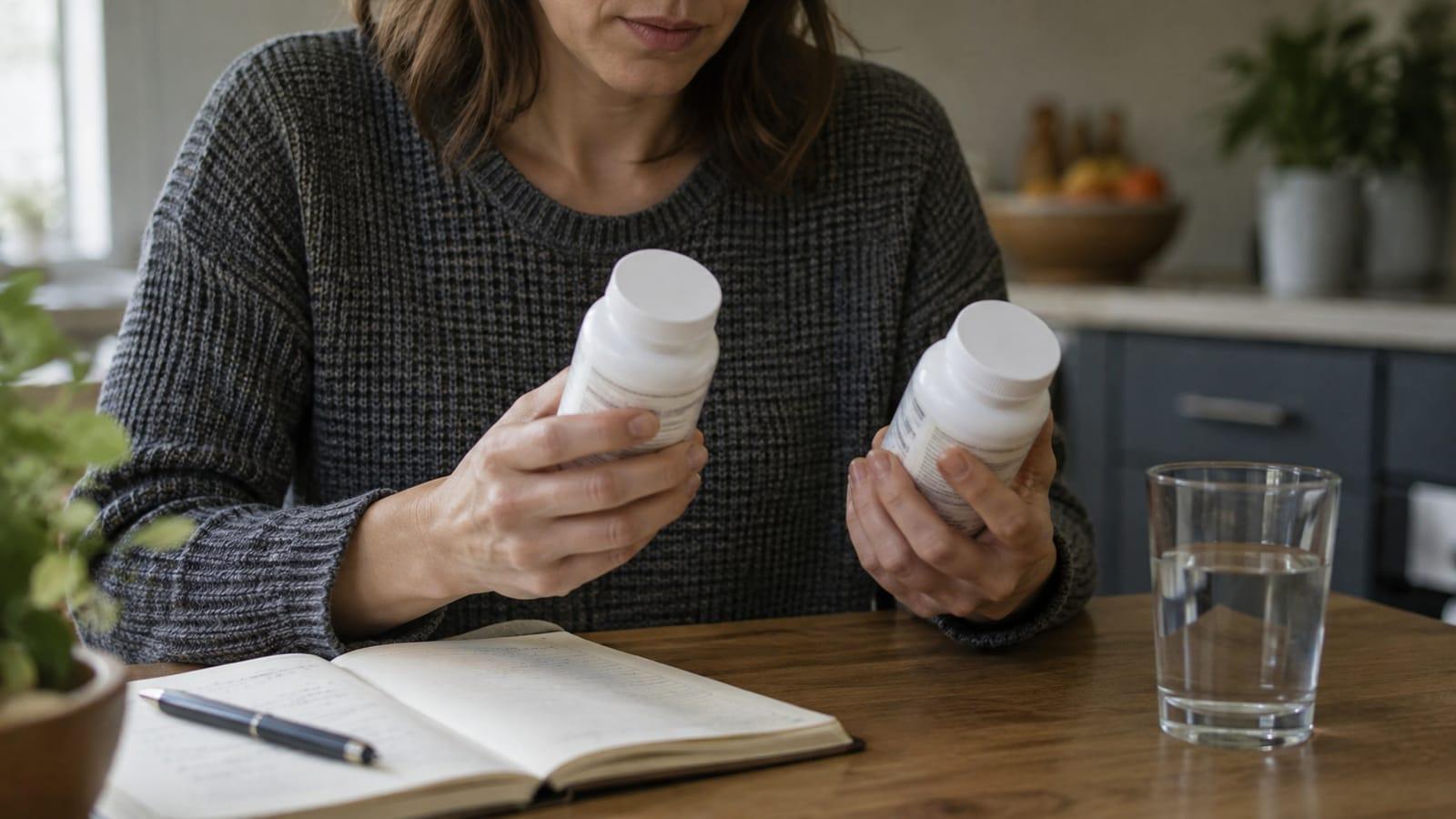
First decide what you want to improve
Sleep supplements are not one treatment. They include a hormone such as melatonin, a nutrient such as magnesium, amino acids and plant extracts. Their ingredients, purposes and safety questions differ. A product sold for sleep can be easy to buy without being a well-supported treatment for insomnia. [1, 2, 3, 4]
This comparison is for adults. It separates ordinary dissatisfaction with sleep from insomnia and problems with sleep timing. Insomnia means difficulty sleeping despite having the opportunity, with effects during the day. A body clock that is out of step with the required schedule asks a different question. The guide to sleeping better helps make that distinction; jet lag needs its own timing plan. [1, 4]
Falling asleep
Staying asleep
Functioning tomorrow
For chronic insomnia, cognitive behavioural therapy for insomnia, usually shortened to CBT-I, remains first-line care. It is a structured treatment addressing sleep habits, time in bed and thoughts about sleep. A supplement is not an established equivalent. [1, 2]
Compare the main ingredients
No ingredient below has been established as the best sleep supplement for everyone. The descriptions are plain-language summaries, not formal grades or a ranking. Separate studies cannot reliably tell us which ingredient would work best in the same person.
| Ingredient | What benefit is supported? | How convincing is the evidence? | Main safety question |
|---|---|---|---|
| Melatonin | A role in some timing problems; a limited prolonged-release option for older adults in European insomnia guidance. | Insomnia guidelines disagree. Release, age and indication must remain attached to the conclusion. | Drowsiness, medicine interactions and uncertain long-term supplement safety. [1, 2, 5, 4] |
| Magnesium | Some small improvements in reported symptoms. | Mixed findings, including newer trials; no established best form or routine insomnia role. | Gastrointestinal effects, kidney function and interacting medicines. [6, 3, 7] |
| Valerian | Some people report better sleep quality. | Variable preparations and weak, inconsistent quantitative results; guidelines advise against routine insomnia use. | Incomplete harms evidence does not establish long-term safety. [8, 2] |
| Glycine | Preliminary signals in small sleep studies. | Short studies with substantial methodological limitations. | Long-term sleep-use evidence is too limited for confident assurances. [9] |
| L-theanine | Some subjective sleep outcomes improve in some studies. | Mixed populations, combinations and small standalone studies limit confidence. | Short trials do not settle long-term use or combinations. [10, 11, 12] |
| Ashwagandha | Some extract-specific improvements, including sleep onset in a small insomnia trial. | Promising but limited; individual endpoints are more useful than a broad sleep-improvement claim. | Liver injury reports, thyroid and autoimmune conditions, pregnancy and medicine interactions. [13, 14, 15] |
Melatonin and magnesium have full profiles because the practical distinctions need more space. For magnesium in particular, the elemental amount is more useful than the large compound weight printed on a pack.
The practical differences are part of the comparison
Benefit and evidence are only two criteria. Risk, time, cost, effort, maintenance and access also affect a decision. A short study tells us when researchers measured a result, not the day a benefit must begin or how long someone should continue.
| Ingredient | Time information | Effort in studied use | After stopping | Access and cost |
|---|---|---|---|---|
| Melatonin | One European insomnia medicine is labelled for up to 13 weeks. | Product-specific timing and release form matter. | No promise of a permanent solution to insomnia. | US supplements and European medicines have different rules; no comparable price survey here. [16, 4] |
| Magnesium | Recent examples lasted four or six weeks. | Daily intake; elemental amount and other sources need checking. | Durable benefit after stopping is not established by these trials. | Form and serving size vary; no verified cost ranking. [17, 6, 3] |
| Valerian | Studies use widely varying durations. | The exact preparation matters; a tea is not automatically the studied extract. | Long-term benefit is uncertain. | No matched preparation or market-price comparison here. [8] |
| Glycine | Healthy-adult studies in the review were short. | Supplement use was tested, not simply a diet containing glycine. | Durable insomnia benefit is unproven in the reviewed material. | No verified market or serving-cost comparison. [9] |
| L-theanine | One small standalone trial used four-week treatment periods. | A defined daily supplement differs from caffeinated tea or a blend. | Maintenance of a sleep benefit is not established. | Products cannot be ranked on value from these studies. [11, 12] |
| Ashwagandha | The cited insomnia trial lasted ten weeks. | Twice-daily use of one specified root extract. | Short trials do not settle long-term benefit or safety. | Different extracts are not interchangeable; cost comparison is unresolved. [14, 15] |
What a better sleep score actually means
A questionnaire can measure distress about sleep, perceived quality or daytime difficulty. It does not directly measure minutes asleep. A wearable estimates sleep from signals such as movement; laboratory sleep measurements use different methods. The result needs its own name. [17, 6, 18]
For example, the newer magnesium studies do not justify a blanket claim of deeper sleep. The bisglycinate study found a small symptom-score difference. A 2026 threonate study found improvement in sleep-related daytime impairment, but not a clear difference in overall sleep disturbance or the Oura sleep outcomes. [17, 6]
Four questions that make a trial result useful
- What changed: minutes, symptoms, perceived quality or next-day function?
- Was the improvement greater than with an inactive comparison product, called a placebo?
- Was the tested preparation the same as the one being discussed?
- Were the people in the study similar to the adults the claim is aimed at?
The same caution applies to botanicals. A small ashwagandha trial found a difference in time to fall asleep after ten weeks, but not clear differences in total sleep time or time awake during the night. “Improves sleep” loses that important distinction. [14]
Does a sleep stack work better?
Adding ingredients does not establish that a product works better. A direct trial of the actual combination is more informative than separate positive studies of its components.
One six-week study randomised 64 adults with poor sleep to a drink containing L-theanine, lemon balm, valerian and saffron, or a placebo drink. Fifty-eight completed it. People with diagnosed sleep disorders were excluded. Sleep efficiency means the proportion of time in bed spent asleep; this and sleep duration were estimated by a Fitbit, rather than measured in a sleep laboratory. The active drink did not clearly outperform placebo on sleep efficiency, total sleep time or reported quality. The study was funded by Team Foods Colombia; the authors reported no sponsor role in conducting, analysing or deciding to publish it. [18]
Sleep-quality score improvement after six weeks
Four-ingredient drink31 completers
3.11points
Placebo drink27 completers
3.86points
Larger bars mean larger reductions in the Pittsburgh Sleep Quality Index, a questionnaire where lower scores indicate better sleep. Both groups improved; the difference was not statistically clear (p = 0.41). This is one formulation, not a comparison of individual ingredients. [18]
This does not prove that every blend fails, or that its ingredients interfere with one another. It shows why promising individual ingredients cannot simply be added into a promised result. A routine built around the actual sleep problem is a clearer starting point than an expanding list of products.
What about chamomile, tart cherry, GABA and CBD?
These candidates are not all supported to the same extent, and none should inherit another ingredient’s findings. The table keeps them separate rather than treating “natural sleep aids” as one intervention.
| Ingredient | What the reviewed evidence can say | What it cannot settle |
|---|---|---|
| Chamomile | A review found a subjective-quality signal across mixed populations. | Reliable improvement in sleep duration or efficiency, or that ordinary tea treats chronic insomnia. [19, 2] |
| Tryptophan | A small pooled evidence base suggests less time awake after falling asleep. | A dependable overall sleep benefit or universal dose. Medicine interactions matter. [20, 21] |
| 5-HTP | A small older-adult study reported exploratory benefits. | A firm placebo-controlled result: its control group took no supplement. [22] |
| GABA | Some small studies suggest an effect on falling asleep. | Reliable improvement across sleep outcomes or proof that an oral supplement reproduces brain GABA activity. [23] |
| Lemon balm | Human research includes mixtures and small studies. | Reliable standalone insomnia treatment from the material reviewed here. [24, 18] |
| Passionflower | Small studies have measured sleep outcomes. | A convincing routine insomnia role; VA/DoD guidance advises against it. [24, 2] |
| Tart cherry | Two small insomnia trials were positive within a recent review. | A clear overall benefit across mixed adults, or a melatonin-equivalent juice dose. [25] |
| CBD | A small pilot was largely negative for insomnia symptoms, with one positive objective sleep-efficiency result. | A reliable insomnia treatment, equivalence to THC mixtures, or harmlessness. [26, 2, 27] |
For CBD, the FDA has also reported liver-enzyme elevations in a safety study at a different, higher dose range than the insomnia pilot. That result cannot give the risk for every gummy, but it prevents an assumption that a nonintoxicating product is automatically low-risk. [27]
How to compare products without a score
A useful label comparison starts with identity and ends with a measurable purpose. A larger milligram number, a longer ingredient list or a sleep-stage claim is not enough.
- 1
Name the problem
Distinguish sleep timing, persistent insomnia and a short period of poor sleep.
- 2
Identify the product
Record the ingredient, release form or extract, amount per serving and other active ingredients.
- 3
Check suitability
A pharmacist or clinician can review medicines, relevant health conditions and product warnings.
- 4
Define improvement
Decide whether the question concerns falling asleep, waking, daytime function or another specific outcome.

The melatonin profile explains why labelled amounts and release forms matter. The magnesium profile explains why other supplements, antacids and medicines can affect the safety calculation. Neither a certificate of product quality nor a clean label would prove that an ingredient treats insomnia. [3, 28]
Where non-supplement options fit
Bedroom changes and devices belong in a separate comparison. They should not appear as if they were extra ingredients in a supplement ranking. The bedroom-temperature guide and light-and-screens guide address environmental questions; their evidence does not turn a supplement blend into a tested combined treatment.
Choose the next question, not the longest ingredient list
The sleep guide is the next step when the cause of poor sleep is unclear. For a specific product decision, start with melatonin’s uses and labels or magnesium’s forms and trial results. For disrupted timing after travel, use the jet-lag guide.
Explore the sleep collectionFind the explanation that matches your sleep problem, from everyday changes to ingredient-specific questions.