
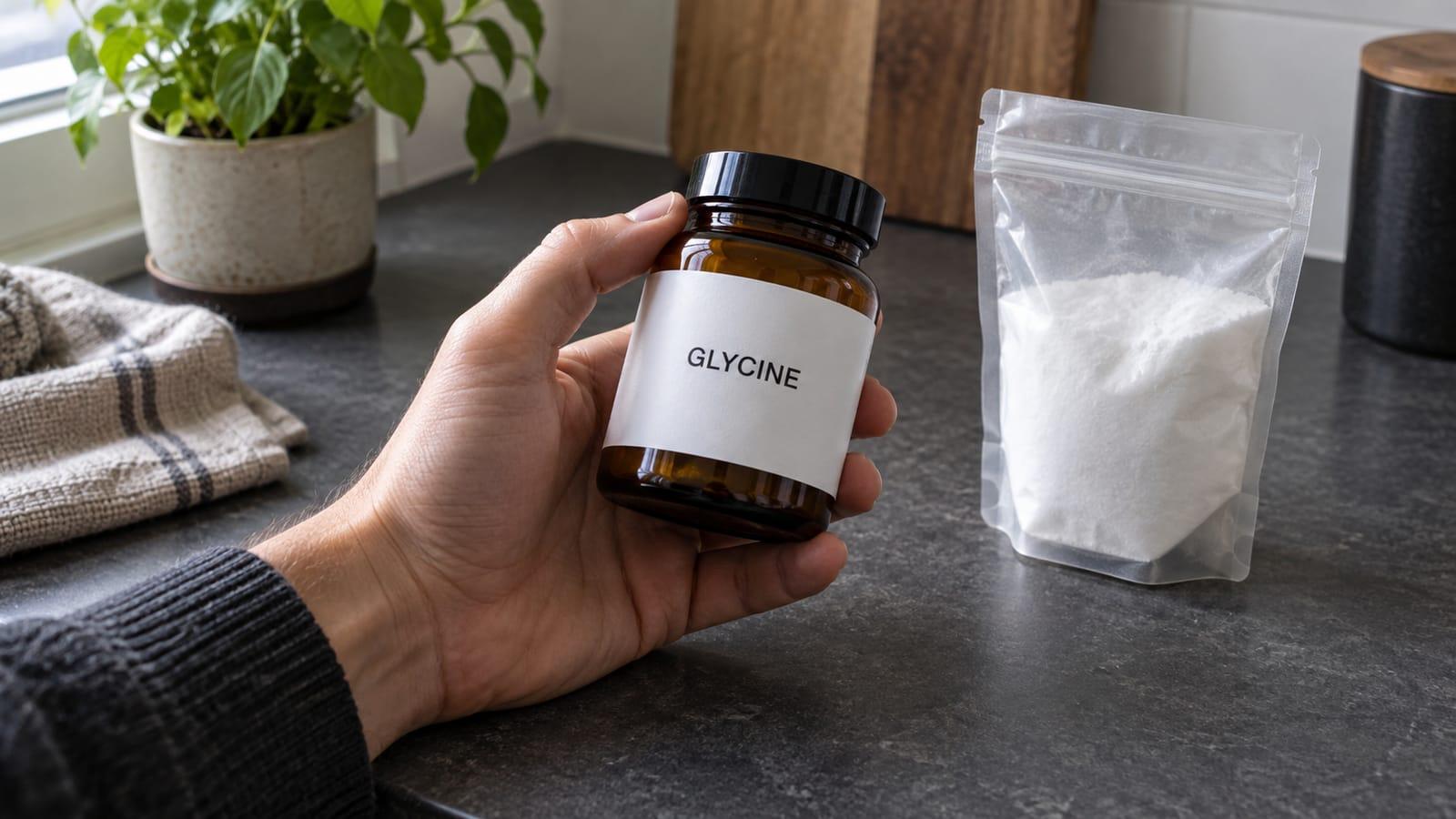
What glycine is
Glycine is an amino acid, one of the building blocks used to make proteins. The body can make glycine, and protein digestion releases amino acids from food. A glycine supplement supplies the individual amino acid rather than a whole protein. [1]
People buy glycine powder or capsules hoping to fall asleep more easily or feel more refreshed the next day. The sleep research suggests some short-term benefits, but it cannot yet tell an adult with persistent insomnia how likely a useful, lasting improvement is. This profile explains the specific results behind those claims. [2, 3, 4]
It concerns general adult sleep questions. The studies below did not establish a treatment for a diagnosed sleep disorder. The main sleep guide helps distinguish difficulty falling asleep, a shifted schedule and problems that need assessment.
Glycine powder, protein and magnesium glycinate are different
These products can share a word or an amino acid without supplying the same ingredient in the same amount. Protein is made of linked amino acids; the trials tested a measured glycine ingredient. The total grams of a protein powder therefore do not tell you the grams of glycine tested for sleep. [1, 2, 3]
Three products, three different amounts
A label comparison, not a chemical structure or a suggested serving.
Protein
Many amino acids joined together
A gram of protein counts the whole protein. It is not a gram of glycine.
Glycine
The individual amino acid
The sleep studies tested a measured glycine ingredient. The amount refers to glycine itself.
Magnesium glycinate
A magnesium compound
Its name refers to magnesium associated with glycine-derived groups. An elemental magnesium amount counts the magnesium.
Sharing a word on the label does not make these interchangeable sleep preparations. Product composition and the serving basis still matter. [1, 2, 3, 5, 6]
Magnesium glycinate, also called bisglycinate, is a magnesium compound with two glycine-derived groups for each magnesium ion. An elemental magnesium figure describes the magnesium itself. It is not a stand-alone glycine amount, and a sleep result for magnesium glycinate cannot establish what glycine alone contributes. [5, 6]
For example, a recent magnesium study tested a preparation delivering 250 mg of elemental magnesium together with 1,523 mg of glycine. Its result belongs to that preparation. It does not show that this amount of glycine alone works, or that it adds to magnesium’s effect. [7]
Food and protein products have their own nutritional purpose. The glycine studies reviewed here do not establish that eating a particular food or using a protein supplement reproduces their sleep results. A “glycine-rich” claim needs more than a total protein figure to make that comparison.
Can glycine help you fall asleep?
Possibly, but the clearest laboratory result comes from only 11 people over a very short exposure. A 2007 study tested 3 g of glycine within an hour before bed against a same-flavour inactive preparation. The adults, aged 30 to 57, reported unsatisfactory sleep but were otherwise described as healthy volunteers. [2]
Each person received both preparations in a randomised, single-blinded crossover study. “Crossover” means that the same people try each condition in separate periods, rather than forming two independent groups. There were two nights per condition, separated by at least a week. The first night was for adaptation and was excluded from the results, leaving one analysed sleep-laboratory night per condition. [2]
| What was measured | What the study found | What that means |
|---|---|---|
| Satisfaction with sleep and difficulty falling asleep | Some self-reported measures favoured glycine. | Participants felt a benefit on selected questions, not every measure. |
| Time to the first period of stage 2 sleep | Shorter with glycine. | Sleep recordings supported an earlier onset of this sleep stage. |
| Time to the first period of slow-wave sleep | Shorter with glycine. | Participants reached this deeper sleep stage earlier. |
| Proportions of time in different sleep stages | No change. | Earlier deep-sleep onset did not establish more total deep sleep. |
The sleep recording, called polysomnography, measures signals such as brain activity to identify sleep stages. The distinction in the last two rows matters: “reached deep sleep sooner” and “got more deep sleep” are different claims. The study supports the former, not the latter. [2]
Several authors were affiliated with Ajinomoto, and its ethics board was involved alongside a hospital board. The accessed report did not identify a separate funding statement. The tiny sample, single blinding and one analysed night per condition limit what it can tell us about everyday use. [2]
Does it help you feel better after too little sleep?
One small experiment found less first-day fatigue, but that is a different question from treating insomnia. In 2012, researchers deliberately reduced healthy men’s usual time in bed by 25%, from about 7.3 to 5.5 hours. Seven men were analysed after exclusions and a dropout; they did not have a sleep disorder. [3]
The same men used 3 g of glycine or an inactive preparation 30 minutes before bed for three consecutive restricted nights in each condition. The single-blinded crossover included 7 to 14 recovery nights between conditions. Time in bed was tracked using sleep logs, without laboratory sleep recordings. [3]
Fatigue after the first night of shortened sleep
A self-rated scale from 0, vigorous, to 100, extremely fatigued. Lower means less fatigue.
10 am
PlaceboMean 48.3; standard error 4.97GlycineMean 33.6; standard error 4.62 pm
PlaceboMean 53.1; standard error 6.2GlycineMean 35.4; standard error 8.626 pm
PlaceboMean 59.6; standard error 8.14GlycineMean 51; standard error 9.73
Average ratings from the same seven men in both conditions. These are score points, not percentages or minutes of sleep. The lines show the reported standard errors, a measure of uncertainty around the means, not confidence intervals or the range of individual scores. The day-one treatment effect across time points was statistically clear, p = 0.022; the subjective benefit was not clear on day three. [3]
Reaction time on a vigilance task also favoured glycine, but several other tests did not. The overall difference in self-rated sleepiness was not statistically clear. The study does not show that glycine can make shortened sleep adequate or provide a substitute for time asleep. [3]
The participants were male Ajinomoto employees, and three authors had company affiliations. The paper declared no commercial or financial conflicts; a separate funding source was not identified in the accessed report. With seven analysed people and many measurements, the findings need cautious interpretation. [3]
How much glycine was studied, and when?
The two original studies described here used 3 g of glycine before bedtime. They did not compare different amounts, establish the best bedtime interval or test a routine for months. Those details describe research exposure, not a universal dose. [2, 3]
The preparation and schedule behind the results
| Study detail | Sleep-laboratory studyAdults with unsatisfactory sleep | Shortened-sleep experimentHealthy men without sleep disorders |
|---|---|---|
| Ingredient and amount | 3 g glycine in a flavoured granule preparation. | 3 g glycine in a flavoured preparation. |
| Timing | Within one hour before bedtime. | 30 minutes before bedtime. |
| Exposure per condition | Two consecutive nights; the adaptation night was excluded. | Three consecutive nights of deliberately restricted time in bed. |
| Useful boundary | A very short test of sleep onset and reported sleep quality. | A test of daytime performance after short sleep, not an insomnia treatment trial. |
Both used an inactive reduced-malt-sugar comparison with the same flavour. They did not compare commercial powders with capsules, establish an optimal dose or test added benefit with another sleep ingredient. [2, 3]
A systematic review found small samples and high risk of bias in this sleep-related evidence. Its search ended in April 2022, and its sleep findings concerned use over a few days. The review’s broader collection of studies across many body systems should not be mistaken for dozens of sleep trials. [4]
There is no reliable timeline for when an individual should expect a lasting benefit from glycine. A few positive nights in research do not establish what happens after stopping or after months of use. The studies above did not answer those questions.
Side effects and what the safety studies cannot tell us
Digestive symptoms are a reported concern, while the long-term nightly safety question remains unanswered by these short studies. A 2006 open safety study involved 12 healthy adults and seven days of glycine exposure within a 17-day observation schedule. It used 9 g per day at varying times, including 9 g before bed on the final three exposure days. [8]
The researchers recorded non-serious soft stools and abdominal pain considered possibly related to bedtime glycine. They did not find serious acute adverse events. This was a small, unblinded study by Ajinomoto-affiliated authors, using a higher amount than the sleep trials. It cannot provide a dependable side-effect rate for a 3 g product or demonstrate safety over years. [8]
The sleep-laboratory trial reported no serious adverse effects during its short exposure; the restricted-sleep report did not provide a complete adverse-event table. Neither resolves use during pregnancy or breastfeeding, in people with significant illness, alongside specific medicines, or in children. This profile does not extend the findings to those situations. [2, 3]
If a health condition, pregnancy or a medicine is part of the question, a pharmacist or clinician can assess the actual product and circumstances. The fact that the body makes glycine does not establish the safety of every supplemental amount or combination.
What to check on a glycine product
The label needs to tell you what ingredient and amount you are buying. This is a product-reading task; the studies do not select a brand or establish that every powder or capsule matches their preparation.
Four useful label questions
- Does it list glycine itself, a protein product or a magnesium compound?
- Is the glycine amount stated per capsule, per scoop or for a multi-unit serving?
- Is the glycine amount disclosed separately, or hidden inside a total blend weight?
- What other active ingredients are present, and do they bring their own use or safety questions?
For the study amounts, 3 g equals 3,000 mg of glycine. A number in milligrams is not automatically a smaller or larger serving until the ingredient and serving basis match. Neither a protein weight nor an elemental magnesium figure can be substituted for that glycine amount. [2, 3, 1, 6]
A mixed sleep product also asks a new question. The stand-alone glycine studies here do not establish extra benefit or safety from adding melatonin or magnesium. Adding several ingredients makes it harder to interpret what helped or caused a symptom.
When another kind of sleep help matters more
The useful next step depends on the sleep problem. Regularly leaving too little time in bed calls for understanding and addressing that constraint; the seven-person experiment does not validate using glycine to sustain a short-sleep routine. Persistent difficulty sleeping despite enough opportunity needs a different assessment from a supplement choice.
For chronic insomnia, guidelines support cognitive behavioural therapy for insomnia (CBT-I) as first-line care. It addresses the patterns that keep insomnia going rather than relying on an ingredient alone. The main sleep guide explains that route and when symptoms such as breathing interruptions or daytime impairment warrant attention. [9, 10]
Glycine can be understood as a preliminary ingredient option with specific short-term findings. The decision should include the uncertain chance of benefit, the product and amount, safety questions, cost and the practical work of taking it. No evidence reviewed here establishes that a more expensive form works better.
Compare glycine with other sleep supplementsSee how the studied problems, outcomes, safety and practical considerations differ across sleep ingredients.