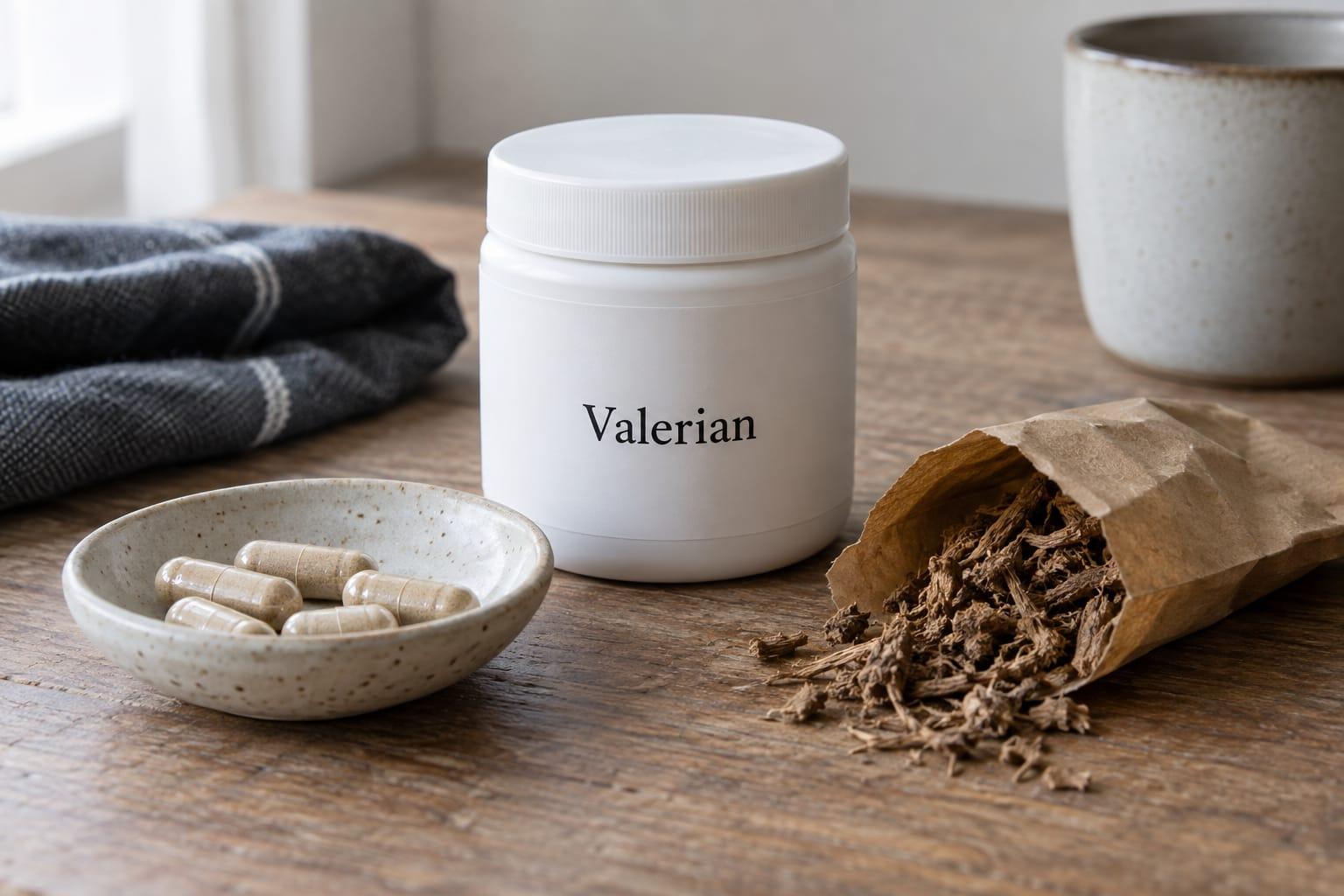
What valerian is
Valerian (Valeriana officinalis) is a plant whose roots and underground stems are used in sleep products. It is sold as dried herb for tea, powdered root, extracts and multi-herb blends. Those forms can differ in the amount of plant material and what the extraction retains. A milligram amount for one extract is not automatically equivalent to the same weight of dried root or another extract. [1, 2]
This page addresses general adult sleep and insomnia claims. If the difficulty sleeping persists despite enough time in bed, the main sleep guide gives a route to assessment and treatment options.
Does valerian help insomnia?
It has not shown a reliable, meaningful benefit for chronic insomnia. Some studies suggest people may feel their sleep improved, but results vary across preparations and measures. A 2024 umbrella review found that the underlying reviews overlap and do not establish consistent quantitative benefit. The American Academy of Sleep Medicine recommends against valerian for chronic insomnia in adults. That is a recommendation about the evidence, not proof that every preparation is inactive. [3, 4]
A useful original test recruited adults who reported insomnia for more than a month. After a two-week sleep diary, 405 people who took at least one tablet were analysed across valerian and placebo groups. They received three tablets providing 600 mg of one valerian extract, about an hour before bed for 14 days. The main outcome was a noticeable improvement in a seven-point daily sleep-quality rating. [2]
Noticeable sleep-quality improvement after two weeks
Valerian extract600 mg nightly
28.7% of participants
PlaceboInactive tablets
21.2% of participants
The 7.5 percentage-point difference was uncertain: the trial could not rule out no difference between groups. The 95% confidence interval ranged from 0.9 points favouring placebo to 15.9 favouring valerian (p = 0.08). It is a self-reported threshold, not extra minutes of sleep. The analysis used 202 valerian and 203 placebo participants who took at least one tablet. [2]
On a separate end-of-study question, a slightly greater share taking valerian said sleep was better or much better. That secondary signal does not overturn the uncertain main result. The trial relied on participants' diaries rather than sleep-laboratory recording, lasted two weeks, and recruitment through a television programme may limit how closely it represents every adult with insomnia. It was funded by the Norwegian Knowledge Centre for the Health Services as part of a public broadcasting collaboration; authors declared no competing interests. [2]
Did it make people fall asleep faster?
The same trial did not establish a clear improvement in how quickly people fell asleep, night awakenings, sleep duration or daytime energy that would support a dependable treatment claim. The 2024 umbrella review likewise cautions against treating varied subjective findings as consistent evidence of measurable sleep improvement. [2, 3]
Different questions, different answers
| Outcome | Two-week extract trial | Reader meaning |
|---|---|---|
| Daily sleep quality | 28.7% versus 21.2% met the trial's improvement threshold; the difference was not clear. | A possible small subjective signal, not a reliable individual expectation. |
| Time to fall asleep | No convincing advantage on the sleep diary outcome. | The tested extract was not established as a way to fall asleep faster. |
| Long-term insomnia | Not assessed after the two-week course. | The result cannot establish lasting treatment or safety. |
The table describes one extract and its own comparison. It is not a result for valerian tea, another brand or a blend. [2]
What amount and timing were studied?
The original trial tested three coated 200 mg extract tablets, 600 mg of extract in total, about one hour before bed for two weeks. The paper described them as equivalent to 3,600 mg of dried valerian root and rhizome, using that product's conversion. This does not give a universal conversion for another product or make 3,600 mg of tea the same intervention. [2]
The NIH safety summary describes apparent short-term use at 300 to 600 mg daily for up to six weeks, while noting that long-term safety is unknown. Neither statement identifies an optimal dose for sleep. A tea bag's weight, a liquid extract's volume and a capsule's total blend weight are not interchangeable. A label should identify the valerian form, amount per serving and other active ingredients. [1]
Side effects and interactions
Reported effects include headache, stomach upset, mental dullness, uneasiness, excitability and vivid dreams. Rare liver-injury reports most often involved valerian with other herbs, so they do not give a useful risk rate for valerian alone. The NIH summary also describes withdrawal symptoms reported after abrupt stopping following chronic use; short sleep trials cannot tell how often this happens. [1]
The two-week trial reported no serious adverse events and no important difference in minor events, but it was too short to settle uncommon harms or use alongside other sleep products. A valerian and lemon-balm blend is a different intervention; its results and risks belong to the whole formula. [2, 1]
What to do with the answer
Valerian is a traditional sleep ingredient with an uncertain practical benefit and important form differences. It is not a well-supported substitute for CBT-I, which guidelines support as first-line care for chronic insomnia. If sleep loss is driven by breathing interruptions, a shifted schedule or pain, the ingredient choice does not answer that cause. [5, 6, 4]
The sleep supplements comparison places valerian beside theanine and other options. It also separates trial results from product labels and personal cost or effort.