
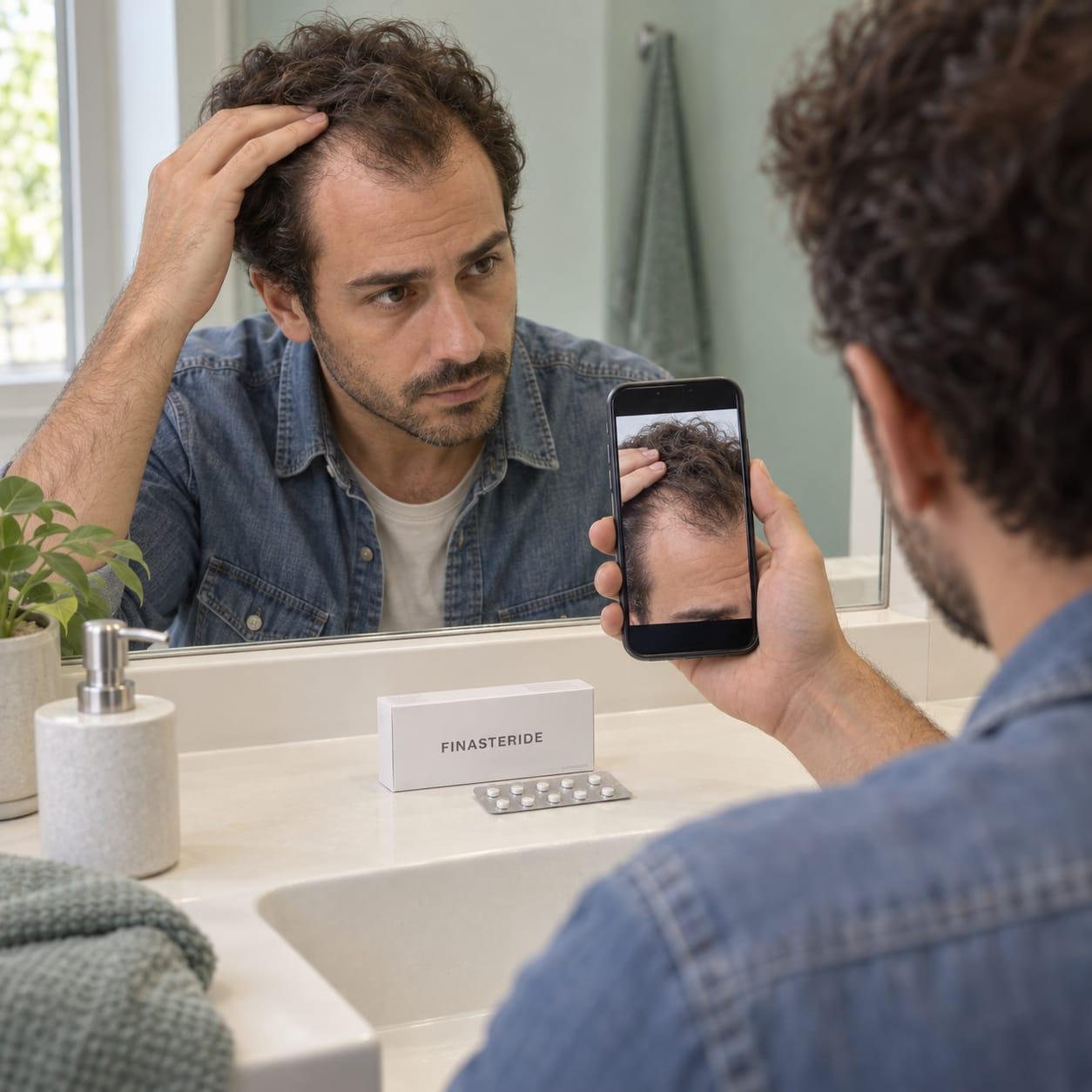
What finasteride does for male pattern hair loss
Finasteride is a prescription medicine for male pattern hair loss. The 1 mg tablet can help preserve hair and increase the amount growing in thinning areas. That means a useful result can be regrowth, less further loss, or both. The evidence supports benefit in groups of men; the amount an individual will notice varies. [1, 2]
This page is for adult men considering the tablet or trying to judge their progress. It explains timing, visible change and continued treatment. Finasteride also has a studied scalp spray, covered separately below and on the topical finasteride page. If the cause of thinning is unclear, the hair-loss types guide helps identify when an assessment comes first. [1, 3]
Regrowth
Maintenance
Visible change
Finasteride shares the core tier of our hair treatment ranking with minoxidil. For judging a personal result, the useful starting point is simpler: what changed, over how long, and how do any side effects affect the decision to continue?
How long does finasteride take to work?
Finasteride takes months to show a benefit. The US Propecia label says three months or more of daily use is generally needed before benefit is observed. Some useful changes may be maintenance rather than obvious regrowth, so a more dramatic appearance is not the only possible result. Trials measured hair at later points, including 24 weeks and 12 months. [1, 4]
The timing is a guide to expectations, not a deadline everyone meets. A trial appointment at 24 weeks tells us when hair was counted. It does not tell us exactly when one person will first notice a change.
The first year: label expectation and study endpoints
US tablet label
When benefit may become apparent
Direct comparison
Hair count in the 2014 trial
Main label trials
Hair-count comparison
The label describes three months or more; the marker is placed at approximately 13 weeks for display. The 24-week and 12-month markers are study measurement points, not guaranteed onset or a personal deadline for changing treatment. [1, 4]
The label describes 1 mg once a day. Nothing in these results establishes that taking more produces a faster or better response. Decisions about continuing or changing treatment need the exact product, what has happened so far and tolerability, rather than a new schedule inferred from a graph. [1, 5]
The full finasteride profile sets out product instructions. This page uses those instructions only to identify the treatment behind the results, not to prescribe a trial for someone whose cause of hair loss is unknown.
What results were seen after six months?
Finasteride increased average hair count over 24 weeks in one trial, but this does not predict an individual’s visible regrowth. The trial compared finasteride with dutasteride and placebo, an inactive treatment. It randomised 917 men across five groups, and 761 completed the study. GSK funded it. In the relevant arms, 179 received finasteride 1 mg, 184 received dutasteride 0.5 mg and 181 received placebo. [4]
This study counted hairs inside a circle 2.54 cm across. Average adjusted total hair-count change was +56.5 with finasteride, +89.6 with dutasteride and a loss of 4.9 with placebo. These are counts in the circle, not hairs per square centimetre. The dutasteride advantage for total count was statistically significant, but the difference in thicker terminal hairs was not. [4]
Two hair-count outcomes in the same 24-week trial
Total hairs gained
56.589.6Terminal hairs gained
36.346
Adjusted mean changes in a circle 2.54 cm in diameter, not hairs per cm². Terminal hairs are the thicker hairs. Dutasteride had a demonstrated advantage in total count, but not in terminal count; that does not establish equal terminal-hair effects. GSK funded the 917-person trial. Placebo total count fell by 4.9 in its 181-person group. [4]
The six- and 12-month figures answer different questions. Here, 56.5 is the increase from the finasteride group’s own starting point. The one-year figure of 107 is its advantage over placebo in a different study. They cannot be joined to predict a person’s month-by-month growth.
If the question is whether a larger average total count justifies choosing dutasteride, the finasteride versus dutasteride comparison covers the rest of that decision. A result on one endpoint does not settle access, safety, maintenance or the outcome an individual will value.
What results were seen after one year?
Two trials in the US label enrolled 1,553 men with thinning at the crown. At 12 months, usable hair counts were available for 1,351: 679 taking finasteride 1 mg daily and 672 taking placebo. The between-group difference was 107 hairs in a measured area of 5.1 cm², favouring finasteride. [1]
In plain terms, the finasteride group had more hair in that patch after a year than the group taking an inactive tablet. The 107 figure belongs to the whole measured 5.1 cm² patch. Usable counts were available for 1,351 men rather than all 1,553 who entered the trials. [1]
The number with its context attached
- Difference at 12 months
- 107 hairsFinasteride group minus placebo group.
- Area measured
- 5.1 cm²A target patch, not the whole head.
- Evaluable hair counts
- 1,351 men679 on finasteride, 672 on placebo.
Two crown-thinning trials, 1,553 men originally enrolled, as summarised in the US Propecia label. The 107-hair figure is a group contrast and not an individual guarantee. [1]
That advantage can come from both regrowth with finasteride and less hair lost than with placebo, the inactive comparison tablet. It therefore does not mean all 107 hairs were new growth. Preserving hair can be part of the benefit even when the mirror shows a modest change.
It also does not tell you the percentage of men who will recover a receding hairline. The quoted trials concern crown thinning and a target-area count. Extending the result to an exact temple shape, a restored juvenile hairline or a guaranteed amount of coverage would require a different endpoint and supporting evidence. [1]
Do results keep improving for five years?
Longer follow-up supports continued benefit, but it does not establish uninterrupted improvement for every man. Of the 1,553 men in the initial trials, 1,215 entered extension studies lasting up to five years. The published summary reports that benefit over placebo was maintained. [2]
The 1,215 figure is the number entering extensions, not the number completing the fifth year. In the sources reviewed, the full paper was unavailable, so final-year participant counts, exact funding disclosures and detailed safety results could not be verified. This limits how far the long-term claim can go. [2]
What five-year follow-up supports
| Supported reading | Claim that goes too far | |
|---|---|---|
| Benefit | An advantage over placebo was maintained in the extension studies. | Everyone keeps gaining hair each year. |
| Participants | 1,215 entered the extensions. | All 1,215 completed five years. |
| Safety | Long follow-up adds information within the study's limits. | A long study rules out later or uncommon adverse effects. |
Based on the published summary of the five-year study. Exact final-year numbers and detailed safety results were not verified from the full paper. [2]
Maintenance can be a meaningful result. The challenge is that nobody has a second version of their own scalp showing what would have happened without treatment. A placebo group provides that comparison at study level. An individual's photographs can show change from their own starting point, but they cannot reproduce the untreated comparison.
How can you tell whether your hair is improving?
Comparable photographs give you and your prescriber something more useful than memory. The same lighting, angle, scalp areas and similar hair length make differences easier to judge. A regular record also keeps the time elapsed clear. These are practical organising suggestions, rather than a method shown to improve treatment response.
The photographs on this page illustrate record-keeping. They are not patient before-and-after results.

Before treating two photos as a change
- Are they showing the same scalp area and angle?
- Are lighting, hair length and styling comparable?
- Do the dates show how long the exact treatment was used?
- Were any other products or procedures introduced between them?
- Is the observation more visible hair, less apparent progression, or simply a different photograph?
The tracking hair growth guide develops this into a simple record of photographs, treatment dates and changes along the way.
What if you do not notice much change?
A useful review first asks what was expected and what was measured. A wish for conspicuous regrowth is different from an aim of slowing further loss. The trials show that treatment can create an advantage over placebo; they do not give an individual a way to calculate invisible hairs saved. [1, 2]
Next comes treatment history: the exact medicine, when it began, how consistently it was used and what else changed. Writing those details down is an organising aid. It avoids interpreting a photograph without knowing which treatment period it represents, or attributing every change to one ingredient in a routine that changed several times.

Adding another treatment is a separate decision. One trial of oral finasteride with topical minoxidil favoured the combination on its improvement scale, but that is not a guarantee for someone dissatisfied with finasteride alone. Only the published summary of that trial was available in the sources reviewed. The minoxidil and finasteride guide keeps the comparison and its limitations together. [6]
A broader hair-loss routine should also distinguish an alternative from an addition. Finasteride and dutasteride are from the same medicine group, and the UK finasteride label excludes combining it with another medicine of that group. The sources here do not establish a personal switch or overlap schedule. [5]
What happens if you stop finasteride?
The hair benefit is lost after stopping. The US Propecia label describes reversal within 12 months, so continued treatment is needed to keep the effect. If side effects make continuing difficult, the discussion with the prescriber needs to consider those symptoms as well as the hair result. [1]
Drug clearance and hair maintenance answer different questions. Finasteride's label describes a blood half-life of about five to six hours in men aged 18 to 60, while the hair-benefit statement covers months after stopping. A short half-life does not make the hair result permanent or predict how quickly a symptom will settle. [1]
If tolerability is the reason for considering stopping, that deserves its own discussion. Hair photographs are not a reason to delay raising symptoms. The finasteride side-effects guide covers sexual effects, mood warnings and what remains uncertain after stopping.
Does the scalp spray work the same way?
The studied scalp spray increased hair count more than an inactive spray, but we cannot say it works equally well as the tablet. Its trial randomised 458 men and assessed the main 24-week hair-count result in 250 with usable photographs. The increase was 20.2 hairs per cm² with the spray, 6.7 with the inactive spray and 21.1 with oral finasteride in the smaller reference group. Polichem and Almirall funded that study. [3]
The similar active-treatment numbers did not establish that spray and tablet are equivalent. The trial was designed to compare the spray with its inactive version. The topical finasteride guide explains the exact product, exposure measurements and why those results cannot describe every compounded spray. [3]
To compare the two core options, continue with minoxidil versus finasteride. To assess an existing plan, the most useful next step is an interpretable treatment record and a review that considers appearance, progression, practical burden and tolerability together.