
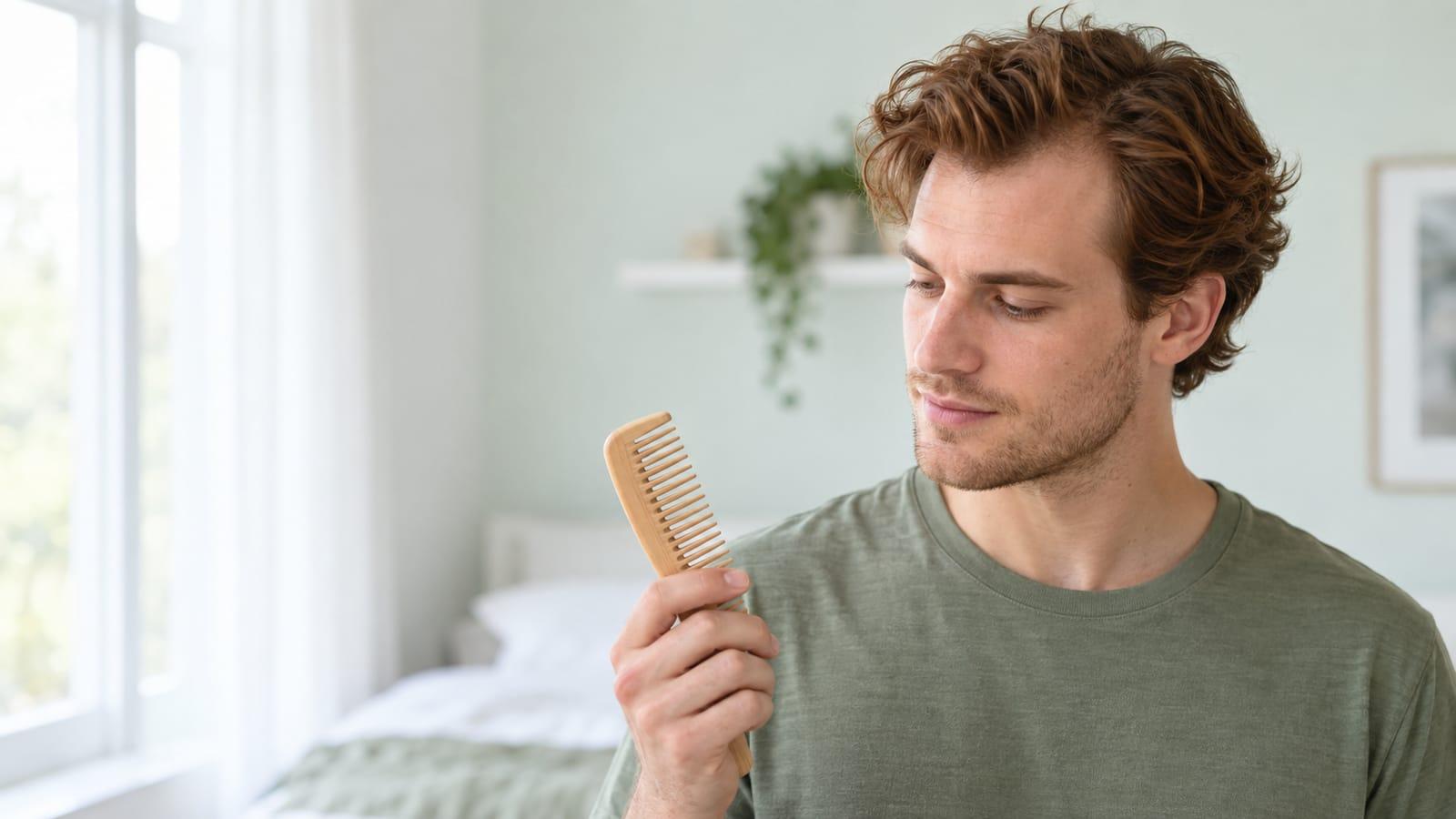
Hair can thin slowly, shed all at once, fall out in patches or simply snap. These are different problems. Our comparison of treatments is written for only one of them: male pattern hair loss, the gradual thinning at the hairline or the crown.
This page sets the main kinds side by side, says which one our comparison of treatments covers, and points to the next step for each. It does not diagnose. Finding the cause takes someone who can examine your scalp and ask about your history.
Why the type comes before the product
Our hair comparison is written for one situation: adult men with male pattern hair loss, known medically as androgenetic alopecia. [1] That is the kind of hair loss the trials of minoxidil and finasteride were run in, so that is where their results apply. Shedding, deficiencies, breakage, scarring conditions and scalp problems each need their own evidence and their own route.
Which hair changes this guide covers
This guide covers
Gradual thinning at the hairline
Gradual thinning at the crown
Get an assessment first
Sudden or widespread shedding
Distinct patches
Painful or inflamed scalp
Heads are seen from above, forehead at the top. Illustrative only: a picture cannot identify the cause of hair loss.
The diagram comes from our main guide to male pattern hair loss, so "this guide" in its labels means the treatment comparison. The same boundary applies to the ranking of six ingredients and to every ingredient profile. None of them is written for women or for anyone under 18, and none is a plan for hair loss during pregnancy or breastfeeding.
What you are seeing, and where to go next
Start from the change itself, not from a product. The first rows follow the same split as the hair questionnaire and the "What are you seeing?" section of the hair hub.
Gradual thinning at the hairline or the crown
Our comparison appliesIn an adult man, this is the change our guide and ranking are written for. It does not confirm male pattern hair loss.Read the main guideSudden or widespread shedding
Assessment firstFar more hair coming out than is usual for you, starting abruptly or across the whole scalp.Why assessment comes firstDistinct patches
Assessment firstHair missing from one or more defined areas.Conditions our sources nameA painful, red, sore or scarring scalp
Assessment firstPain, burning, marked redness, sores or areas that look scarred, with hair loss or without it.Why assessment comes firstLoss after marked weight loss, a new medicine or pregnancy
Assessment firstThe timing raises a question about the cause. It does not answer it.What timing can and cannot tell youHair that breaks instead of falling out
A different outcomeHair that snaps or feels fragile is a problem of the hair shaft, the visible strand, not of regrowth.Breakage and hair careFlaking or itching, with no hair loss
A scalp questionDandruff and other scalp conditions are treated for flaking and itch, not for regrowth.Scalp conditionsA possible vitamin or mineral deficiency
A separate questionCorrecting a deficiency that has been assessed is one question. Taking a supplement because hair is thinning is another.Vitamins for hair lossNot sure what you are seeing
Start hereA few short questions that point to a page. It does not diagnose, and you can skip it.Take the hair questionnaire
If more than one row fits, the assessment rows take priority. In our questionnaire, ticking sudden shedding, patches or a painful scalp leads to the assessment message even when gradual thinning is ticked as well.
Gradual thinning at the hairline or the crown
Male pattern hair loss is gradual thinning at the hairline or the crown. [1] It has treatments tested in controlled trials. Minoxidil applied to the scalp has shown regrowth in men against the same product without minoxidil, and finasteride tablets have placebo-controlled evidence both for keeping existing hair and for regrowing some of it. [3, 4]
The clearest single set of numbers comes from a trial of 5% minoxidil foam in 352 men aged 18 to 49, reported in the UK product information. [5, 6]
Hairs gained after 16 weeks of foam, in men with pattern hair loss
5% minoxidil foam180 men
+21.0hairs per cm²
Foam without minoxidil172 men
+4.3hairs per cm²
Change in non-vellus hair count in a marked target area, as reported in the UK product information. A target area is a small patch of scalp chosen for the study, not the whole head. The men in this trial had pattern hair loss, so the result says nothing about other kinds. [5]
Results like these are why the type matters. They were measured in men with pattern hair loss, and they do not carry over to shedding, patches or a scarred scalp. Even within pattern hair loss the improvement takes months, differs from person to person and lasts only while treatment continues. [7, 4]
If this is your situation, the comparison in the main guide sets out the six ingredients and the ranking puts them in an order of consideration. The profiles of minoxidil and finasteride give the trial numbers, the label instructions and the side effects. For what can be combined and what is a choice between alternatives, see hair loss routines.
The products have limits of their own. The two US men's minoxidil labels we checked are for the top of the scalp, not a receding hairline, and the two UK men's labels set age ranges: 18 to 65 for the solution and 18 to 49 for the foam. [9, 10, 7, 5]
Signs that call for an assessment first
Three kinds of change take a reader out of our comparison: sudden or widespread shedding, distinct patches, and a scalp that is painful, red, sore or scarring. The reason is the same each time. Different causes can need different care, so these signs should not lead straight into a routine built for pattern thinning.
Sudden or widespread shedding
- What our sources say
- Shedding has its own named conditions, such as telogen effluvium, assessed from the history and, when needed, tests.
- Where it leads
- To an assessment of the cause. Our questionnaire stops here and shows no comparison.
Distinct patches
- What our sources say
- Patches appear in the descriptions of tinea capitis, a scalp infection, and of loss from hairstyles that pull.
- Where it leads
- To an assessment. These cannot be told apart from a description or a photo.
A painful, red, sore or scarring scalp
- What our sources say
- Symptoms like these can go with more than one condition, and some scarring conditions damage the hair follicle permanently.
- Where it leads
- To an assessment, without delaying it to try a supplement or an oil first.
The lines under "What our sources say" come from American Academy of Dermatology pages and British Association of Dermatologists leaflets. The lines under "Where it leads" are our own editorial routing, which those organisations did not review. [11, 12, 13, 14, 8]
Two cautions about reading these signs. A scalp that does not hurt is not proof that nothing is going on: the absence of pain does not rule out an active condition. And this is not an urgency scale. We set no deadlines, because a description is not enough to set them.
Other kinds of hair loss our sources name
Several conditions that are not pattern hair loss come up in the sources behind this site. We describe each only as far as those sources go, and we do not match your signs to one of them. Each needs its own assessment.
Five named conditions
What the source we read says, and what follows for anyone holding a pattern hair loss product.
| Condition | What the source says | What follows |
|---|---|---|
| Telogen effluvium | A form of shedding. The British Association of Dermatologists leaflet, dated October 2025, covers its triggers, how it is diagnosed from the history with tests when needed, and its course. | Shedding after an event is not automatically telogen effluvium, and the leaflet is not a basis for one standard treatment when shedding carries on. |
| Alopecia areata | Can affect the scalp, beard, eyebrows and eyelashes. The 2025 British guideline covers specialist treatments, local and body-wide, alongside psychological support and camouflage. | Results from pattern hair loss trials, such as minoxidil with microneedling, cannot be carried over to it automatically. |
| Tinea capitis | A scalp infection that adults can get too. It can resemble dandruff, eczema or psoriasis, and can come with broken hairs, patches or inflammation. | It needs an assessment and sometimes a laboratory test. A shampoo can be an add-on but does not replace body-wide treatment when that is needed. |
| Scarring alopecias | A group that includes lichen planopilaris, frontal fibrosing alopecia and central centrifugal cicatricial alopecia. Some scarring alopecias damage the hair follicle permanently. | Care aims to control the disease and keep the follicles that are still alive. The American Academy of Dermatology says minoxidil alone does not control the inflammation of central centrifugal cicatricial alopecia. |
| Traction alopecia | Hair loss linked to repeated pulling. The signs the American Academy of Dermatology lists are pain from a hairstyle, broken hairs, a hairline that moves back and patches where the hair is under tension. | An advanced stage can be permanent, and changing the style late does not guarantee regrowth. |
Patient leaflets, a guideline and society pages, read for what they say about scope. None of them is a trial of a treatment, and we give no prevalence figures because we did not extract any. [13, 17, 14, 12, 18, 19, 8]
The trials of minoxidil with microneedling mentioned in the alopecia areata row are covered on the page about microneedling for hair loss.
Scarring conditions change the goal. A scar that has already formed is not the same problem as the gradual thinning of pattern hair loss. Early regrowth, or treating pattern hair loss that happens to be present as well, does not show that a destroyed follicle has come back. [18, 19]
The American Academy of Dermatology's overview of causes also covers hair loss from cancer treatment, hormonal imbalance, infection, medicines and hair pulling. [12] Apart from what this page says about scalp infection and medicines, we have not reviewed those, so we name them and stop there.
Hair loss after marked weight loss, a new medicine or pregnancy
When hair loss starts after something specific, the sequence matters to whoever assesses it. It is still only a sequence. Our research treats every case below the same way: an event before the hair loss opens a question, and it does not close one.
| When the loss started | What the timing can tell you | What it cannot tell you |
|---|---|---|
| After a strict diet or marked weight loss | That nutrition is worth raising. The history is part of how shedding is assessed. | That there is a deficiency, that the shedding is telogen effluvium, or that it will settle by itself. |
| After starting a new medicine | That the prescriber should hear about it. | That the medicine is the cause. |
| After a pregnancy | That there is a plausible context for shedding. | That it is telogen effluvium, or that pattern hair loss in women is ruled out. |
| In the first weeks of minoxidil | That it may be the temporary rise in shedding the UK foam label describes between the second and sixth week. | That the treatment is working, or what kind of hair loss you have. |
The first three rows are our own reading rules, informed by the British Association of Dermatologists leaflet on telogen effluvium and the American Academy of Dermatology's pages on diagnosis and causes. [13, 2, 12] The last row is a label statement about one product: the same label says to stop and get advice if the extra shedding continues for more than two weeks. [5] The minoxidil profile has more on shedding in the first weeks, and the page on minoxidil side effects covers what the labels say to do when a symptom appears.
Hair that breaks instead of falling out
Breakage and hair loss are different problems. Breakage is damage to the hair shaft, the visible strand. Regrowth is about the follicle, the structure in the skin that produces the strand. A healthier-looking shaft does not create new follicles, and our comparison does not present medicines for pattern hair loss as treatments for breakage.
The practices our research asks about are bleaching, heat, friction and styles that pull. Having one of them in your routine does not prove that styling is the only cause. What the American Academy of Dermatology offers for fragile hair is practical care advice, not the result of a regrowth trial.
| Aim | What the American Academy of Dermatology advises | What it does not do |
|---|---|---|
| Washing | Wash according to how dirty or oily the hair is and its type, and concentrate the shampoo on the scalp. | Set a washing timetable that suits everyone. |
| Dryness and friction | Use conditioner after washing, applied in a way that suits the lengths and the hair type. | Stimulate new follicles. |
| Detangling | Use a wide-tooth comb and work from the ends. The best moment differs for straight and curly hair. | Give one wet or dry routine for every texture. |
| Heat and styling | Limit heat, use low or medium settings and handle hair gently while drying. | Show whether pattern hair loss is responding. |
| Styles that pull | Loosen styles that pull or hurt. | Guarantee regrowth when the change comes late. Prolonged pulling can cause permanent loss. |
The advice in the table is attributed to the American Academy of Dermatology. [20, 8]

Our library lists gentle hair-shaft care under care and practices with the label "Other outcome": it helps manageability and appearance, not regrowth. Cosmetic coverage, for making hair look fuller now, sits in the same group among all the options we compare. Both can be chosen without any regrowth treatment.
Flaking and itching without hair loss
Flakes and itch are scalp outcomes. The treatments for them are judged on flaking, itching and flare-ups, and none of that is a measure of hair growth. Three situations come up in our sources.
Dandruff and seborrhoeic dermatitis
- Keep in mind
- Ingredient, formulation and the maintenance phase change the instructions. There is no universal frequency or contact time.
Scalp psoriasis
- Keep in mind
- Not all scaling comes from a fungus, so an antifungal shampoo is not an automatic answer.
A reaction to a product
- Keep in mind
- A diagnostic patch test is a professional procedure. Noting the product, the place and the timing helps when describing a reaction.
These summaries come from British Association of Dermatologists and American Academy of Dermatology pages, the US Food and Drug Administration's page on hair dyes and the Academy's page on patch testing. [21, 22, 23, 24, 25]
One older trial shows what a scalp treatment is measured on. A 2% ketoconazole shampoo was given to 575 people with dandruff or seborrhoeic dermatitis of the scalp. Of those who improved, 312 went on to a six-month phase in which they used the same shampoo once a week, the shampoo on an alternating schedule, or a shampoo without ketoconazole. The researchers counted how many relapsed. [26]
Dandruff or seborrhoeic dermatitis that came back within six months
Shampoo without ketoconazolePlacebo
47%% who relapsed
2% ketoconazole shampooOnce a week
19%% who relapsed
Relapse of dandruff or seborrhoeic dermatitis among 312 people who had already improved on the shampoo, out of 575 treated at the start. A third group on an alternating schedule relapsed in 31% of cases. The first phase had no comparison group, only responders went on, and we could read only the published summary, which does not report who funded the trial. Hair growth was not what the trial measured. [26]
Flaking that comes with patches, broken hairs or inflammation is a different matter. Tinea capitis can resemble dandruff, eczema or psoriasis, which is one reason a scalp with those signs belongs in the assessment group above. [14] We have not published a comparison of scalp treatments.
Could it be a vitamin or mineral deficiency
It is a fair question, and it is a separate one. Correcting a deficiency that has been assessed has its own medical reason. That is different from treating male pattern hair loss, and different again from taking a supplement because hair is thinning. We do not give a universal biotin, iron, zinc or vitamin D routine for everyone who notices thinning, and a questionnaire cannot establish a deficiency. [27, 28, 29, 30]
Two points from our research are worth keeping in view. A diet, including a vegetarian or vegan one, does not on its own show that a deficiency exists. And a single laboratory value with no context is something for a professional to interpret, not a dose to act on.
Vitamins for hair loss: deficiency versus supplementationBiotin, iron, zinc and vitamin D, and what changes when a deficiency has been assessed.The main guide also has a short section on vitamins and deficiencies and how they relate to the six ranked ingredients.
What an assessment involves
"Get assessed" is only useful if you know what it means. The American Academy of Dermatology describes how dermatologists find the cause of hair loss. [2]
How a cause is found
As described by the American Academy of Dermatology.
- It starts with
- History and examinationYour history and an examination.
- Further tests
- When neededWhich ones depends on what is suspected.
- Causes
- Can be severalMore than one can be present at the same time.
This is why an earlier diagnosis does not close the question when something new appears. [2]
We deliberately leave some things out. This page does not teach a pull test or how to recognise scarring, because those belong to an examination and not to a mirror. It does not sort signs by urgency, and it does not list tests to ask for.
Worth noting down beforehand (an organising suggestion of ours, not something a study tested)
- When it started. And whether it came on gradually or suddenly.
- Where. The areas involved, and whether that has changed.
- Scalp symptoms. Pain, burning, redness, sores or discharge, and when they began.
- Everything you take or apply. Medicines, supplements and hair products, with the form, how often and since when.
- Earlier assessments. What you were told, by what kind of professional, and when.
- Recent changes. A new medicine, a strict diet or marked weight loss.

Where to go next
If the change is gradual thinning at the hairline or the crown in an adult man, the comparison applies and the two pages below are the place to start. If it is anything in the assessment rows, the next step is not on this site. For how we handle evidence and why we stop where the sources stop, see our methodology.
Male pattern hair loss: treatments and supplements explainedWhat pattern hair loss is, what can realistically be done, and the six ingredients compared. The ranking on one pageSix ingredients in an order of consideration, with ties shown and the reason for each place. The hair questionnaireA few questions that point to the relevant page. It does not diagnose hair loss or prescribe anything.