

What finasteride is
Finasteride is a prescription medicine. For hair loss it is a 1 mg tablet taken once a day, approved in the United States and the United Kingdom for men with male pattern hair loss. There is also a spray for the scalp. It is authorised in some European countries, Spain among them, while in the United States no finasteride product for the scalp is approved. [1, 2, 3, 4]
Finasteride lowers the level of a hormone called DHT in the blood, by about 65% within a day of a 1 mg tablet according to the US label. That is a blood measurement, not a measure of regrowth. We do not go further here into how it acts on the hair follicle. The sources behind this page are clinical trials, product labels and safety notices from medicines regulators, and they are what a decision depends on. [1]
A 5 mg tablet of the same medicine is used for an enlarged prostate. This page is about the 1 mg dose for hair loss, and figures from the 5 mg product do not carry over.
This page is about adult men with male pattern hair loss: gradual thinning at the hairline or the crown. If hair is falling out suddenly, in patches, or the scalp is sore or inflamed, the first step is an assessment, not a product. Check that the guide fits your situation before comparing anything.
Where it sits in our comparison
Finasteride is one of the two options to weigh first for male pattern hair loss, tied with minoxidil. The position rests on the 1 mg tablet: it has trials against placebo, follow-up to five years and a simple daily dose on the US and UK labels. Sharing the top tier does not mean the two medicines have equal effects. The spray keeps its own, more cautious assessment. [1, 2, 5] The two medicines are set side by side in the minoxidil and finasteride comparison.
How finasteride rates
Position 2 of 6 in our ranking. Same tier as minoxidil: our review does not pick a winner between them. The same eight criteria for every ingredient.
- EffectivenessStrength
- Benefit shown against placeboIn two trials of 1,553 men, the tablet did better than placebo on hair count at one year. Part of the benefit is keeping hair that would otherwise be lost, not only regrowing it.
- Evidence strengthStrength
- Broader clinical supportPlacebo-controlled trials with follow-up to five years, summarised in the product labels. This is not a formal certainty grade, and we did not re-read each original trial report.
- Risks and tolerabilityTrade-off
- Sexual and psychiatric warningsSexual side effects judged related to treatment were more common than with placebo in the first year: 3.8% against 2.1%. Regulators also warn of depression, suicidal thoughts and sexual problems that can continue after stopping, with no reliable figure for how often.
- TimeDepends
- Three months or more before benefitThe US label says it generally takes three months or more. Trials counted hair at 6 and 12 months.
- CostDepends
- Depends on country and providerIn our price check it was the dearer of the two core options in the US example and the cheaper one in the UK example. That is not a global ranking.
- RoutineStrength
- One tablet a day, on prescriptionOne tablet a day, with or without food. It needs a prescription and some attention to changes in mood or sexual function.
- MaintenanceTrade-off
- Benefit lasts only with continued useThe benefit lasts while you take it. The US label describes it reversing within 12 months of stopping.
- AccessDepends
- Tablet approved (US and UK checked); spray variesThe 1 mg tablet is approved for men in the US and UK, on prescription. The spray is authorised in some European countries and is not approved in the US.
An order of consideration for adult male pattern hair loss, not a score. Strength, Depends and Trade-off describe each line on its own; they do not add up to a number.
The same eight criteria are used for every ingredient in the comparison. How we apply them is on the methodology page.
Tablet or spray
1 mg tablet
Taken by mouth once a day. It reaches the whole body, and it is the form that the US and UK labels, the long trials and the regulators' mood warnings are about.
- Evidence in men
- 1,553 men in two trials: more hair than placebo at one year, with follow-up to five years.
- Reference use
- One 1 mg tablet a day on the US and UK labels, with or without food.
- Keep in mind
- Sexual side effects and warnings about mood. Prescription only.
Scalp spray
One specific spray, 2.275 mg per mL, applied once a day with its own cone applicator. Other sprays and mixes are different products.
- Evidence in men
- 458 men over 24 weeks: more hair than the same spray without finasteride.
- Reference use
- 1 to 4 sprays of 50 µL once a day on the Spanish label. That is far less than 1 mL.
- Keep in mind
- Less reaches the blood, but some does. Not approved in the US.
Advantages
Tablet or spray? One trial included both, and it was built to compare the spray with a spray containing no finasteride. A smaller group took the tablet as a reference. After 24 weeks the hair counts for spray and tablet were close, which is not the same as proving that they work equally well. The tablet has years of follow-up behind it. The spray has 24 weeks, and its Spanish label states that there is no clinical experience beyond six months. [8, 3] The topical finasteride page covers that trial and that label.
What might tip the choice (practical differences, not differences in proven effect)
- You want the form with the longest track record. That is the tablet: controlled trials, extensions to five years, and labels in the US and UK.
- You would rather limit how much reaches the blood. The studied spray led to lower blood levels and a smaller drop in DHT. That has not been shown to mean fewer side effects.
- You live in the United States. No scalp finasteride is approved there. What is sold is made to order by compounding pharmacies, and the FDA has issued an alert about those products.
- Someone at home is or may be pregnant, or there are children. A spray on the scalp can transfer by contact. The Spanish label tells you to prevent that and to wash any skin that touches it.
What the trials measured
Tablets against placebo
The main evidence is summarised in the US product label. Two trials enrolled 1,553 men with thinning at the crown, who took either finasteride 1 mg or a placebo every day. After 12 months, hair counts were available for 1,351 of them: 679 on finasteride and 672 on placebo. The men on finasteride had 107 more hairs than the men on placebo in the patch of scalp that was measured, an area of 5.1 cm². [1]
That number is the gap between the two groups, in that patch. It is not 107 hairs per square centimetre, and it is not the gain over the whole head.
A gap like this can come from two things: more hair on the medicine, and less hair lost. Both count, and the label's summary does not split them. The benefit does not have to be a large visible change. A later trial shows how the gap can open up: over 24 weeks the count went up by 56.5 hairs in the measured area with finasteride and down by 4.9 with placebo. [9]
Over five years
The two trials carried on. Of the 1,553 men, 1,215 entered extension studies that ran for up to five years, and the benefit over placebo was maintained. Two limits apply. The 1,215 are the men who entered the extensions, not the number who completed five years. And we could read only the published summary, from which we could not verify the final numbers or the details on side effects. [5]
Compared with dutasteride
Dutasteride is a medicine of the same group. One trial put the two side by side: 917 men were randomly assigned to five groups and 761 completed the 24 weeks. The count of all hairs in the measured area, a circle 2.54 cm across, rose more with dutasteride 0.5 mg than with finasteride 1 mg. [9]
Change in hair count after 24 weeks, in one trial
Dutasteride 0.5 mg184 men
+89.6hairs in the measured area
Finasteride 1 mg179 men
+56.5hairs in the measured area
Placebo181 men
−4.9hairs in the measured area
Average change in total hair count inside a circle 2.54 cm across. These are hairs in that circle, not hairs per square centimetre. The trial was funded by GSK. [9]
The difference between the two medicines was about 33 hairs in that circle. When only the thicker "terminal" hairs were counted, the gap was smaller, 46.0 against 36.3, and the trial did not show it to be a real difference. A network analysis of 23 studies, which builds on trials like this one and is not independent of them, put the gap at about 7 hairs per square centimetre at 24 weeks, and its own authors rated that comparison as low quality. It had no dutasteride data at 48 weeks. [9, 10]
So dutasteride produced a larger average gain in hair count over six months. That does not settle the choice. It is not approved for hair loss in the US or UK, it stays in the body far longer, and its long-term data are more selected. See the full dutasteride profile. The finasteride and dutasteride comparison goes through that trial, the side effects and how long each stays in the body.
The spray against placebo
The spray's main evidence is one placebo-controlled trial of one product. It randomly assigned 458 men aged 18 to 40 to the finasteride spray, to the same spray without finasteride, or to the tablet. 323 completed it, and photographs good enough to count hairs were available for 250. [8]
Hairs gained after 24 weeks in the spray trial
Finasteride spray105 men
+20.2hairs per cm²
Spray without finasteride97 men
+6.7hairs per cm²
1 mg tablet, for reference48 men
+21.1hairs per cm²
Change in hair count in a 1 cm² target area, in the men with usable photographs. The 250 are those whose images could be analysed, which is a different thing from the number who dropped out. The trial was funded by Polichem and Almirall. [8]
The spray did better than the spray without finasteride. Its result was close to the tablet's, but the trial was not designed to prove that the two are equivalent, and the tablet group was small.
What the evidence does not show
- How finasteride ranks against minoxidil. The evidence we reviewed does not establish an order. One trial compared them directly, but only its summary was available to us.
- That the spray works as well as the tablet. One trial found similar numbers without being built to prove it.
- That one spray's result applies to another. Strength, volume and applicator decide how much medicine is delivered.
- How often side effects continue after stopping. There is no reliable figure, in either direction.
- What happens beyond five years. The controlled follow-up we found ends there.
How to use it: what the labels say
Product labels are the reference for how much to take and how often. They are specific to the product and the country. We checked these three at the end of September 2026. [1, 2, 3]
Three labels, side by side
The US and UK tablets and the Spanish spray, checked at the end of September 2026.
| On the label | USPropecia1 mg tablets | UKPropecia1 mg tablets | ESAlocare2.275 mg/mL scalp spray |
|---|---|---|---|
| For | Men with male pattern hair loss. Not for women or children | Men with male pattern hair loss. Not for women, children or adolescents | Men aged 18 to 41 with mild to moderate hair loss |
| Amount | One 1 mg tablet | One 1 mg tablet | 1 to 4 sprays of 50 µL |
| How often | Once a day | Once a day | Once a day |
| How | With or without food | With or without food | On a dry scalp, with the supplied cone, left on for at least 6 hours |
Each column is one product's own label. No scalp finasteride is approved in the US, and we could not confirm the status of this spray in the UK.
Details that matter more than they look
- One tablet a day is the whole dose. The labels give 1 mg once a day. They do not describe taking more for a better result.
- Not together with a medicine of the same group. The UK label excludes combining finasteride with other medicines of its kind, which includes dutasteride.
- Broken tablets and pregnancy. Finasteride must not be used in pregnancy, and the US label warns against contact with crushed or broken tablets for women who are or may be pregnant.
- Tell whoever orders your blood tests. Finasteride lowers PSA, a blood marker used to check the prostate, so the result reads differently.
- The spray dose is small. One to four sprays of 50 µL is 0.05 to 0.2 mL a day, or about 0.11 to 0.46 mg of finasteride. In the trial a doctor chose the number of sprays from the size of the thinning area. A product that tells you to use 1 mL is a different product.
- Keep the spray to yourself. The Spanish label says to prevent contact with women who are or may be pregnant and with children.
How long it takes
The dedicated finasteride results guide separates the first signs described by labels from the endpoints researchers measured. For a botanical comparison, see saw palmetto versus finasteride.
Think in months. The US label says it generally takes three months or more of daily use before a benefit shows. Trials counted hair at 6 and 12 months and followed men for up to five years. For the spray, the Spanish label expects signs of growth after three to six months of use. In its trial, the difference from the spray without finasteride was already there at 12 weeks, and the main count was at 24. [1, 9, 8, 3]
The first year: what the labels expect and when trials measured
Tablet, US label
Men with pattern hair loss
Tablet trials
When hair was counted
Spray, Spanish label
Men 18 to 41
Spray trial
When hair was counted
A label's timing is when a benefit is expected to show. A trial time point is when researchers measured. Neither is a promise of when you will see a change. [1, 9, 8, 3]
Side effects and safety
This is the part of the decision that deserves the most time. Three kinds of information are involved, and they should not be mixed: what was counted in trials, what regulators warn about from reports made after the medicine went on sale, and what is still not known. A separate page on the side effects of finasteride takes them one at a time.
Sexual side effects
In the three one-year trials summarised in the US label, 945 men took finasteride and 934 took placebo. At least one sexual side effect that the investigators attributed to the treatment was recorded in 36 men on finasteride (3.8%) and 20 on placebo (2.1%). The difference is 1.7 percentage points, or about 17 more men in every 1,000 over that first year. [1]
Sexual side effects attributed to treatment in the first year
At least one of these
3.8%2.1%Lower sex drive
1.8%1.3%Erection problems
1.3%0.7%Ejaculation problems
1.2%0.7%Stopped because of them
1.2%0.9%
Percentage of men in each group, from three trials in the US label. One man can appear in more than one row, so the rows do not add up. These are first-year figures, not a lifetime risk, and they say nothing about symptoms that continue after stopping. [1]
Other studies counted differently and found different numbers. In the 24-week trial with dutasteride, sexual or breast-related side effects were recorded in 24 of 179 men on finasteride (13.4%) and 12 of 181 on placebo (6.6%). Impotence was recorded in 11 and 7 of them. That trial tracked these events as a special category, so its figures cannot be set next to the label's. A pooled analysis of 15 trials and 4,495 participants, covering finasteride and dutasteride, found sexual side effects about 1.7 times as likely with finasteride 1 mg as with placebo. [9, 11]
What all of this has in common: sexual side effects are more frequent with finasteride than with placebo, and most men in these trials did not report any.
Effects that continue after stopping
The US label and the UK medicines regulator both report sexual problems that continued after men had stopped taking finasteride. This comes from reports made once the medicine was on sale, not from trials, so there is no reliable figure for how often it happens. In May 2026 the UK regulator confirmed that sexual dysfunction with finasteride tablets can persist after treatment is stopped. [1, 7]
Nobody can honestly give you a percentage here. "It never happens" and "it happens to this many men in a hundred" are both claims the evidence does not support.
The medicine itself leaves the blood quickly: half of a dose is gone in about five to six hours in men aged 18 to 60. That describes the medicine, not a symptom. It is not a timetable for a side effect to settle. [1]
Mood
Depression and suicidal thoughts are recognised side effects of finasteride tablets. In 2025 the European medicines regulator confirmed suicidal thoughts as a side effect of the 1 mg and 5 mg tablets, with a frequency that is not known. In 2026 the UK regulator confirmed the association with depression and suicidal thoughts and asked prescribers to ask about a history of either and to review symptoms. Changes in mood can appear with or without sexual side effects. [12, 7]
Fertility, pregnancy and blood tests
Sperm. One trial gave finasteride 1 mg or placebo to 181 healthy men aged 19 to 41 and measured semen in 79 of them, over 48 weeks of treatment and 60 weeks without it. It found no significant difference in the main sperm measures. These were healthy volunteers, so the result does not answer the question for men who already have a fertility problem, and the trial did not look at pregnancies or births. [13]
Pregnancy. Finasteride must not be used in pregnancy, and the US label warns against contact with crushed or broken tablets for women who are or may be pregnant. If your partner is pregnant or you are trying to conceive, the leaflet for your own product and country is the reference, and it is a question to raise with the prescriber. We do not work out a timetable for conception from these sources. [1]
PSA. Finasteride lowers PSA, a blood marker used to check the prostate. In the label's data the average went from 0.7 to 0.5 ng/mL after 12 months on 1 mg. Tell the clinician who orders or reads the test that you take it. [1]
With the spray
Putting finasteride on the scalp does not keep it out of the rest of the body. In the spray trial, 181 men used the spray, 181 a spray without finasteride and 84 took the tablet. [8, 14]
Sexual side effects attributed to treatment over 24 weeks, spray trial
Finasteride spray181 men
2.8%
Spray without finasteride181 men
3.3%
1 mg tablet84 men
4.8%
Each percentage stands for a handful of men. Groups this small cannot show that the spray is safer than the tablet, and they cannot show that it is not. A correction to the paper moved one figure for men who stopped treatment from the spray group to the tablet group. [8, 14]
The European review that confirmed suicidal thoughts as a side effect of the tablets found no evidence linking them to the sprays. That is an absence of evidence in that review, not a guarantee. [12]
In the United States the picture is different, because sprays there are made to order. The FDA's alert of April 2025 describes finasteride from these products being absorbed into the body, reactions on the scalp, and transfer to other people through contact. It mentions 32 reports received between 2019 and 2024, many of them with symptoms that continued after stopping. Reports like these show that something can happen. They do not show how often. [4]
A report from a US telehealth company covers 638,629 men who were prescribed its scalp products: two sprays and a serum, all containing finasteride 0.3% and minoxidil, one of them with further ingredients. About a quarter of them, 151,352, answered a follow-up question: 121,615 said they were satisfied and 4,034 reported side effects or other negative reactions. The company funded the report, the answers are the patients' own, and there was no comparison group. It describes what those men said. It cannot show that a scalp product is safer than the tablet. [15]
If you stop
The benefit depends on continued use. The US label says that after stopping, the effect on hair reverses within 12 months. [1]
That describes what was observed. It is not advice to stop, to take breaks or to take the tablet every other day. None of the sources here tested schedules like those.
For the spray, the Spanish label also says to keep using it to keep the benefit, and notes that its clinical experience ends at six months. What happens to the hair after stopping the spray was not measured in the sources we reviewed. [3]
If you are thinking of stopping because of a side effect, tell your prescriber what you noticed and when. The section on effects that continue after stopping explains what is and is not known.
Combining finasteride with other options
Combining is optional. Each pairing below is a separate question with its own evidence. [6, 16, 2, 9, 17, 18, 3, 19, 20]
Finasteride + minoxidil on the scalp
Direct trial evidence, with limitsA trial of 450 men, 428 of them assessed at 12 months, compared finasteride tablets, minoxidil on the scalp and the two together. More men were rated as improved with both (94.1%) than with finasteride alone (80.5%) or minoxidil alone (59%). Those are shares of men who improved on the study's scale, not amounts of hair, and only the published summary was available to us. A small study of 22 men already taking finasteride adds that a minoxidil lotion had a limited extra effect, and that staying on finasteride did not keep all of it once the lotion was stopped. The UK tablet label still states that no data are available on using it together with minoxidil on the scalp.
Minoxidil and finasteride togetherFinasteride + dutasteride
Alternatives, not a pairBoth belong to the same group of medicines, and the UK finasteride label excludes taking it with another medicine of that group. One trial found a higher total hair count with dutasteride after 24 weeks. That makes it an alternative to discuss with a prescriber, not something to add.
Finasteride and dutasteride comparedFinasteride + finasteride and minoxidil, both on the scalp
Mixed results, product by productSmall trials exist. In one, of 42 men, a finasteride spray in the evening was added to a minoxidil lotion in the morning: photographs favoured the combination, but hair density did not improve significantly more than with minoxidil alone, which was applied twice a day. In another, of 60 men, a single solution containing both was used, and the advantage depended on the part of the scalp and on which hairs were counted. Each preparation has its own strength, volume and risks. The Spanish spray label says not to apply other products to the treated area, and no scalp finasteride is approved in the US.
Finasteride on the scalpFinasteride + the tablet and the spray together
Not establishedThey are two routes for the same medicine. Nothing we reviewed tests using both.
Finasteride + minoxidil tablets
Not establishedA service evaluation followed 502 men who took a single tablet combining finasteride 1 mg and minoxidil 2.5 mg for about a year. It had no comparison group and no complete record of side effects, so it cannot show what the combination adds, or how safe it is next to either medicine alone.
Minoxidil tabletsFinasteride + saw palmetto
Compared, not combinedAn open-label trial of 100 men compared saw palmetto 320 mg a day with finasteride 1 mg a day for 24 months. Photographs showed improvement in 38% of the men on saw palmetto and 68% of those on finasteride. It tested one against the other, not the two together.
Full saw palmetto profile
For the bigger picture of what goes with what, see which options can be combined and which are alternatives.
What it costs
These are single prices we recorded on 29 September 2026, one offer per product, worked out for 30 days at the labelled amount. They are examples, not national averages, and we do not convert between currencies. The minoxidil prices from the same check are shown next to them for comparison.
Cost of 30 days of use, from one observed offer each
United States · US dollars
Finasteride 1 mg tabletsSubscription service, listed price
$26.67
Minoxidil 5% foamStore-brand, assuming one can a month
$9.71
Minoxidil 5% solutionStore-brand, 1 mL twice a day
$7.31
United Kingdom · pounds
Finasteride 1 mg tabletsOnline pharmacy, generic
£9.46
Minoxidil 5% foamRegaine for Men, 1 g twice a day
£19.17
Minoxidil 5% solutionOnline pharmacy, 1 mL twice a day
£16.25
Medicine only. The US finasteride price is a subscription's listed $80 for 90 tablets; the same page showed a $56 offer, which we did not use, and $5 shipping per delivery. The UK price is £26.50 for 84 tablets, plus a £3 prescription fee and £2.90 delivery per order. Consultation fees and taxes are not included.
Over a year the tablets come to about $324 in the US example and £115 in the UK example. In this price check finasteride cost more than minoxidil in the US and less in the UK. Price says nothing about which works better.
We found no price for the spray on its own. The one offer we saw in the UK was a made-to-order mix of finasteride, minoxidil and tretinoin at £26 for 60 mL. That is a different product and cannot be compared.
Not for women or under-18s
The tablet labels are for men. The UK label excludes women, children and adolescents, and finasteride must not be used in pregnancy. This page and our hair guide are written for adult men, and nothing here should be carried over to hair loss in women. [1, 2]
Keeping track
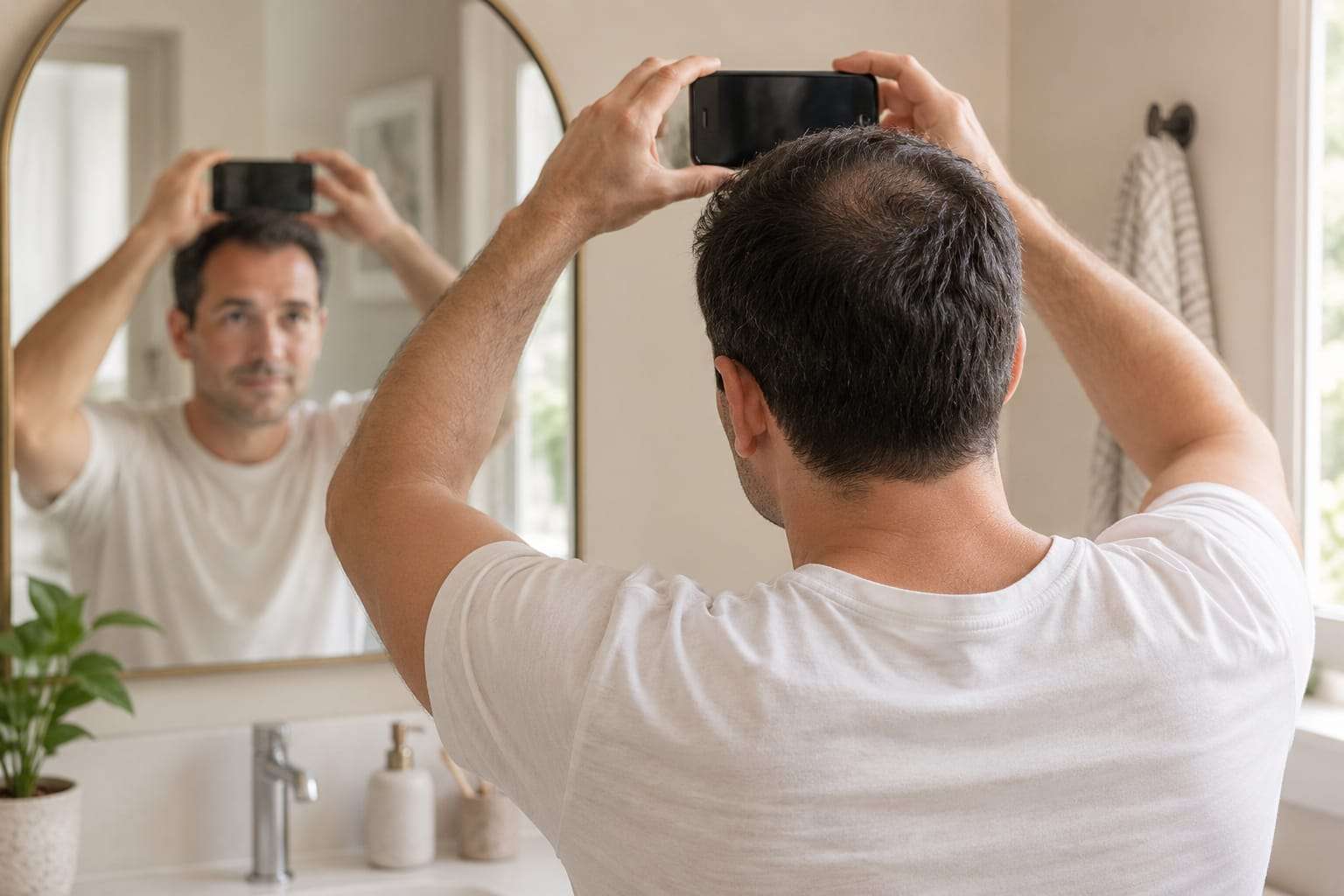
Day-to-day changes are too small to see in the mirror, and with finasteride part of the result is hair that does not fall out, which is harder still to notice. Three habits help. They are organising suggestions of ours, not something tested in a trial:
- Photos. The same areas once a month, in the same light, at the same hair length and from the same angle.
- A record. The exact product, the date you started and any days you missed.
- How you feel. Any change in mood or in sexual function, with the date you noticed it.
Bring all three to the review with your prescriber. You will have something to compare instead of an impression, and anything you noticed along the way will already be written down.