
What a useful hair record can tell you
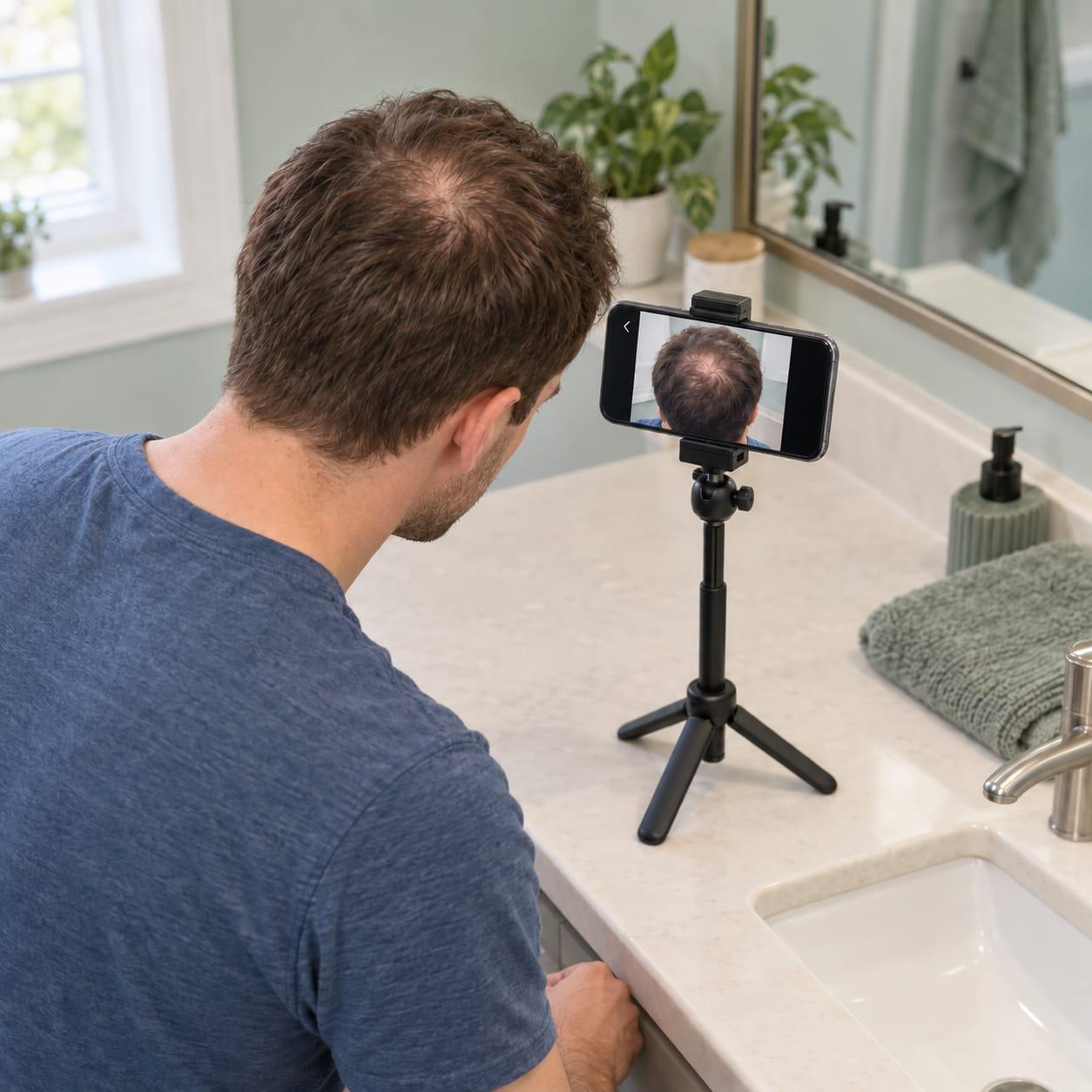
You can track your hair with a repeatable set of photographs and a short note of what you use. Take the same views in similar light, keep the dates and record any product changes. Together, these make it easier to describe what has changed than relying on memory.
A monthly photo set is our practical suggestion. The setup and blank record below help you organise the history; they do not measure hair as precisely as a clinical study. Treatment review dates and safety instructions still come from your product leaflet or prescriber.
Three things worth keeping together
- Appearance
- Consistent photosSame areas, angle, light and hair length where possible.
- What happened
- Product historyExact preparation, start date, changes and missed use.
- How it felt
- Symptoms separatelyWhat you noticed and when, without guessing the cause.
Our suggested structure for a simple personal record.
This page fits a routine for gradual male pattern hair loss. Sudden loss, patches or a painful scalp are reasons for an assessment, as explained under types of hair loss. A photo folder cannot decide which condition you have.
Set up photographs you can repeat
The best home setup is one you can reproduce without much effort. Choose the views you want to compare, such as the front, each temple and the crown. A starting set makes the later images easier to interpret because there is something definite to return to.
Try to repeat the light, camera position, angle and hair length as closely as practical. Monthly photos can make this manageable. That interval is a way to organise the record, not a deadline for seeing new growth.

| Setup detail | A simple way to record it |
|---|---|
| Views | Name the files front, left temple, right temple and crown, if those are the views you use |
| Position | Note where you stand and roughly where the camera is held |
| Light | Use the same room and light source where practical |
| Hair | Record whether it is wet or dry, its length and any styling product |
| Date | Keep the original date with every image |
| Changes | Note a haircut, different camera or changed setup alongside the photograph |
Use the views and file names that fit your record. If you have had a haircut or changed your camera, note it beside the photo. You can still keep the image; the note helps explain why it may look different.
Keep the original photographs. If a close crop helps you inspect an area, retaining the uncropped file preserves the context. Avoid choosing only the most flattering starting or later photograph. A consistent sequence is more useful for a conversation than one dramatic pair.
Keep a product record beside the photos
“Using minoxidil” can mean a scalp solution, a foam or tablets. Those forms have different evidence, instructions and risks. The minoxidil profile separates them, and foam versus liquid covers the scalp formulations. A record needs the actual product, not only the ingredient name. [1, 2, 3, 4]
The same principle matters for botanicals. Saw palmetto trials used different extracts; the rosemary comparison tested a particular lotion rather than a generic essential oil. A new brand may therefore represent a different preparation, even if the front label names the same plant. [5, 6, 7]
A blank routine record to copy
Copy these fields into a notebook or a document and fill in your own details.
| Your entry | What it helps explain | |
|---|---|---|
| Product and form | [Exact name, ingredient, form and strength] | Which preparation the record concerns. |
| Start or change date | [Date and what changed] | Where that change sits in the photo sequence. |
| Instructions used | [Product leaflet or prescriber's directions] | The reference for the routine, rather than a study dose from another product. |
| Missed use or pauses | [Dates or a plain description] | What actually happened during the period. |
| Symptoms | [What happened, when and any advice received] | A separate safety history, without deciding causation. |
| Review point | [Date and where the instruction came from] | Whether it comes from a label, a prescriber or a planned photo review. |
Recording missed applications or pauses helps explain how long you actually used a product. For what to do after a missed application, follow its leaflet. The minoxidil application page explains the instructions, including why more than the labelled amount does not improve the result. [1, 2]
Set the review date from the right source
A monthly photo date and a product's treatment review point are different things. The first keeps a record manageable. The second comes from the product label or the prescriber and can include an instruction to stop if there has been no improvement.
Minoxidil shows why there is no universal three-month or six-month test. The UK men's foam label gives 16 weeks, the two US men's scalp labels give four months, and the UK men's solution label gives one year as their no-improvement stopping points. These are instructions for the identified products, not interchangeable rules. [1, 2, 8, 9]
Minoxidil: product-specific no-improvement review points
UK men's foam
Regaine 5%
US men's products
The solution and foam labels reviewed
UK men's solution
Regaine 5%
The UK labels say to stop if there is no improvement at the stated point; the US labels say to stop and see a doctor. Months are positioned approximately on the week axis. These are not promises of growth, and another product or country may have different instructions. [1, 2, 8, 9]
The US finasteride label says benefit generally takes three months or more. That is a statement about possible timing, not an automatic rule to declare failure at three months. The finasteride results page separates early expectations from the results measured at later trial visits. [10]
For rosemary and saw palmetto, the trial dates are observation points rather than approved product review instructions. Six months for the rosemary lotion, or 16 weeks and 180 days for particular saw palmetto extracts, does not set a universal deadline for every retail product. [7, 5, 6]
Read the photographs without inventing a target
At a planned look-back, put the same views beside each other and check the conditions before interpreting the hair. If length, lighting or styling differs, include that in the description. “These photographs are difficult to compare” is a useful conclusion.
Write what you can see in plain words: “looks similar”, “looks different at the crown” or “unclear”. If the photos do not give a clear answer, keep that uncertainty in the note. There is no need to turn an impression into a score.
Questions for a look-back
- Are these the same scalp views under reasonably similar conditions?
- What changed in the routine between the photographs?
- Were there pauses, product changes or other things worth explaining?
- Is the appearance different consistently, or only in one photograph?
- Does the product's review instruction or a prescriber's plan require a discussion now?
Clinical trials count hairs in defined areas or use specified photographic rating methods. For example, the US finasteride label describes a measured patch of 5.1 cm², while the rosemary report does not clearly state its counted area. An ordinary home photograph does not reproduce either method. Trial numbers therefore should not become a target to count in your phone images. [10, 7]
The hair treatments ranking explains why even trial outcomes cannot all be placed on one scale. Your own record has a more modest purpose: documenting change well enough to support a useful conversation.
Keep symptoms separate from the growth review
A scheduled photograph is not a reason to wait with a concerning symptom. Product labels can give instructions to stop and seek advice before a routine review date. Minoxidil labels include warning symptoms beyond scalp irritation, and finasteride carries sexual and psychiatric warnings. The relevant symptom guidance belongs with the product being used. [1, 2, 8, 10, 11, 12]
The UK men's minoxidil foam label also describes temporary increased shedding between weeks two and six. It says to stop and get advice if the increased shedding persists for more than two weeks. Early shedding does not diagnose the type of hair loss or prove the treatment will work. [2]
A supplement belongs in the history too. Biotin can interfere with some laboratory tests, so its exact product and amount can matter even when the issue under discussion is unrelated to visible hair change. [13]
Record changes without treating them as an experiment
If two treatments started together and your hair later looks different, the photos cannot identify which treatment caused it. If you switch a product, the dates help describe the sequence, but they do not establish why a change occurred. Home records have no untreated comparison group.
Record changes when they happen, and discuss changes to a prescribed plan with the prescriber. A photo record is not a reason to stop and restart a medicine to test it yourself. Hair loss routines explains which combinations have been studied.
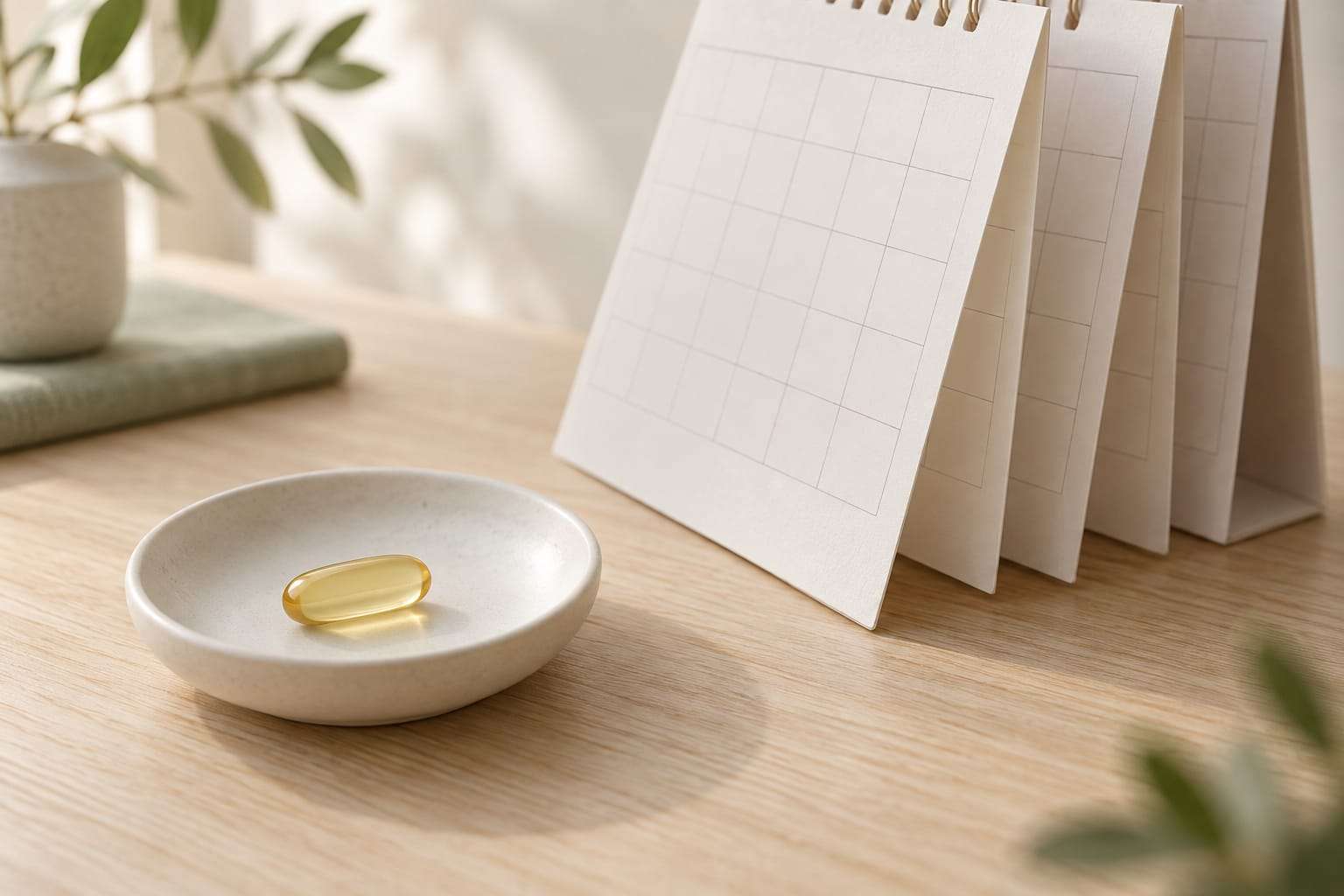
What happens after stopping also differs by treatment. The UK minoxidil solution label mentions reports of regrowth disappearing within three to four months after stopping, rather than a fixed deadline for each person. The US finasteride label says its effect reverses within 12 months. We found no corresponding stopping study for the rosemary lotion or saw palmetto extracts. An unknown is not evidence that a result is permanent. [1, 10, 7, 5, 6]
Bring a short account to the review
The useful output is a concise history: the first and latest comparable views, what you used, when it changed, missed periods and anything you noticed. Keeping the fuller folder available is sensible, but a conversation need not start with every image you took.
What the photographs seem to show
Include whether the conditions match and whether your impression is uncertain.What the routine actually involved
Use exact product names and dates. Include supplements and changes of preparation.What needs deciding
For example, how to interpret an unclear change, follow a product's review instruction or discuss a symptom.
These prompts can help you prepare a concise account for a review.
A record has done its job if it makes that conversation clearer, including when the conclusion is that the photographs do not settle the question.
How hair-loss options fit into a routineWhich pairings have evidence, which are alternatives and which additions remain uncertain.