
What bedroom temperature can and cannot tell you
Bedroom temperature is the temperature of the air around the bed. Thermal comfort means how comfortably warm or cool you feel. Those are related, but they are not the same measurement: clothing, covers and the bed itself also form part of your sleeping environment. Research on cooling bedding illustrates why changing a temperature measurement and improving sleep are separate questions. [1, 2]
This guide is for adults considering ordinary bedroom changes. It does not prescribe a setting for babies, an extreme-weather safety threshold or a treatment for persistent insomnia. If the main question is why sleep is difficult despite a comfortable room, start with what helps you sleep better. The Sleep collection separates environment, habits, supplements and body-clock questions.
Comfort
Room conditions
Sleep
These questions provide a way to organise a decision. They are not a validated scoring system, and there is no need to buy a sensor before using them.
Is 18°C the best temperature for sleep?
The research reviewed here does not establish 18°C as a universal target. In one home-monitoring study, 50 older adults had their most favourable sleep associations at roughly 20 to 25°C, with substantial differences between individuals. Their average age was 79, and sleep was estimated using Oura rings. This was observation, not random assignment to different thermostat settings. [2]
That finding is useful because it challenges a one-number rule. It does not justify replacing 18°C with another rule for every age, climate and bed. The sample was predominantly women and white, and relatively affluent. Funding included the TMCITY Foundation and a US National Institute on Aging fellowship. [2]
A practical starting description is more useful than arguing over one degree: “I wake feeling too warm under the duvet” identifies something you can examine. “My room is not at the ideal number” assumes that the number has already been proved. It has not been proved for everyone in the evidence above.
Room air, covers and clothing are different adjustments
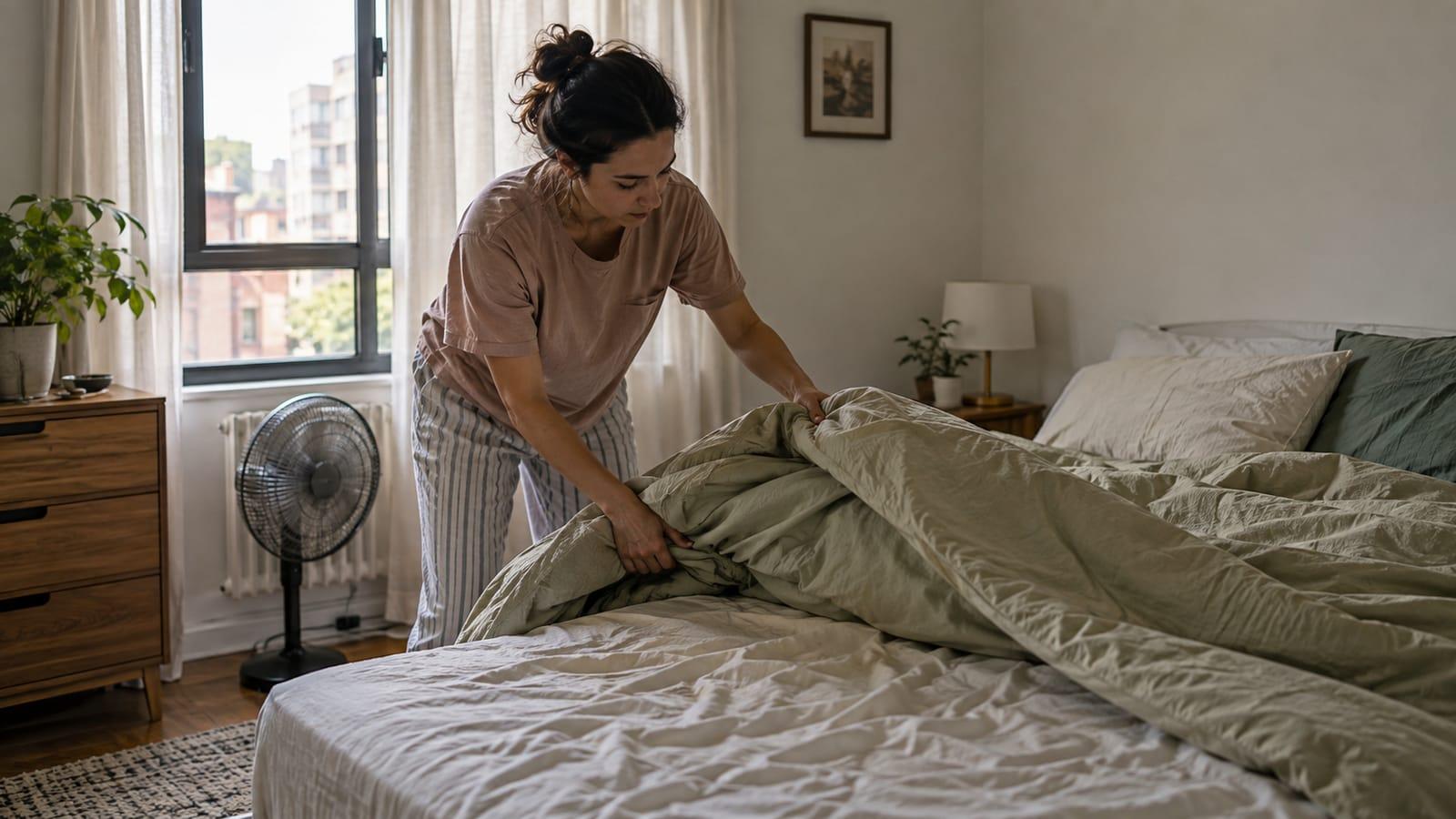
Treat the bedroom as a set of adjustable conditions rather than one thermostat setting. For example, changing a cover and changing the whole room are different actions. If two people share a bed, their reports of comfort can also differ; there is no reason to force their descriptions into a single average.
As a practical example, feeling too warm under the covers is a reason to try a lighter layer. Feeling cold is a reason to consider an extra layer or a small room adjustment, then reassess comfort. These are editorial examples of adjusting the environment, not proven sleep treatments or temperature targets.
The table is a practical planning aid. It does not rank these changes by proven sleep benefit or prescribe a particular fabric, fan or bedding weight.
| What you notice | What to examine | What a change would tell you |
|---|---|---|
| Comfortable at first, too warm under the covers later | Covers, clothing and whether room conditions change overnight | Whether that specific adjustment improves comfort |
| Cold when settling down | Room and bed conditions together | Whether the change solves the discomfort without creating another |
| Comfortable under the covers, but the room feels stuffy | Air exchange as well as temperature | Whether the problem is really one of warmth |
| Two people prefer different warmth | Which adjustments can be individual | Whether both can be comfortable without one thermostat compromise |
| Bad sleep without clear thermal discomfort | The broader sleep pattern | Whether temperature is the right question to pursue |
Light and screen habits deserve their own look. A room can feel comfortable while its lighting or the activities taking place in it remain relevant to the evening routine.
Do cooling mattresses and bedding improve sleep?
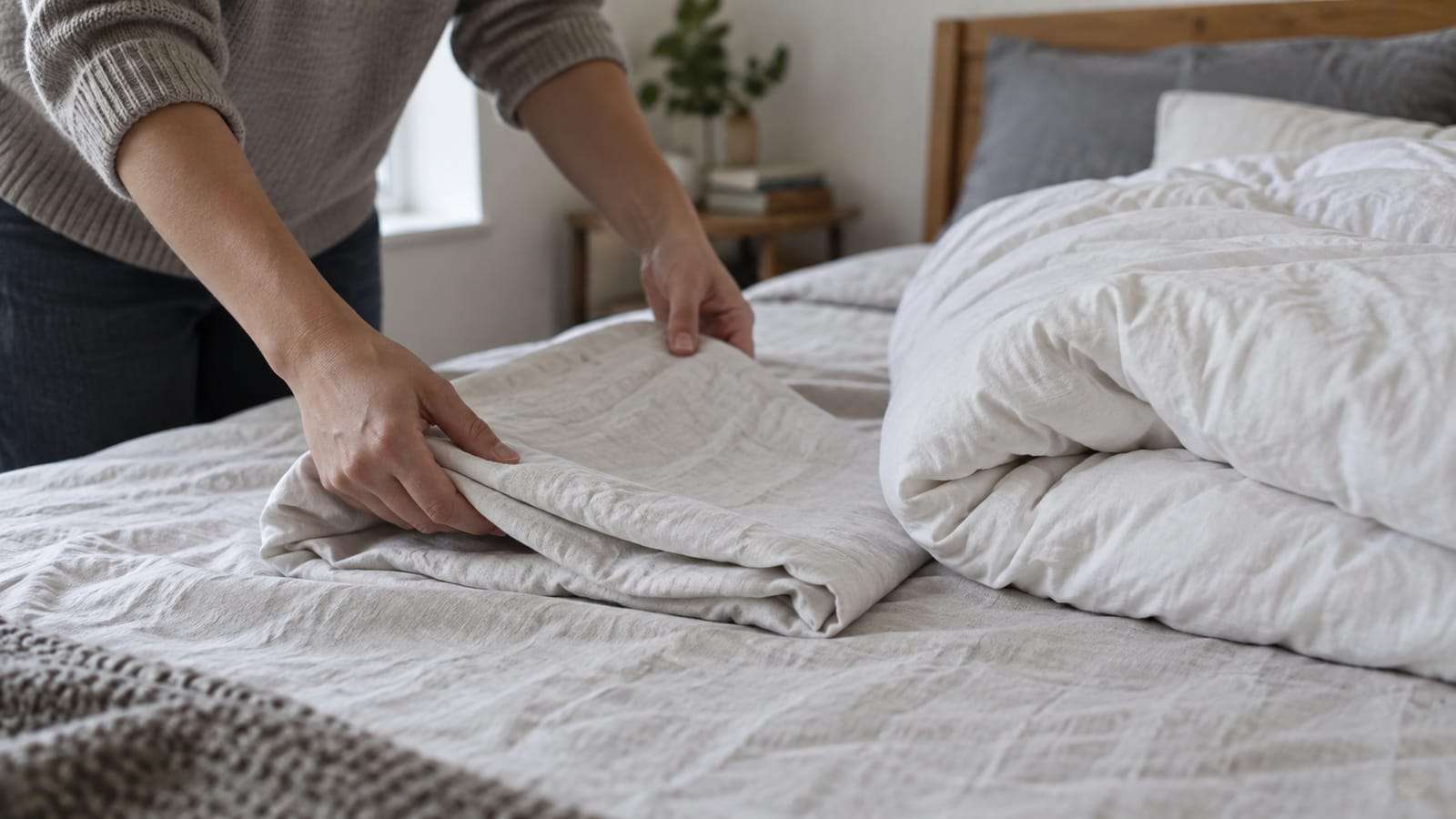
Cooling products may change thermal conditions without clearly improving sleep. A review published in 2025 included nine randomised trials in healthy adults aged 18 to 64, with searches through March 2024. It found no clear pooled differences in sleep onset, duration, wakefulness during the night, efficiency or stages. The authors rated the evidence low or very low in certainty. [1]
Sleep efficiency is the proportion of time in bed spent asleep. It is a sleep outcome. A change in skin or core body temperature is a physiological outcome. A product can affect the latter without demonstrating the former. The review reported no specific grant; its full trial tables and complete conflict disclosures were not available in the text we accessed. [1]
Three claims that need different evidence
- Temperature
- Changes heatDoes the product alter a measured thermal condition?
- Comfort
- Feels betterDoes the person prefer the sensation?
- Sleep
- Sleeps betterDoes a meaningful sleep outcome improve against a comparison?
A thermal result alone does not establish the sleep claim. [1]
Before paying for a product, separate your own aim from the advertising. Buying something because it feels comfortable is a different decision from buying it to treat insomnia. Ask whether the evidence concerns the actual product, people with your kind of discomfort, and sleep rather than only temperature. This review cannot select a current brand or establish a benefit for every person who feels hot at night.
The sleep-supplement comparison uses the same basic distinction: a plausible biological effect is not enough to establish a useful sleep result. Neither bedding nor a supplement needs to be added just because another option feels uncertain.
Ventilation is not the same as cooling
Ventilation exchanges indoor air with outdoor air. It need not make a bedroom colder, and a fan moving air within a room is not necessarily providing that exchange. Local heat, noise, outdoor air and security are practical constraints when considering an open window. A mechanical-ventilation experiment cannot prescribe one window position for every home. [3]
A four-week Belgian study had 29 completers; 23 bedrooms provided a usable high-versus-low ventilation comparison. Tracker-estimated deep sleep differed, but most sleep measures and cognition did not. [3]
Sleep duration did not clearly differ
Lower ventilation
421minutes
Higher ventilation
427minutes
Mean Fitbit-estimated sleep duration in the 23-bedroom comparison, not laboratory sleep measurement. The six-minute observed difference was not statistically clear (p=.865). It is not a promised gain from opening a window. [3]
Room temperature remained similar while humidity and air-quality measures changed. Carbon dioxide was used as an indicator of ventilation, not tested as an isolated cause. Funding included ASHRAE and VLAIO; ventilation-company employees were coauthors. This small study does not establish a universal carbon-dioxide threshold for sleep. [3]
Can a warm bath or shower help?
Warm bathing may help some aspects of sleep, but the research does not establish one reliable effect or required routine. The proposed explanation involves heat leaving the body after warming, rather than keeping the body hotter throughout sleep. This is a possible mechanism, not a reason to seek the hottest tolerable bath. [4]
A 2019 review suggested benefits for falling asleep, efficiency and perceived quality. Its studied exposures included water at 40 to 42.5°C, often one to two hours before bed. These are study conditions, not instructions for what you should reproduce. We accessed its abstract, not the complete trial tables or funding disclosures. [4]
A water-immersion review published in August 2026 found a different pattern across ten trials: clearer duration and efficiency results, but no clear sleep-onset or questionnaire-quality benefit. Its full protocols, confidence intervals and overlap with the older review were unavailable in the accessed abstract. Yunnan public research funding was reported. [5]
| Question | What the reviews support |
|---|---|
| Could warming before bed help? | Possible benefits, with different outcomes across reviews |
| Is faster sleep onset established consistently? | No: the newer review did not show a clear onset benefit |
| Is there a universal water temperature or exact interval? | These reviews do not establish one for individual use |
| Can a standardised effect be converted into minutes? | Not without the necessary underlying data |
The table summarises the two reviews, which should not be counted as independent sets of all-new trials. [4, 5]
A practical way to adjust your bedroom
Start with the discomfort you can describe, then make a manageable change. The sequence below is an editorial way to organise observations, not a tested treatment protocol. There is no required number of nights or guaranteed improvement attached to it.
Describe the problem
Write down when you feel too hot or cold, whether it is the air or under the covers, and what tends to wake you.Choose one change you can interpret
For example, alter one bedding layer rather than replacing the mattress, changing the thermostat and starting a supplement together.Record sleep as well as comfort
Note settling, awakenings and how you feel the following day. A cooler room alone is not the outcome you are trying to understand.Review whether the question has changed
If you are comfortable but still sleeping badly, reconsider the wider sleep problem instead of endlessly lowering the temperature.
A compact record might have four columns: what felt wrong; what changed; sleep that night; next-day functioning. Note unusual circumstances so that one unusually good or bad night does not become a product verdict. This record helps a conversation; it does not establish causation.
For questions about adding magnesium or melatonin, use the relevant ingredient evidence rather than interpreting improvement after several simultaneous changes as proof that one worked.
Where to go if comfort is not the whole problem
A bedroom adjustment answers an environmental question. It should not become an endless search for the perfect setting when the central problem is persistent difficulty sleeping, insufficient time for sleep or a schedule that does not match when you feel sleepy. The main sleep guide helps separate those situations.
For travel across time zones, use the jet-lag guide; a comfortable room and a body clock aligned to the destination are different aims. For the room's other major daily signal, read how light and screens relate to sleep.
Explore the Sleep collectionChoose the next question: sleep habits, environment, body-clock timing or supplement evidence.