
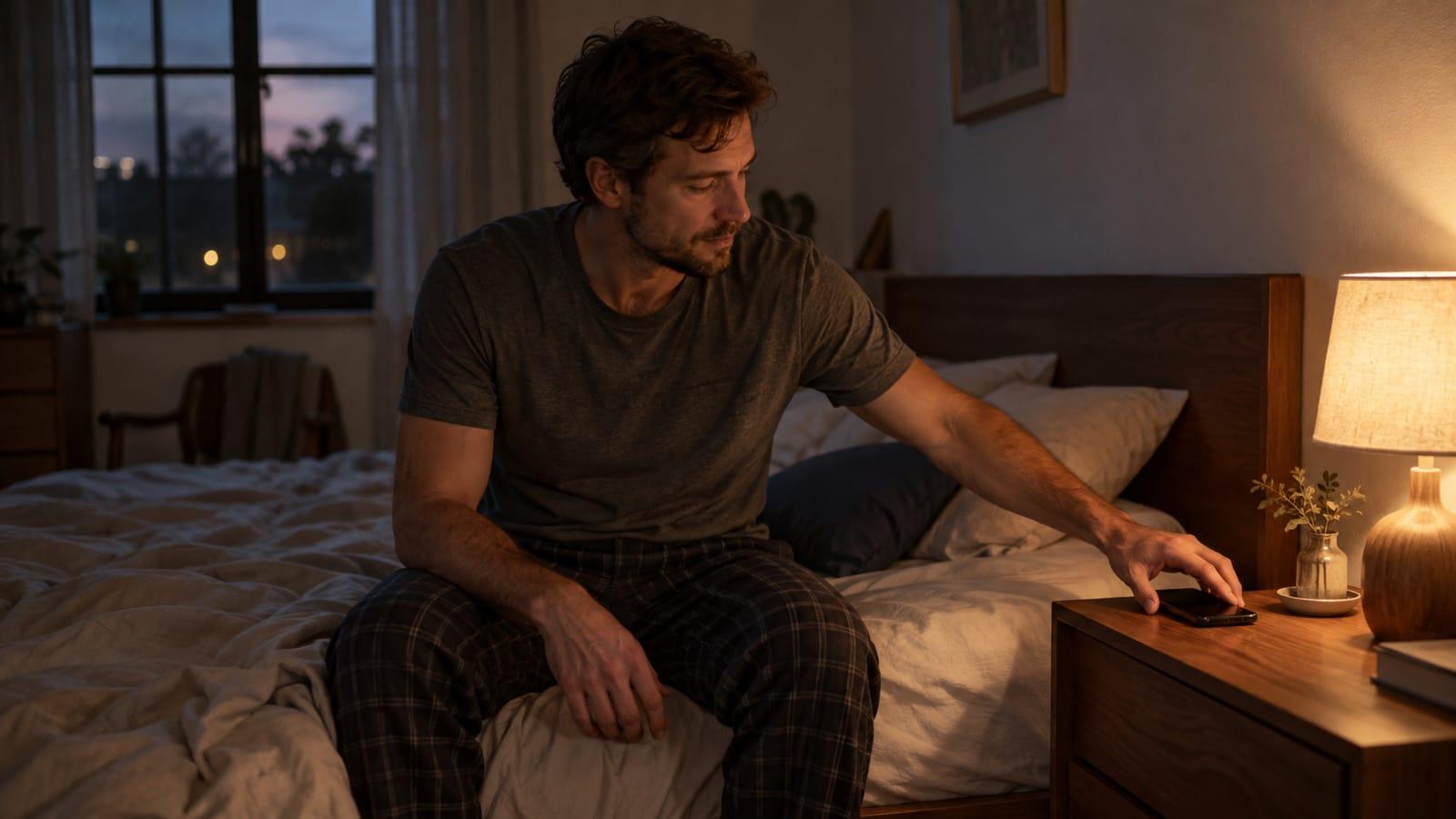
Light exposure and screen use are different questions
Light reaching the eyes helps regulate the circadian rhythm, the body's roughly 24-hour timing system, and can affect alertness. A screen also contains something you are doing: reading, working, watching or messaging. Changing its colour does not change that activity or decide when you put it down. [1, 2]
This guide concerns ordinary light exposure and screen habits in adults. It separates the reason light matters from evidence that a particular filter improves sleep. It is not a schedule for treating jet lag, night-shift work or a diagnosed body-clock disorder. Start with the main sleep guide if you are unsure whether the difficulty is your environment, sleep opportunity or something else.
The light
The activity
The outcome
The distinction prevents an easy mistake: expecting one software setting to answer every question about late-night screen use. The same separation between a plausible mechanism and a measured benefit appears in the sleep-supplement guide.
Why the time of day matters
Light is a timing signal, so daytime and evening exposure are different questions. Expert guidance for healthy adults favours ample daytime light, lower exposure before bed and darkness during sleep, while preserving enough light for safety. Daylight contains short-wavelength, or blue, light; avoiding it all day is not the aim. [1]
The signal depends on timing, brightness, duration and spectrum, meaning the mix of wavelengths. The light reaching the eyes matters, rather than simply how a lamp looks. These principles concern general day-active routines. Moving sleep timing for jet lag is a separate question. [1]
The 2022 guidance is expert consensus, not a trial showing that a particular lamp treats insomnia. Its authors disclosed lighting-industry links. It supplies a useful framework; it does not certify consumer products. [1]
Start with the day and the whole room
A light routine should account for the whole day, rather than begin and end with the phone. In the consensus framework, daytime light and lower evening exposure complement one another. A daytime window or outdoor setting and a bedside lamp are not competing products for the same job. [1]
For practical planning, walk through the places where you spend the day and evening. Notice which lights are on, what activity they support and which changes are realistic. This is an observation exercise, not a requirement to measure every room or achieve a perfect exposure score.
| Part of your routine | Question to ask | What this can clarify |
|---|---|---|
| Daytime work or study | Where am I spending the day, and what light is available? | Whether the evening phone is receiving all the attention while daytime conditions are ignored |
| Evening tasks | Which lights do I need for the task? | Whether the whole room needs the same lighting as a small work area |
| Phone or television | What am I doing, and when do I intend to stop? | Whether the issue is the display, the activity or both |
| During sleep | Is there unwanted light in the room? | A specific environmental problem to address |
| Getting up at night | Can I move around safely? | A constraint that takes priority over pursuing darkness at any cost |
The questions are practical applications, not a trial-tested checklist. The bedroom-temperature guide uses a similar approach: identify the disturbance before deciding that a purchase is needed.
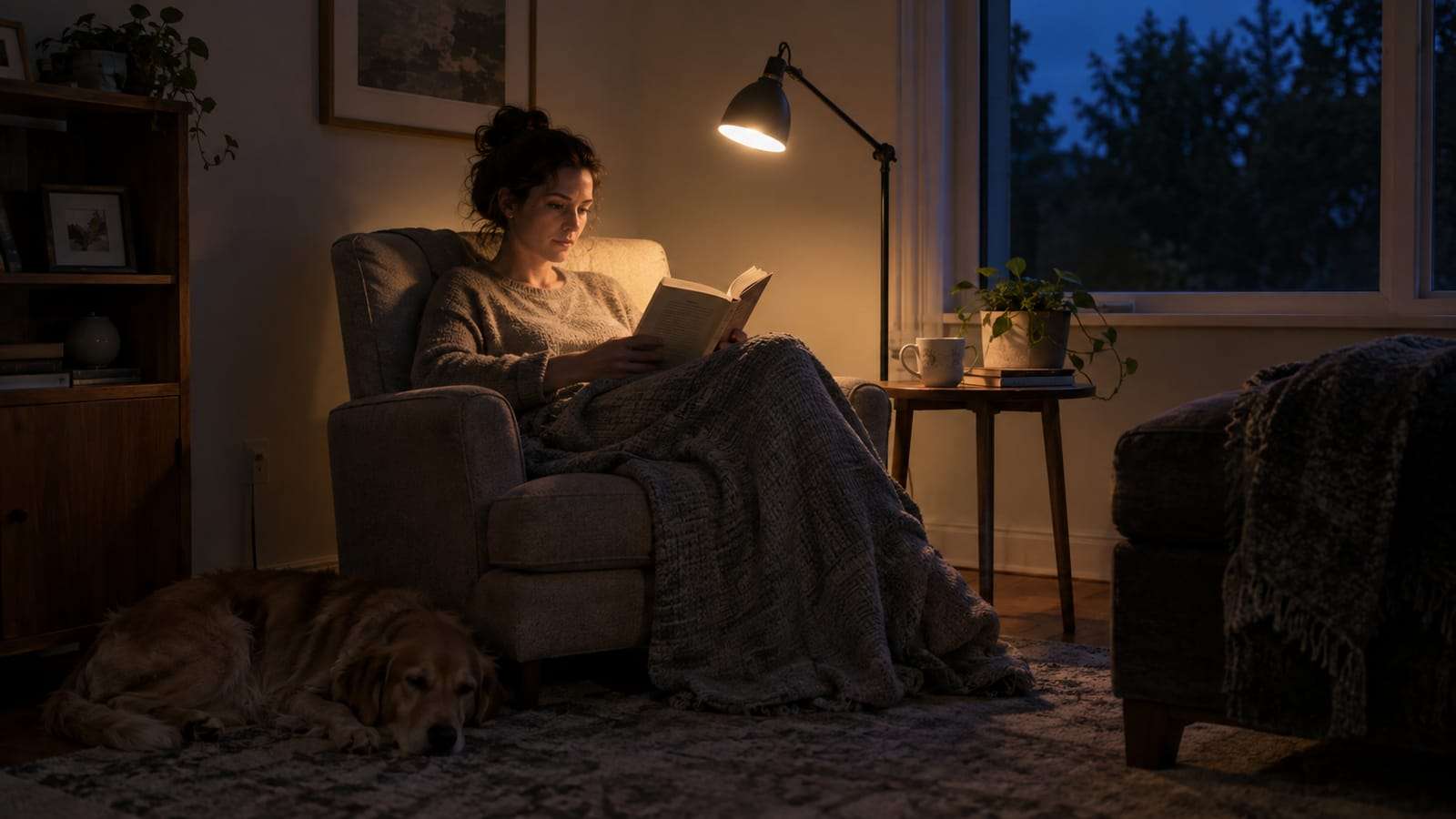
What else matters about screens besides their colour?
A filter cannot create more time for sleep if the activity continues past the time you intended to stop. Nor can a display setting tell you whether a work conversation, a game or a video is easy for you to leave. These are practical questions about the use of the device, separate from its optical settings.
It helps to name the actual problem before trying to solve it. “I keep replying to messages after I meant to go to bed” suggests a different adjustment from “the screen feels glaring in a dark room”. Neither description establishes a diagnosis, and the same person may recognise both.
Bedtime keeps moving
Record the time you meant to finish and when you actually stopped. A colour change does not answer why the activity continued.The display feels too bright
Consider the display and surrounding lighting as a practical comfort question, without treating a preferred setting as proven sleep protection.The activity is hard to leave
Identify the task, conversation or entertainment that keeps going. An intentional stopping point addresses a different issue from a filter.
This does not quantify how much each behaviour affects sleep. The trials below also do not isolate every kind of screen activity. The broader sleep guide puts routine changes in context, instead of assigning all sleep difficulty to one device.
Does night mode make phone use safe for sleep?
A warmer screen setting is not a guarantee of better sleep. A seven-night randomised trial enrolled 167 adults aged 18 to 24 and compared iPhone use with Night Shift on, Night Shift off, or no phone during the final hour before bed. There were no significant full-sample differences in the measured sleep outcomes. Sleep was estimated with movement monitoring. [2]
The study does not test every screen, setting or age group. It also does not prove that using a phone and not using one are equivalent. A favourable no-phone finding in a subgroup was exploratory, so it should not replace the main result. Funding and conflict details were unavailable in the abstract we accessed. [2]
What this particular trial tested
- People
- 167 adultsUniversity-age participants, aged 18 to 24.
- Duration
- Seven nightsA short comparison, not long-term use.
- Comparison
- Three conditionsNight Shift on, off or no phone in the final hour.
The full sample did not show a clear sleep advantage from the software feature. [2]
Use a setting because you prefer the appearance if that is your reason. The extra claim, that it protects your sleep despite continued use, needs evidence the trial did not establish.
Do blue-light blocking glasses improve sleep?
A reliable sleep benefit has not been established, and the uncertainty is substantial. A 2025 review pooled three small crossover trials, in which participants tried both amber and clear lenses at different times. The 49 participants included healthy adults, athletes and people with insomnia symptoms. Sleep was estimated by actigraphy, a method based on movement, rather than a laboratory recording of brain activity. [3]
The pooled results did not clearly favour amber lenses for falling asleep, duration, efficiency or wakefulness during the night. This is an imprecise result, not proof that the lenses are equivalent. [3]
Amber versus clear lenses: uncertain sleep differences
Time to fall asleep
A negative value means faster onset
−4.86 (−20.23 to +10.52)
Total sleep time
A positive value means longer sleep
+8.75 (−35.31 to +52.82)
Estimates and 95% confidence intervals from three crossover trials, 49 participants. Both intervals cross zero. Trials lasted about a week or nine nights; protocols and populations differed. [3]
A confidence interval shows the uncertainty around the estimate. These ranges include both benefit and worse outcomes. The review's small samples and methods limit precision; it also estimated a statistical correlation needed to combine crossover results. University funding covered the publication charge, and no commercial or financial relationships were declared. [3]
A broader Cochrane review published in 2023 also found uncertain sleep-quality results: three of six sleep trials favoured filtering lenses and three did not, among 148 participants. The trials were too varied for a pooled sleep estimate. This broader review overlaps the smaller review's evidence; the two are not independent confirmations. [4, 3]
A product label needs more than the words blue light
A blue-light claim does not identify the amount or range of light filtered, the timing of use or a demonstrated sleep effect. Amber lenses, lightly tinted computer glasses and software filters are different interventions. Eye-comfort or eye-health claims also ask different questions from sleep. Findings should stay attached to the tested intervention and outcome. [3, 4]
What is being changed?
| Screen software | Filtering lenses | Your routine | |
|---|---|---|---|
| Main question | Does changing this display setting improve sleep? | Do these lenses improve sleep when used as studied? | Is the activity delaying or complicating bedtime? |
| Important detail | The specific device, setting and use | The specific lens and timing | What you do and when you stop |
| What not to assume | A warm display guarantees protected sleep | Every blue-light product has the same effect | One universal screen cut-off works for everyone |
The product findings come from different interventions and cannot be transferred automatically between them. [3, 2, 4]
For a purchase decision, ask what result would make the item useful to you and whether the evidence measured that result. A claim about filtering a wavelength is not a measured reduction in sleeplessness. The same question is useful when reading about magnesium or another option offered for sleep.
Build a routine around the problem you have
Begin with a description of what you want to change. Is the problem unwanted light during sleep, a very bright evening room, insufficient attention to daytime light, or an activity that keeps extending? Choosing one question makes a change easier to interpret.
Use a short record if it helps: the problem noticed; the change made; when screen use ended; how sleep and the next day felt. Avoid treating one night or one tracker score as a verdict. This is a practical record, not a validated experiment, a required schedule or a test for a sleep disorder.
If the question is whether to take melatonin, read its timing, formulation and indication evidence separately. A hormone involved in sleep timing is not a reason to assume that a capsule cancels the effects of any lighting pattern. The supplement comparison addresses the treatment claims.
When you need a different sleep question
Persistent sleep difficulty deserves more than repeated purchases of filters or lamps. The main guide to better sleep helps decide what to assess next. For travel, jet lag concerns moving the body clock relative to local time, not merely making a room darker.
Keep the environment questions distinct as well. Temperature and bedding may matter to your comfort even when light is well managed. Neither page supplies an individually prescribed treatment schedule.
Find your next sleep questionExplore the connected guides on habits, environment, supplements and timing.