
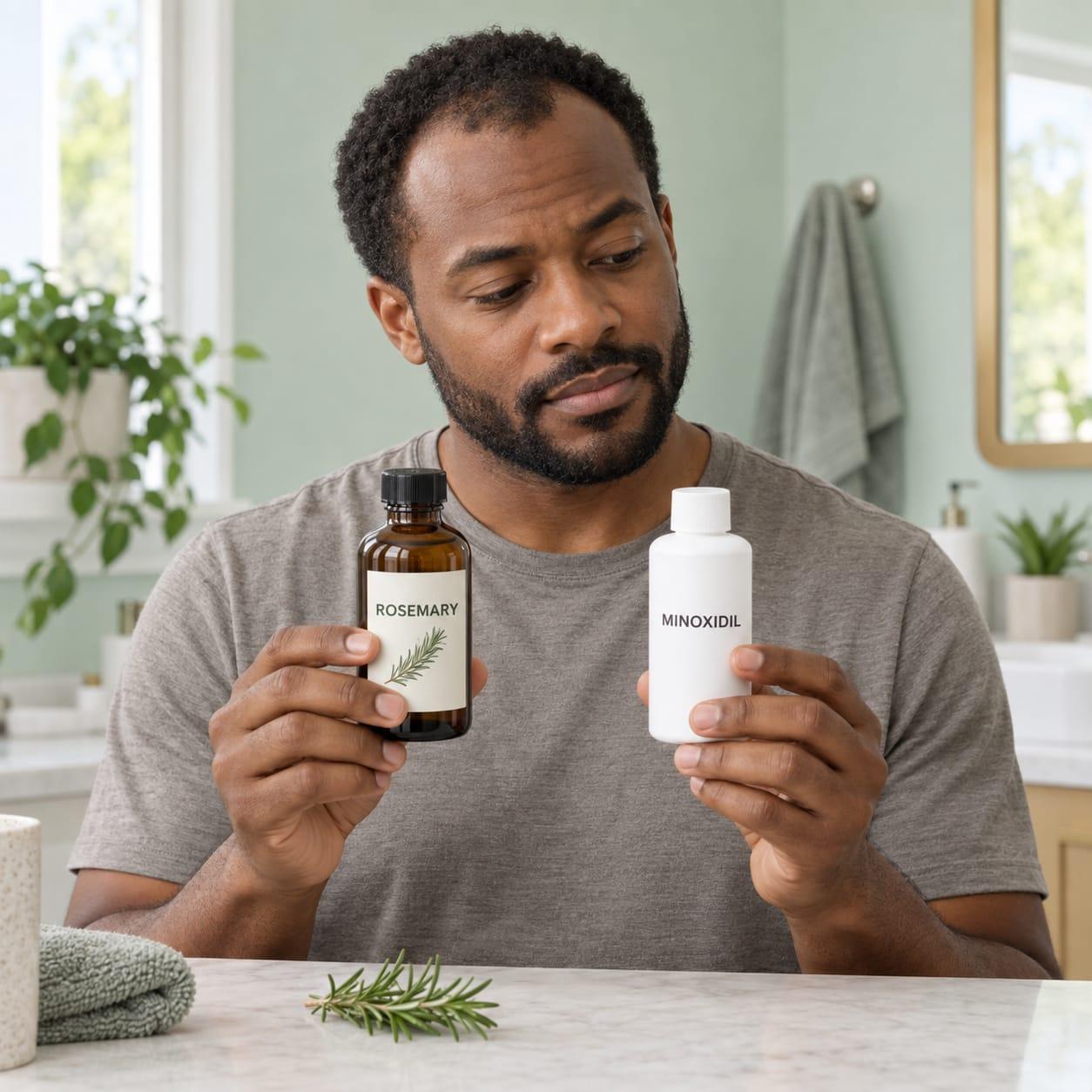
Does rosemary work as well as minoxidil
Minoxidil has stronger evidence for treating male pattern hair loss. It is a medicine applied to the scalp as a liquid solution or foam. Rosemary is a plant ingredient sold in lotions, concentrated essential oils and shampoos. Those rosemary products are not interchangeable. [1, 2, 3, 4]
The claim that rosemary works just as well comes from a comparison of one finished rosemary lotion with 2% minoxidil. It did not establish that they work equally well, and it did not test the 5% minoxidil used in the men's products covered here. This page compares those scalp products; minoxidil tablets are a separate treatment. [4, 3, 2, 5]
Rosemary and minoxidil at a glance
| Rosemary lotionA finished lotion, not essential oil | Minoxidil on the scalpLiquid solution or foam | |
|---|---|---|
| Direct comparison | One lotion against 2% minoxidil. | The rosemary comparison does not test 5% minoxidil. |
| Inactive comparison | No inactive comparison, or placebo, group in the lotion study. | Solution and foam each have trials against a product without minoxidil. |
| Product identity | The study describes a finished lotion, but does not give its complete formula. | The men's US and UK products have identified strengths and product-specific labels. |
| After stopping | Not measured in the studies we reviewed. | Continued use is needed to maintain regrowth, according to the labels. |
Minoxidil has been tested against inactive products. The rosemary lotion has only the direct comparison described below. [4, 1, 2, 3, 6]
If the loss is sudden, patchy or painful, the type of hair loss needs attention before this comparison. The trial does not tell us how either option works for those situations.
The studied lotion is not an essential-oil recipe
The lotion was standardised to at least 3.7 mg of 1,8-cineole per mL. This is a compound found in rosemary oil, used here as a marker. It is not the total amount of rosemary oil. The paper does not report the lotion's base or its overall oil percentage. [4]
Without the full formula, there is no reliable way to turn the study into a recipe. Mixing essential-oil drops into another oil would make a different product. We could not confirm a current US or UK retail product that matches the lotion studied. [4]
The fuller rosemary profile also covers a 2025 trial of oil blends. The reported results belong to those blends. Company funding, an employee among the authors and unclear comparisons between groups limit interpretation, and the study cannot isolate rosemary's contribution. [7]
What happened in the 100-man trial
The study enrolled men aged 18 to 49 with pattern hair loss. Fifty used a rosemary lotion and fifty used 2% minoxidil, each at 1 mL twice a day for six months. Researchers counted hairs on standardised close-up photographs at the start, three months and six months. The trial had academic support, and the lotion was supplied by its maker. [4]
Average hair counts in the photographed area
Rosemary lotion
122.8129.6Minoxidil 2%
138.4140.7
One single-blind trial of 100 men, 50 per group, with no placebo. The area counted is not clearly reported, so these are not hairs per cm². Starting counts differed. There was no significant difference between treatments. Academic support; lotion supplied by its maker. [4]
Neither group showed a significant change at three months. At six months both had higher counts than at the start. The average rise was roughly seven hairs for rosemary and two for minoxidil in photographs containing more than a hundred hairs. The difference between treatments was not statistically significant. [4]
The trial was single-blind, and the report does not fully describe how the men were allocated to the groups. We found no repeat trial using the same lotion. These limitations matter when a small result is used to support a much broader claim about rosemary products. [4]
Why no significant difference does not mean equal
“No significant difference” means the study did not clearly distinguish the results. The treatments might be similar, or the study might be too small to tell. Proving that two treatments work equally well requires a study planned to test that question. This one was not. [4]
There is also no placebo group. Both groups improved from their starting counts, but the study cannot establish how much of either change would have happened without an active treatment. It therefore gives a narrower answer than a trial that compares each product with its inactive version. [4]
Three claims the comparison does not establish
- Rosemary equals minoxidil. Failing to find a difference does not prove the treatments work equally well.
- Rosemary equals 5% minoxidil. The comparator was 2%.
- Any rosemary product works. The study tested one finished lotion.
Nor does the larger numerical rise in the rosemary group prove it was better. The groups began at different counts, and the study did not establish a significant between-group difference. Reading the highest change as the winner would ignore the comparison the paper actually made. [4]
This is why our ranking does not place rosemary alongside minoxidil. It is a judgement about the depth and applicability of the evidence, not a claim that the trial proved rosemary ineffective.
What the wider minoxidil evidence adds
A separate trial of 393 men compared 5% minoxidil solution with 2% solution and the liquid without minoxidil over 48 weeks. The 5% group did better than both comparison groups, with more scalp irritation at the higher strength. We verified this in the published summary, but not a precise numerical gain, so we do not supply one. [1]
For 5% foam, the UK product information reports a trial of 352 men aged 18 to 49 over 16 weeks. Hair counts rose by about 21 hairs per square centimetre with minoxidil, against about four with foam without minoxidil. These results provide context for minoxidil; they are not a second head-to-head comparison with rosemary. [2]
Why the separate trials cannot make a league table
- Rosemary comparison
- 6 monthsCounts in a photographed area of unclear size.
- Minoxidil foam
- 16 weeksHairs per cm² in an identified target area.
- Minoxidil solution
- 48 weeksDifferent participants and comparison groups.
Time, participants and measurement differ. Subtracting the results would not measure a rosemary versus 5% minoxidil effect. [4, 2, 1]
If your main difficulty is the feel of a scalp treatment, the useful comparison may be minoxidil foam versus liquid. The evidence for rosemary does not establish that switching to it would preserve the same benefit or avoid irritation.
Is rosemary gentler on the scalp
The comparison does not settle that either. Itching increased in both groups. The paper's summary and results text say it was more frequent with minoxidil, while a figure caption states the opposite. We found no correction resolving the contradiction and therefore do not claim a tolerability advantage for rosemary. [4]
A separate case report describes contact dermatitis, a skin reaction, after a 53-year-old man used an alcohol-based rosemary preparation on his chest. Patch testing supported the diagnosis. This was another product on another body area, and one case cannot give a frequency, but it shows why “plant-based” is not a guarantee against skin reactions. [8]
Rosemary
Itching occurred in the trial, and a skin reaction has been reported with a separate preparation. How often reactions occur with retail scalp products is not established here.Minoxidil solution
The UK product contains alcohol and propylene glycol, which can contribute to irritation. Its label also includes warning symptoms beyond the scalp.Minoxidil foam
The UK foam has no propylene glycol, but other ingredients can still irritate. A different base is not a guarantee of no reaction.
These are product-specific cautions, not comparable side-effect rates. [4, 8, 3, 2]
For the warning symptoms and the distinction between scalp forms and tablets, see minoxidil side effects. A red, swollen or increasingly itchy scalp is a reason to stop the irritating product and seek advice, rather than assume the reaction proves it is working.
Routine, review dates and stopping
The rosemary trial used two applications a day for six months. Six months was a measurement point, not a universal instruction to continue an unsuitable product until then. No study we reviewed established how long to maintain a result or what happens to the hair after stopping rosemary. [4]
Minoxidil has clearer but product-specific instructions. The UK men's foam label sets a 16-week point to stop if there is no improvement, the US men's solution and foam labels set four months to stop and see a doctor, and the UK men's solution label sets one year. These rules cannot be exchanged between products. [3, 2, 6, 9]
Minoxidil's regrowth needs continued use. The UK solution label mentions reports of regrowth disappearing within three to four months after stopping. These are observations, not a fixed deadline for each person. Rosemary's unknown maintenance requirements are not evidence that its effects last longer. [3, 4]
For a practical record, tracking hair growth separates photographs, missed applications, product changes and symptoms. The value is a clearer history, not an at-home clinical trial.
Can they be used together
The rosemary trial compared the products as alternatives. It did not test adding rosemary to minoxidil. We found no trial establishing the benefit of that addition or what the products do to each other on the scalp. The UK minoxidil labels also restrict use with other medicines applied to the scalp. [4, 3, 2]
If you are comparing botanicals more broadly, saw palmetto versus finasteride involves a different oral preparation and a different study. Its result cannot strengthen the rosemary comparison or establish a class effect for “natural” treatments.
Where to go next
If your priority is a scalp treatment with stronger evidence for male pattern hair loss, minoxidil is the better-supported option in this comparison. The next questions are which form fits your routine and how well your scalp tolerates it. The rosemary lotion has a small study behind it, but that does not establish the same effect for essential oils or shampoos.
How to use minoxidilAmounts, application and review points from the specific men's labels.