

Is saw palmetto a natural alternative to finasteride
Finasteride has stronger evidence for male pattern hair loss. It is a prescription medicine; this comparison concerns the 1 mg tablet taken by mouth. Saw palmetto is a plant supplement made from the berries of the Serenoa repens palm. Hair studies have used particular oily extracts, which differ from ground berry powder and mixed hair formulas. [1, 2, 3, 4, 5]
Saw palmetto is therefore not a proven equivalent of finasteride. Some extracts have shown a benefit in small studies, but those results belong to the products tested. The practical comparison includes the likelihood of benefit, the exact product, side effects and the need to keep using it. [4, 5, 6, 1]
A supplement and a prescription medicine compared
| Saw palmettoPlant extracts in capsules | FinasteridePrescription tablet | |
|---|---|---|
| Place in the ranking | Limited evidence, specific to the preparation. | Core option, alongside minoxidil. |
| Evidence | Small trials, several with commercial involvement, of different extracts. | Larger studies against inactive tablets, with follow-up to five years. |
| Access | Sold as a supplement. A retail product is not automatically a studied extract. | Prescription medicine with US and UK hair-loss labels. |
| Main uncertainty | How a particular product performs and its longer-term risks. | The individual's benefit and risks, including sexual and mood effects. |
Finasteride and minoxidil share the top tier; this is not a ranking of one above the other. [4, 5, 6, 1, 2, 7, 8, 9]
This comparison concerns adult male pattern hair loss. Sudden shedding, patches or scalp pain need a different starting point, covered in types of hair loss.
Why the extract matters more than the front label
Saw palmetto, also called Serenoa repens, is sold as ground berries, oily extracts and multi-ingredient formulas. The placebo-controlled hair trials we reviewed used extracts, not ordinary berry powder. The weight of a capsule can also differ from the amount of extract inside it. [3, 4, 5]
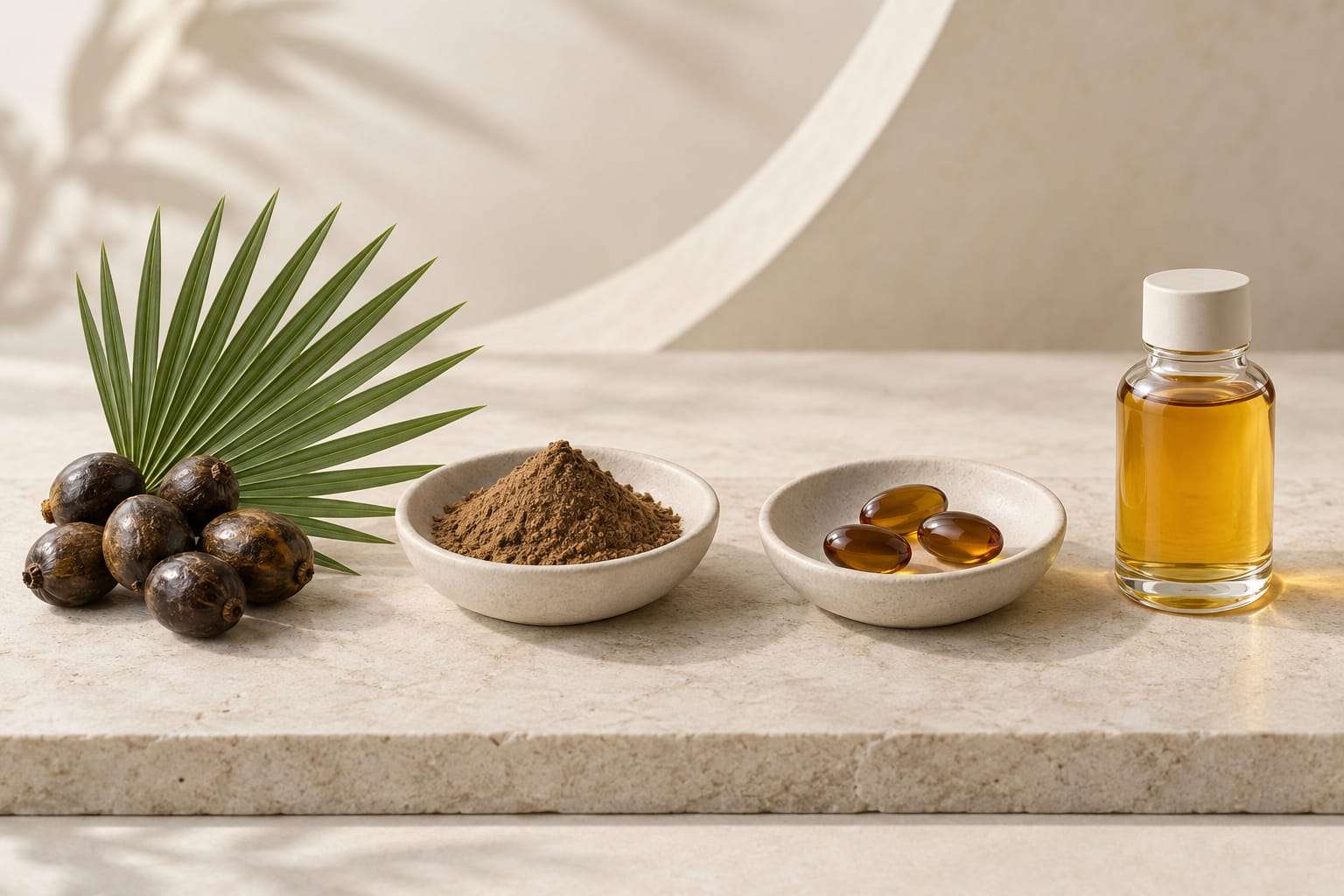
In the 16-week study, a 400 mg capsule supplied 100 mg of extract. In the 180-day study, the daily softgel supplied 160 mg of extract containing 105 mg of a named fatty-acid fraction. The direct finasteride comparison used 320 mg a day, with extract details unavailable to us. Those quantities describe different products, not three strengths of the same treatment. [5, 4, 6]
The amount depends on which extract was tested
| 16-week study | 180-day study | 24-month comparison | |
|---|---|---|---|
| Daily amount | 100 mg extract in a 400 mg capsule. | 160 mg extract, supplying 105 mg of a named fatty-acid fraction. | 320 mg saw palmetto. |
| Comparator | An inactive capsule, or placebo. | An inactive softgel, or placebo. | Finasteride 1 mg. |
| People | Men and women, analysed together. | 60 adults, half of them men. | 100 men. |
Study amounts describe what was tested. They are not instructions or evidence that more milligrams work better. [5, 4, 6]
A label may state the percentage of fatty acids in an extract. That gives more detail about its contents, but still does not prove that two products will have the same effect. Our price check found no US or UK product documented as matching a studied preparation, so we do not present a saw palmetto price as though it were the cost of reproducing a trial.
What the direct comparison found
A 2012 study followed 100 men with mild to moderate pattern hair loss for 24 months. It compared saw palmetto 320 mg a day with finasteride 1 mg a day. The study was open-label, meaning the men knew what they were taking, and there was no placebo group. We could read only the published summary, not the full report. [6]
Men rated as improved on photographs at 24 months
Finasteride 1 mg
68%% of men
Saw palmetto 320 mgExtract details not available to us
38%% of men
One open-label study of 100 men, with no placebo. These are shares of men rated as improved, not percentages of hair gained. Only the published summary was available; the extract details and a funding declaration were not verified from that access. [6]
The result favours finasteride. It does not mean a man gains 68% more hair with finasteride or 38% more with saw palmetto. Nor does it provide a precise prediction for an individual. It is a photographic judgement of whether improvement occurred in each man. [6]
The study points towards more men improving with finasteride, but the summary alone cannot tell us precisely how much better it works or how the side effects compare. It also does not identify the saw palmetto extract well enough to match a shop product. A bottle marked “320 mg” may contain a different preparation. [6]
For the wider finasteride evidence and what its measurements mean, see finasteride results.
What the placebo-controlled extract trials add
Two small studies provide signals of benefit for their own oral extracts. They are worth separating from the finasteride comparison, because neither tested whether its extract could replace finasteride. [4, 5]
The 180-day study enrolled 60 adults with self-perceived thinning hair: 40 took the extract and 20 took placebo. Half the participants were men, but the published result is not a male-only estimate. Thicker terminal hairs were counted in two one-square-centimetre areas and added together. The total rose by 18.6 hairs with extract and fell by 10.1 with placebo. When the front area was considered alone, the difference was not shown. [4, 10]
Who was studied and how hairs were counted
- Study population
- 60 adults30 men, with men and women pooled for the result.
- Measured areas
- Two patchesCounts summed. Not a result per cm².
- Publications
- One trialThe 90-day and 180-day reports describe the same people.
The trial was sponsored by a supplement company, as declared in its 90-day report, and was registered after it began. [4, 10, 11]
The 16-week study enrolled 80 people across four groups. The oral comparison assigned 20 to extract and 20 to placebo; 18 and 19 were analysed. Hair density rose by about 5.2% from the starting level with extract and fell by about 3.2% with placebo. Men and women were analysed together, and four authors were employees of a commercial company. [5]
These findings support interest in the studied extracts. They do not establish the effect of a generic saw palmetto supplement, a long-term safety advantage or equivalence with finasteride. The full saw palmetto profile also explains why inconsistent topical-lotion results and multi-ingredient formulas are kept separate.
What the larger finasteride evidence shows
The US label summarises two trials in 1,553 men with thinning at the crown. At 12 months, those taking finasteride 1 mg had 107 more hairs than those taking placebo in a measured 5.1 cm² patch. This is the difference between groups in that patch, not 107 extra hairs over the whole scalp or a promise of an individual gain. Extensions followed benefit for up to five years. [1, 7]
That is a different outcome from “men rated as improved” in the saw palmetto comparison. It strengthens the evidence that the tablet has an effect, but it cannot be placed on the same numerical scale as the extract studies. The minoxidil versus finasteride page applies the same restraint to the two core options.
Finasteride has risks of its own. Better documented efficacy is not the same thing as suitability for everyone, and the tablet remains a decision that involves a prescriber. [1, 2]
Is saw palmetto safer or free of hormonal effects
The hair studies cannot establish that saw palmetto is safer than finasteride. In the 180-day trial, no side effect was attributed to the extract, but groups of 40 and 20 cannot exclude uncommon problems. Participants were assessed clinically without blood tests. [4]
In the 16-week trial, the oral extract changed blood levels of DHT, a hormone. This does not show how much hair it will grow, but it is a reason not to describe the extract as hormonally neutral. [5]
Saw palmetto
The US NIH centre for complementary health lists digestive symptoms, dizziness and headache, generally mild and infrequent. The hair studies do not resolve rare risks or fertility effects.Finasteride
In first-year trials in the US label, 3.8% reported at least one treatment-related sexual adverse effect, compared with 2.1% on placebo. These are first-year trial figures, not a lifetime risk.Mood and symptoms after stopping
Finasteride carries regulatory warnings about depression, suicidal thoughts and sexual problems that may continue after stopping. A frequency for persistent symptoms is not established.
The evidence comes from different kinds of sources and is not a head-to-head safety comparison. [3, 4, 5, 1, 8, 9]
A larger saw palmetto safety trial concerned urinary symptoms, not hair loss. Its safety analysis included 357 men aged 45 or older. Over 18 months, there was no clear difference from placebo in reported side effects or questionnaires about erections and ejaculation. It was publicly funded, with extract donated by its maker. That is useful information about that extract and population, not a fertility study or proof about all hair supplements. [12]
The finasteride side-effects page explains the warning evidence in detail. For saw palmetto, possible added effects with blood thinners or antiplatelet medicines are described largely through case reports. Other medicines and planned surgery are reasons to discuss the exact product with a pharmacist or clinician. [13]
Can saw palmetto be added to finasteride
We found no trial establishing the benefit of saw palmetto alone added to finasteride, and the safety of that combination has not been established. Comparing the two as alternatives does not test taking both. The same gap applies to combining saw palmetto with dutasteride. [6, 5]
One trial in 225 adults, 165 men and 60 women, tested a multi-ingredient capsule on top of varied hair-loss medicines for six months. Photographic ratings favoured the addition, but there was no placebo capsule, and two authors worked for the company selling the formula. The result belongs to that whole formula and treatment setting. It cannot show what saw palmetto alone adds to finasteride or minoxidil. [14] The routines page separates these questions.
Time, records and what happens after stopping
The extract trials measured at 16 weeks and 180 days; the direct comparison measured at 24 months. These dates are research observation periods, not a single time-to-result promise for saw palmetto. No study we reviewed measured what happens to the hair after stopping it. [4, 5, 6]
Finasteride's US label says benefit generally needs three months or more and that the effect reverses within 12 months after stopping. Unknown persistence for saw palmetto does not mean its effects last longer. [1]
For anyone documenting a routine, consistent photographs and an exact product record are more informative than recalling whether a bottle seemed helpful. A product change belongs in that record, especially when extracts differ.
Where to go next
Finasteride is the better-supported option for male pattern hair loss in this comparison, with prescription requirements and side effects to consider. Saw palmetto has some encouraging results for specific extracts, but it is not a proven equivalent or a proven safer substitute. The wider comparison can help if you also want to consider treatments applied to the scalp.
Compare the main hair-loss optionsSix ingredients, three evidence tiers and the same eight questions for each.