
Minoxidil for the scalp comes with written instructions. This page sets out what four men's product labels say about how much to use, how to put it on and how long to wait. It then shows what the trials counted at 16 and 48 weeks. Nothing below is a tip of ours unless we say so.
It covers the 5% solution and the 5% foam, used by adult men with male pattern hair loss. Tablets are a different decision, covered on the page about oral minoxidil. If you are still deciding whether minoxidil is the place to start, the minoxidil profile has the evidence, the side effects and the costs.
The four labels behind this page
A label is written for one product in one country. We read four, all for men's 5% products, at the end of September 2026: two from the United Kingdom and two from the United States. They agree on the main points and differ on the details, so this page keeps them apart. [1, 2, 3, 4]
UK solution
- Measured with
- The pump supplied. Six presses of that pump give 1 mL.
- What we read
- The UK product information, text revised in December 2024.
UK foam
- Measured with
- The product's cap. Half a capful is about 1 g.
- What we read
- The UK product information, text revised in June 2026.
US solution
- Measured with
- The dropper supplied, 1 mL at a time.
- What we read
- The Drug Facts label: use, warnings, directions and other information.
US foam
- Measured with
- The product's cap, half a capful at a time.
- What we read
- The Drug Facts label and the steps for use in its leaflet, updated in January 2026.
How much to use, and how often
All four labels say twice a day. The amount for each application is 1 mL on the two solution labels and half a capful on the two foam labels. [1, 2, 3, 4]
Amount and frequency on four men's labels
US and UK products, read at the end of September 2026.
| On the label | UKRegaine for Men Extra Strength5% solution | UKRegaine for Men Extra Strength5% foam | USMen's Rogaine Extra Strength5% solution | USMinoxidil 5% (For Men)5% foam |
|---|---|---|---|---|
| Each time | 1 mL, over all thinning areas | 1 g, about half a capful, over all thinning areas | 1 mL | Half a capful |
| Measured with | The pump supplied: six presses give 1 mL | The product's cap | The dropper supplied | The product's cap |
| How often | Twice a day | Twice a day | Twice a day | Twice a day |
| Most in a day | 2 mL | 2 g | No figure in the sections we read. The label says more, or more often, will not improve results | No figure in the sections we read |
Each column is one product's own label. An amount on one label is not an instruction for another product. [1, 2, 3, 4]
What 1 mL and half a capful mean
The labels give the amount in three different ways: a volume of liquid, a weight of foam, and a share of a cap. This is how far each one goes.
Reading the amount on the label
- It is the total, not an amount per area. On the UK labels the 1 mL of solution, or the 1 g of foam, is spread over all the thinning areas together.
- It is an amount of product. One millilitre of solution and one gram of foam describe the product that comes out of the pack, not the weight of medicine inside it.
- The measure belongs to the pack. Six presses equal 1 mL only for the pump supplied with the UK solution. The US solution comes with a dropper. A spray is often the same solution with a different applicator, and its presses cannot be counted across from another bottle.
- Half a capful is half of that product's cap. The UK foam label puts it at 1 g. We found no weight or volume for the US capful in the sections we read, and we do not work one out.
- Solution and foam do not convert. Half a capful of foam is not 1 mL of solution.
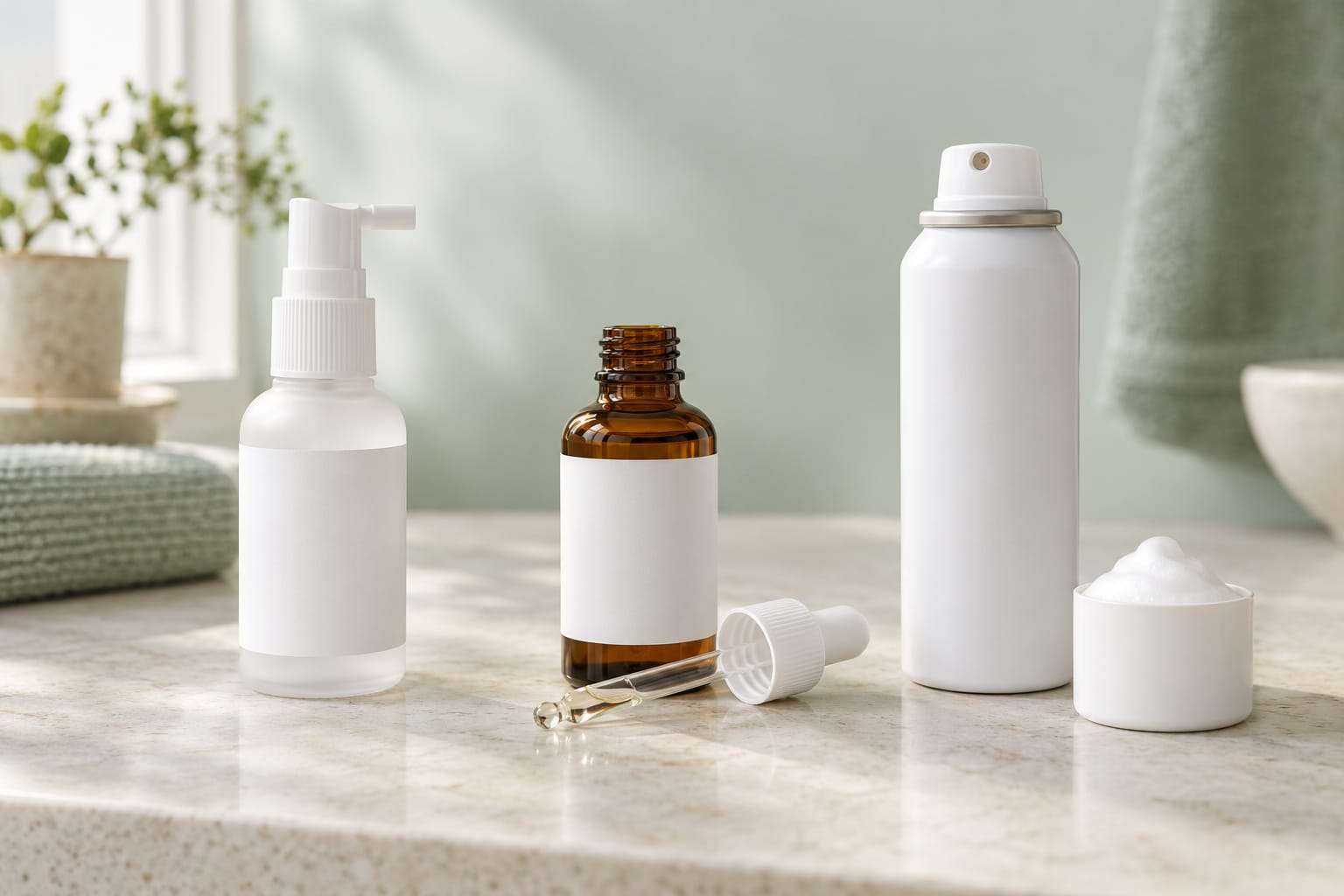
How long a pack lasts follows from the same numbers. At 1 mL twice a day, 30 days use 60 mL of solution. At the UK foam label's 1 g twice a day, the 60 g can listed on that label holds 30 days of applications if nothing is wasted. The profile works out what a month costs in our US and UK price check. [2]
How to apply it, step by step
Solution and foam are handled differently, and the UK and US labels do not record the same details. Below, the passages we read from one named label are arranged in order of use, with the other country's label described next to it.
Solution: what the UK label says, in order of use
- 1
Start dry
Hair and scalp are thoroughly dry before the solution goes on.
- 2
Measure 1 mL
With the pump supplied. Six presses of this pump give 1 mL.
- 3
Cover the thinning areas
That one millilitre is spread over all the affected areas of the scalp.
- 4
Wash your hands
After applying. The same again later in the day.
The US solution label we read, for Men's Rogaine Extra Strength, is shorter: 1 mL with the dropper, twice a day, directly onto the scalp in the hair loss area. The sections of that label we read do not mention dry hair or washing your hands. That is a limit of what we read, not proof that the full leaflet leaves them out. [1, 3]
Foam: what the US label and leaflet say, in order of use
- 1
Start with a dry scalp
The leaflet in the pack asks for a dry scalp.
- 2
Half a capful
Of this product's own cap. We do not convert it into grams or millilitres.
- 3
On the scalp, not the hair
In the hair loss area, massaged in with the fingers.
- 4
Wash your hands
After applying. The same again later in the day.
The UK foam label describes the same routine in its own terms. It gives 1 g, about half a capful, applied with the fingers to dry hair and scalp across all the thinning areas, with hands washed afterwards, twice a day and no more than 2 g in a day. [4, 2]

The details, label by label
The table collects the small points people ask about most: dry or damp hair, hands, bedtime, and what else is on the scalp. Where a cell says the sections we read are silent, the full leaflet may still cover it.
Application details on four men's labels
What each label says, and where the sections we read say nothing.
| On the label | UKRegaine for Men Extra Strength5% solution | UKRegaine for Men Extra Strength5% foam | USMen's Rogaine Extra Strength5% solution | USMinoxidil 5% (For Men)5% foam |
|---|---|---|---|---|
| Hair and scalp | Thoroughly dry | Dry | Not in the sections we read | Dry scalp, in the leaflet |
| Where | All thinning areas of the scalp | All thinning areas of the scalp | Directly on the scalp, in the hair loss area. The label is for the top of the scalp | On the scalp, not the hair, in the hair loss area. The label is for the top of the scalp |
| Applied with | The pump supplied | The fingers | The dropper supplied | The fingers, massaged in |
| Hands | Wash afterwards | Wash afterwards | Not in the sections we read | Wash afterwards |
| Before bed | Not in the sections we read | Not in the sections we read | Not in the sections we read | Let the foam dry completely first, in the leaflet |
| State of the scalp | Not on an inflamed, infected, irritated or painful scalp | A normal, healthy scalp. Not an inflamed, infected, irritated or painful one | Not on a red, inflamed, infected, irritated or painful scalp | Not on an inflamed scalp |
| Other scalp medicines | Not to be used together | Not to be used together | Not to be used together | Restricted, according to our notes on the four labels together. We have no passage for this label on its own |
These are selected passages, not the complete text of any label. Our notes on these labels record no instruction about applying minoxidil to damp or towel-dried hair. That is a limit of our notes. The leaflet in your pack may cover it. [1, 2, 3, 4]
Questions the labels answer, and questions the sections we read do not
We read the parts of each label that say who it is for, how to use it, what to watch for and what to expect. Some everyday questions are answered there. Others are not answered in what we read, and for those the place to look is the full leaflet in your pack, or a pharmacist. We do not fill the gaps with advice from elsewhere.
Is once a day enough?
On the labelAll four men's labels say twice a day. The once-a-day instruction we found on a label belongs to a US women's 5% foam, and the trials of once-a-day foam were run in women, against a 2% solution. They do not justify a lower frequency for men. In one small study of 22 men already taking finasteride, the minoxidil lotion was applied once a day. That was the study's own protocol, not a label. [5, 6, 7, 8]What if an application is missed?
Not in our notesOur notes on these labels record no instruction about a missed application. That is a limit of our notes. The leaflet in your pack may cover it. We do not suggest a catch-up of our own.Can another medicine go on the scalp as well?
On the labelThe two UK labels and the US solution label say not to use minoxidil together with other medicines applied to the scalp. Our notes on the four labels together record the same restriction for the US foam, though we have no passage for that label on its own. That is a rule of those products, and it is about medicines. [1, 2, 3, 4]What has been studied togetherCan foam and solution be used together?
Not a label questionThey are two ways of applying the same medicine, so using both duplicates one treatment. Each label describes its own product used on its own, with its own amount.Foam and solution comparedWashing, hair dye and styling products
Not in our notesOur notes on these labels record no instruction about washing your hair, colouring it or using styling products, or about how long to leave minoxidil on before washing. That is a limit of our notes. The leaflet in your pack may cover it.Sun, swimming and hats
Not in our notesOur notes on these labels record no instruction about sunshine, sunscreen, swimming or wearing a hat after applying. That is a limit of our notes. The leaflet in your pack may cover it.Does the time of day matter?
Partly on the labelThe labels say twice a day and, in the sections we read, do not fix the hours. The US foam leaflet asks for the foam to be completely dry before bed. We found no trial showing that a particular time of day makes minoxidil work better. [4]Derma rollers and microneedling
Not in the sections we readThe passages we read from the two UK labels and the US solution label give no time to restart after needling, and they exclude an irritated or painful scalp. [1, 2, 3]What the microneedling trials did
Not in our notes and not in the sections we read both describe a limit of what we recorded: the passages on who the product is for, how to use it, warnings and what to expect. A full leaflet can say more.
How long minoxidil takes to work
Think in months. The labels separate two moments: when the first signs may appear, and the point to stop if nothing has changed. The UK solution label expects first signs after two months or more, and the UK foam label after eight weeks or more. The two US labels say results may be seen at two months and that some men need at least four. [1, 2, 3, 4]
The first year: label rules and trial time points
UK foam
Men 18 to 49
UK solution
Men 18 to 65
US solution and foam
Men 18 and over
Trials
When hair was counted
A review point is the label's instruction to stop if there has been no improvement. The two US labels also say to ask a doctor. A trial time point is when researchers measured, not a promise of when you will see a change. The 24-week trial compared minoxidil by mouth with the solution. [1, 2, 3, 4, 9, 10]
The review points differ a great deal: 16 weeks on the UK foam label, one year on the UK solution label, and 4 months on the two US labels, which also say to ask a doctor. None of them replaces another. They are also rules about hair, not about side effects. A symptom that worries you does not wait for a review point. The main guide has more on how long to give any treatment.
Shedding in the first weeks
The description we rely on comes from the UK foam label. It warns that hair shedding can temporarily increase between the second and sixth week, and that this usually settles within a couple of weeks. If the extra shedding carries on for more than two weeks, the label says to stop and get advice. [2]
One trial counted it. In a 24-week comparison of minoxidil by mouth with the 5% solution, funded by a Brazilian dermatology society's support fund, temporary shedding in the first two months was recorded in 7 of the 45 men who used 1 mL of solution twice a day, and in 4 of the 45 in the oral group. That is one small trial. It does not set a timetable for everyone, and it does not make a longer or heavier loss normal. [9]
Minoxidil before and after: what the trials counted
Before-and-after pictures show one person, from one angle, in one light. This page shows none, and it makes no claim about what any one person will see. What the trials offer is different: a count of hairs in a small marked patch of scalp, before treatment and at a set week, set against men who used the same product without minoxidil.
The clearest numbers are for the foam. The UK product information reports a trial of 352 men aged 18 to 49, of whom 180 used 5% minoxidil foam and 172 used the same foam without minoxidil. [2, 11]
Hairs gained after 16 weeks of foam
5% minoxidil foam180 men
+21.0hairs per cm²
Foam without minoxidil172 men
+4.3hairs per cm²
Change in non-vellus hair count in a marked target area, as reported in the UK product information. Non-vellus means every hair except the finest, downy ones. A target area is a small patch of scalp chosen for the study, not the whole head. The gap between the two groups is 16.7 hairs per square centimetre. [2]
The two scalp trials in men, side by side
Each form was tested against its own product without minoxidil, in a separate study.
| In the trial | 352 men5% foam16 weeks | 393 men5% solution48 weeks |
|---|---|---|
| Who | Men aged 18 to 49 with pattern hair loss | Men aged 18 to 49 with pattern hair loss |
| Compared with | The same foam without minoxidil: 180 men against 172 | A 2% solution and the liquid without minoxidil: 157 men on 5%, 158 on 2%, 78 on neither |
| What was counted | Non-vellus hairs in a marked patch of 1 square centimetre, and the men's own assessment | Non-vellus hairs, and ratings of scalp coverage by the men and the investigators |
| Result | About 21 hairs per square centimetre gained, against about 4 | 5% did better than 2% and than the liquid without minoxidil. We could not verify the size of the gain, so we print no number |
| Also recorded | Hair was not counted after week 16 | More itching and scalp irritation with 5% than with 2% |
| Funding | Not stated in the summary we read | Not stated in the summary we read |
The foam numbers come from the UK product information. That label does not name the published report, but a trial of the same size and design was published in 2007, and 143 of its men carried on in an open phase that looked at safety up to 52 weeks. For both trials we read the published summary, not the full paper. [2, 11, 10]
Two things follow. On the scalp, minoxidil did more than the same product without it, in trials set up to check exactly that. And the gain is a rise in density in the treated area. It is an average across a group, and it is not a promise that hair comes back completely.
The trials do not show which of foam and solution regrows more hair in men, because each was tested in its own study. Foam and solution compared goes through that question.
Keeping track with photos
The hair tracking guide sets out a simple photo setup and use record, with practical examples rather than promised results.

Day-to-day change is too small to see in a mirror, and memory is a poor judge at 16 weeks or 4 months. Three habits give the review point on your label something to work with. They are organising suggestions of ours, not instructions from a label and not something a trial tested.
- Photos. The same areas, in the same light, at the same hair length and from the same angle. At an interval you can keep up, once a month for example. We found no study showing that one interval is best.
- A record. The exact product, the date you started and the applications you missed.
- Reactions. Any scalp reaction or other symptom, with the date.
Photos do not show the cause of hair loss, and on their own they do not decide whether a treatment should change. If you are unsure what they show when the review point arrives, that is a good moment to ask a pharmacist or doctor.
What happens if you stop
All four labels say the same thing in their own words: regrowth depends on continued use. [1, 2, 3, 4]
- All four labels
- Keep using itRegrowth is kept only while the product is used.
- UK solution label
- 3 to 4 monthsReported time for regrowth to disappear after stopping.
- Trials counted hair for
- 16 to 48 weeksNo longer than that in the trials on this page.
The three to four months come from reports mentioned on the UK solution label, not from a trial that stopped treatment and measured the result. It is not a fixed deadline for each person, and it is a statement about that solution. [1, 10, 2]
One small study did take minoxidil away. Twenty-two men aged 19 to 40, all taking finasteride every day, were randomly given a 5% minoxidil lotion (7 men) or the same lotion without minoxidil (15 men). It measured changes in the hair cycle, not simply the number of hairs. When the lotion was stopped, staying on finasteride did not keep all of that change. The work was carried out and paid for by an organisation its author is affiliated with. The page on minoxidil and finasteride together covers that combination. [8]
In what we read, the labels give no schedule for taking breaks, for using it less often once hair has regrown, or for coming off gradually. And an instruction to keep going is not evidence about what happens over many years.
When the labels say to stop and ask
Each label has its own list. These are the main points across the four. Apart from the review point itself, none of them waits for a date.
Symptoms away from the scalp
- Which labels
- The two US labels list these. The UK solution label lists the same symptoms, and the UK foam label has a stop rule for symptoms of this kind too.
A red or irritated scalp
- Which labels
- Both UK labels, when it persists, and the US solution label. The US solution label adds unwanted hair on the face.
Two more points come from single labels. The UK foam label says to stop and get advice if the early shedding goes on for more than two weeks. The US solution label says that if the product is swallowed by accident, medical help or a poison control centre should be contacted straight away. [2, 3]
Who the labels are for, and who they are not
Who each label covers
All four are for men. The limits are each label's own.
- UK solution
- Men 18 to 65All thinning areas of the scalp.
- UK foam
- Men 18 to 49All thinning areas of the scalp.
- US solution and foam
- Men 18 and overHair loss on the top of the scalp.
The two US labels say they are not intended for frontal baldness or a receding hairline. [1, 2, 3, 4]
The hairline point is a statement about those two labels, not a trial result. What the labels and trials say about the front of the scalp is on the page about minoxidil and a receding hairline.
Situations the labels leave out or send to a doctor first
- Hair loss with no known cause, or that is sudden or patchy. The US labels exclude choosing the product yourself in these cases.
- Anyone under 18. None of the four labels covers it.
- A scalp that is inflamed, infected, irritated or painful. The UK labels specify a normal, healthy scalp, and the US labels exclude an inflamed one.
- Known heart disease. A reason to get professional advice before using it, according to the labels' warnings.
- Women. Women's products carry their own instructions, even at the same strength, and the men's instructions should not be carried over.
These exclusions are rules on the labels. They are not a way of working out what kind of hair loss someone has. The profile has a short section on minoxidil for women, and our comparison of treatments is written for adult men with gradual thinning at the hairline or the crown.
Where to go next
Using a product the way its label says is one part of the decision. The others are whether it suits you, what it can do and what it asks in return. The ranking explains why minoxidil is one of the two options to weigh first, and the methodology page sets out how we read labels and trials.
If the choice between those two options is still open, minoxidil vs finasteride sets them side by side.
Full minoxidil profileTrials, label instructions, timelines, side effects and what is not known. Minoxidil foam vs liquidThe two scalp forms compared: evidence, base ingredients, feel and price. Minoxidil side effectsWhat the labels and trials recorded, on the scalp and with the tablets. Male pattern hair loss: the full guideWhat it is, the six ingredients compared, and what each one involves.