

What saw palmetto is
Saw palmetto is a palm, known to botanists as Serenoa repens. Supplements are made from its berries, either ground into a powder or made into an oily extract that is rich in fatty acids. It is sold as a food supplement. For the extracts that were studied, we found no authorisation as a hair-loss treatment in the US or UK. [1, 2, 3]
People consider it for hair because it is thought to act on the same hormone pathway as finasteride, and in one trial an extract taken by mouth did change the level of the hormone DHT in the blood. A plausible mechanism is a reason to run trials. It does not tell you how much hair comes back, or how safe a product is. [2]
The question that matters here is narrower than "does saw palmetto work?". It is: which extract, in what amount, in which people, measured how. The answers differ from one study to the next, and that is the main thing to understand before buying anything.
This page is about adult men with male pattern hair loss: gradual thinning at the hairline or the crown. If hair is falling out suddenly, in patches, or the scalp is sore or inflamed, the first step is an assessment, not a product. Check that the guide fits your situation before comparing anything.
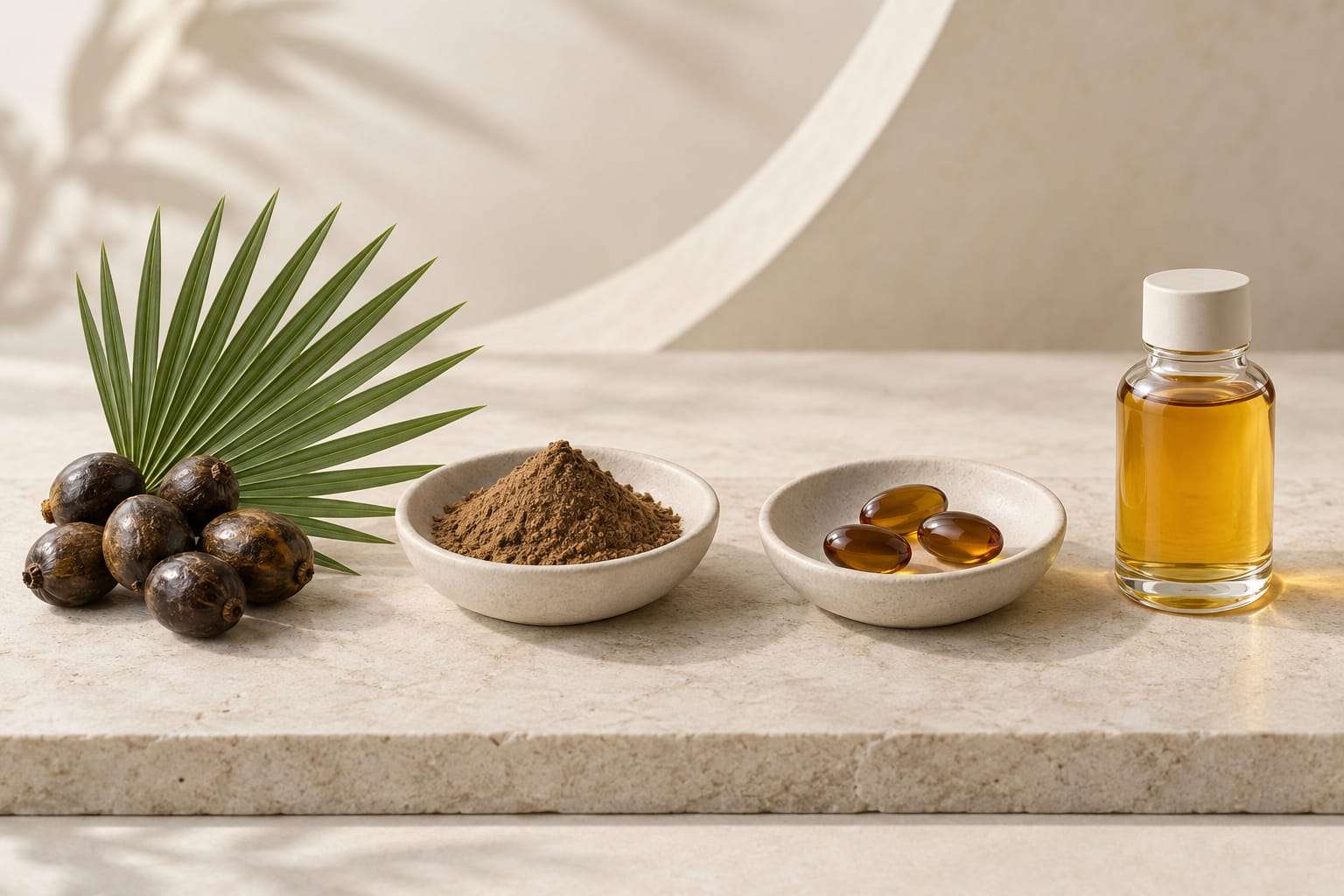
Where it sits in our comparison
Saw palmetto is in the third group of our comparison, labelled limited evidence, alongside rosemary and pumpkin seed oil. It has more published studies than the other two, but they test different preparations, and more publications of that kind do not add up to stronger proof. The two core options, minoxidil and finasteride, have much larger trials behind them. [3, 2, 4]
How saw palmetto rates
Position 4 of 6 in our ranking. Same tier as rosemary and pumpkin seed oil: the order among them is editorial. The same eight criteria for every ingredient.
- EffectivenessDepends
- Limited signal for specific preparationsTwo named extracts did better than placebo on hair counts or hair density in small trials. Against finasteride, fewer men improved on saw palmetto.
- Evidence strengthTrade-off
- Limited supportSmall trials of different preparations, several with company funding or company employees among the authors. The two reports on the 180-day trial describe the same 60 people.
- Risks and tolerabilityDepends
- Little hair-specific safety dataFew side effects were recorded in the hair trials, which are too small to rule out rare ones. No study we reviewed measured fertility, and the safety of taking it with finasteride or dutasteride has not been established.
- TimeDepends
- Study time points onlyStudies measured at 16 weeks, 180 days and 24 months. Those are the moments researchers looked, not when a result is due.
- CostDepends
- No comparable price yetWe found no US or UK price for a product shown to match a studied extract, so we do not quote one.
- RoutineStrength
- Daily capsule; amount depends on the extractOne capsule a day in the two extract trials. The real work is checking that a product is the extract that was studied.
- MaintenanceDepends
- Not established after stoppingNo study measured what happens after stopping, or whether the result holds over years.
- AccessTrade-off
- Studied extract not matched to shop productsSaw palmetto is easy to buy. A product documented as the same extract as in the trials is not something we could confirm in the US or UK.
An order of consideration for adult male pattern hair loss, not a score. Strength, Depends and Trade-off describe each line on its own; they do not add up to a number.
The same eight criteria are used for every ingredient in the comparison. How we apply them is on the methodology page.
Extract, lotion or blend
Named extract, by mouth
An oily extract with a stated content of fatty acids, in a capsule. This is what the placebo-controlled trials used.
- Evidence
- Two small trials against placebo, lasting 16 weeks and 180 days.
- Amount in the trials
- 100 mg or 160 mg of extract once a day, depending on the product.
- Keep in mind
- The result belongs to that extract, not to the ingredient name.
Lotion for the scalp
Applied to the scalp and, in one trial, rinsed off after half an hour. Studied less well than the capsules.
- Evidence
- One group of a small trial whose numbers do not agree, and one study with no comparison group.
- Amount in the trials
- A 20% lotion, about 5 mL a day.
- Keep in mind
- We do not draw a conclusion on hair density from these.
Blend in one capsule
Saw palmetto mixed with other active ingredients. Formulas like this exist, and some have their own studies.
- Evidence
- A 2002 trial of a mix with beta-sitosterol: 6 of 10 men were rated as improved.
- Amount in the trials
- The amounts we have come from a later review, not from the trial report.
- Keep in mind
- A blend's result cannot be credited to saw palmetto alone.
Advantages
Is it a "natural finasteride"? Nothing we reviewed supports that. The one study that put them side by side found improvement in fewer men on saw palmetto, and it was not designed to show the two are equivalent. The label "natural" also says little about safety: the oral extract in one trial changed a hormone level in the blood, so it is not free of hormonal effects. [4, 2]
How to read a saw palmetto label
- Extract or powder. Ground berries and an oily extract are different products. The placebo-controlled trials used extracts.
- Milligrams of what. In one trial a 400 mg capsule held 100 mg of extract. The weight of the capsule is not the amount of extract.
- What the extract contains. The studied extracts state their fatty-acid content: at least 85% in one, and a named fatty-acid fraction of 105 mg per capsule in the other. A percentage on another label does not make that product equivalent.
- Single ingredient or blend. If saw palmetto is one of several actives, the evidence that applies is the evidence for that whole formula.
What the trials measured
Named extracts against placebo
Two trials tested a specific extract against a placebo capsule.
The first enrolled 60 adults who felt their hair was thinning, 30 of them men. Forty took one softgel a day containing 160 mg of an extract, which supplied 105 mg of a proprietary fatty-acid fraction, and 20 took a placebo, for 180 days. Thicker "terminal" hairs were counted in two small areas of the scalp, one at the front and one at the back, and the two counts were added together. [3, 5]
Change in thicker hairs after 180 days, two areas added together
Saw palmetto extract40 people
+18.6hairs
Placebo20 people
−10.1hairs
Terminal hairs counted in two 1 cm² areas and summed. This is not a figure per square centimetre and not a figure for men only. When the front area was looked at on its own, the difference was not shown. The trial was sponsored by a supplement company, as declared in the 90-day report, and it was registered after it had started. [3, 5, 6]
Two papers describe this trial, one at 90 days and one at 180. They report the same 60 people. They are one study, not two.
The second trial had four groups and 80 people in all, men and women, and ran for 16 weeks. In the two groups that took capsules, 20 people were assigned to 100 mg of extract a day and 20 to placebo, and 18 and 19 were analysed. [2]
Change in hair density after 16 weeks
Saw palmetto extract, 100 mg18 people analysed
+5.2%% from the start
Placebo19 people analysed
−3.2%% from the start
Percentage change in hair density from each group's own starting point. Men and women were analysed together. Four of the authors are employees of a commercial company. [2]
Both trials point the same way: the extract group gained a little while the placebo group lost a little. Both are small and short, and each tested its own product.
Against finasteride
One study compared saw palmetto with a medicine. It followed 100 men with mild to moderate hair loss for two years. One group took saw palmetto 320 mg a day and the other finasteride 1 mg a day, and everyone knew which one they were taking. [4]
Men rated as improved on photographs after 24 months
Finasteride 1 mgPrescription medicine
68%% of men
Saw palmetto 320 mgExtract details not available to us
38%% of men
Share of men judged to have improved, not the amount of hair gained. There was no placebo group, the men were not blinded, and we could read only the published summary. [4]
This is the only direct comparison, and it is less favourable to saw palmetto. It does not measure the gap precisely, and it cannot say much about differences in side effects.
On the scalp
The four-group trial also tested a 20% saw palmetto lotion, about 5 mL a day, rinsed off after 30 minutes. It reported less hair coming out on a combing test. For hair density, the paper's own numbers of participants and its statistics do not agree between tables, so we do not report a result. [2]
An earlier study gave scalp products containing saw palmetto to 50 men for 24 weeks and found higher hair counts than at the start. It had no comparison group, so the change cannot be separated from the natural course of things or from the way the hair was measured. The products were supplied by their maker, which also provided compensation. [7]
In a blend
The oldest trial, from 2002, tested saw palmetto together with beta-sitosterol, another plant compound. Its summary reports that 6 of the 10 men who took the mix were rated as improved. A later review adds that 26 men were enrolled and that 11% improved on placebo, details we could not confirm in the trial report itself. Whatever the mix did, the trial cannot say how much of it was saw palmetto. [8, 9] More trials of multi-ingredient products are on the page about vitamins, under hair formulas.
That review, published in 2020, gathered nine articles and 381 patients. It is useful as a map, but it puts extracts, blends, lotions and different diagnoses side by side, and it does not produce one overall effect that could be applied to a product. [9]
What the evidence does not show
- That any saw palmetto product works. The trials tested named extracts.
- That it matches finasteride. The one comparison found improvement in fewer men.
- That more milligrams work better. The amounts come from different preparations.
- That adding it to a medicine helps. No trial we reviewed tested saw palmetto on its own on top of minoxidil or finasteride.
- What happens after stopping, or over years. No study measured it.
How it was used in the trials
Saw palmetto has no hair-loss label to refer to. What exists is the way each trial used its own preparation. [3, 2, 4]
Three trials, side by side
What each study gave, to whom and for how long.
| In the trial | 2026Fatty-acid extractSoftgel | 2023Standardised oilCapsule | 2012Extract, details not availableBy mouth |
|---|---|---|---|
| People | 60 adults, half of them men | About 20 per group, men and women | 100 men |
| Amount | 160 mg of extract, with 105 mg of fatty acids | 100 mg of extract in a 400 mg capsule | 320 mg |
| How often | Once a day | Once a day | Each day |
| For | 180 days | 16 weeks | 24 months |
| Against | Placebo | Placebo | Finasteride 1 mg |
Each column is one study's own preparation. These describe what was tested. They are not doses to follow, and they do not carry over to another product.
Details that matter more than they look
- Study amounts are not instructions. They tell you what a trial gave, to people chosen for that trial.
- Splitting the amount is not shown to help. A common suggestion online is 160 mg in the morning and 160 mg in the evening. No hair study we found shows that this works better than once a day.
- Tell your pharmacist or doctor what else you take. This matters most with medicines that affect bleeding, and before surgery.
- Not in pregnancy or while breastfeeding. The US National Institutes of Health centre for complementary health warns that it may be unsafe.
How long it takes
The trials measured at 16 weeks, at 90 and 180 days, and at 24 months. Those are the moments the researchers chose to look. With preparations and measurements this different, they cannot be ordered to say which acts fastest, and none of them is a promise of when a change shows. [3, 2, 4]
Side effects and safety
Three levels of information are involved here, and they are worth keeping apart: what was recorded in the small hair trials, what a larger trial for another purpose found, and what official sources warn about without being able to put a number on it.
In the hair trials
In the 180-day trial, no side effect was attributed to the extract. Participants were checked clinically, without blood tests. Groups of 40 and 20 people are far too small to rule out uncommon problems, so "none recorded" is not the same as "none possible". [3]
In the 16-week trial, the capsules changed the level of DHT in the blood. That is a sign the extract does something to hormones, and a reason not to assume that a plant product is hormonally neutral. [2]
In a larger trial, for a different purpose
The largest safety study we reviewed had nothing to do with hair. It gave a saw palmetto extract or a placebo to 369 men aged 45 and over with urinary symptoms, raising the amount from 320 mg to 640 mg and then 960 mg a day over 18 months. Among the 357 men in the safety analysis, there was no significant difference between the groups in side effects, serious or not, or in questionnaires about erections and ejaculation. It was publicly funded, with the extract donated by its maker. [10]
That is reassuring about common side effects, in those men, with that extract. It is not a test of fertility, and it is not a test of the extracts sold for hair. The amounts used there are not hair doses.
What official sources say
- Common complaints. The US National Institutes of Health centre for complementary health lists digestive symptoms, dizziness and headache, generally mild and infrequent.
- Pregnancy and breastfeeding. The same centre warns that saw palmetto may be unsafe.
- Bleeding. A cancer centre's reference on herbs reports possible added effects with blood thinners and antiplatelet medicines, mostly from individual case reports. That is a reason to check, not a measured risk.
- Other medicines. The same reference notes laboratory findings on the enzymes that process some medicines, with an unknown effect in people.
What is not known
- Fertility. No study we reviewed measured sperm or fertility with saw palmetto.
- Use with finasteride or dutasteride. Safety of the combination has not been established.
- Long-term use of a hair extract. The longest hair study ran for two years, without a placebo group.
If you stop
No study measured what happens to the hair after stopping saw palmetto, or whether it has to be taken continuously to keep a result. We do not know, and neither does anyone selling it.
Combining saw palmetto with other options
Saw palmetto is something to compare with the other options, not something to add to them by default. [4, 8, 12, 13, 14]
Saw palmetto + finasteride or dutasteride
Not establishedSaw palmetto is thought to act on the same pathway as these medicines. It has been compared with finasteride, not added to it, and the safety of taking them together has not been established.
Full finasteride profileSaw palmetto + minoxidil
Not establishedNo trial we reviewed tested saw palmetto on its own added to minoxidil. Formulas that contain it have been studied on top of medicines, but their results belong to the whole formula.
Full minoxidil profileSaw palmetto + pumpkin seed oil and rosemary
Not establishedEach was studied on its own, as a specific preparation. Nothing we reviewed tests the three together, and their separate results cannot be added up.
Full pumpkin seed oil profileSaw palmetto + other actives in the same capsule
Belongs to the blendA mix with beta-sitosterol was tested in 2002. A result for a blend is evidence for that blend. It does not show what saw palmetto contributes.
For the bigger picture of what goes with what, see which options can be combined and which are alternatives.
What it costs
We did not record a price for saw palmetto. Our price check only counts a product when it can be matched to the preparation that was studied, and for saw palmetto we found no US or UK product with that match. A missing figure is not a low one.
If you compare products yourself, compare the price of the amount of extract, not the price per capsule or per bottle, and check what the extract is. A cheaper product that is ground berry powder is a different thing from the extracts in the trials.
Not for pregnancy or breastfeeding
Saw palmetto may be unsafe in pregnancy and while breastfeeding. The trials were done in adults, so it has not been studied in under-18s. Two of them included women, but they do not give results for women that we can use, and this page and our hair guide are written for adult men. [1, 3, 2]
Keeping track
The saw palmetto versus finasteride comparison focuses on the direct study, the different extracts and the practical tradeoffs.
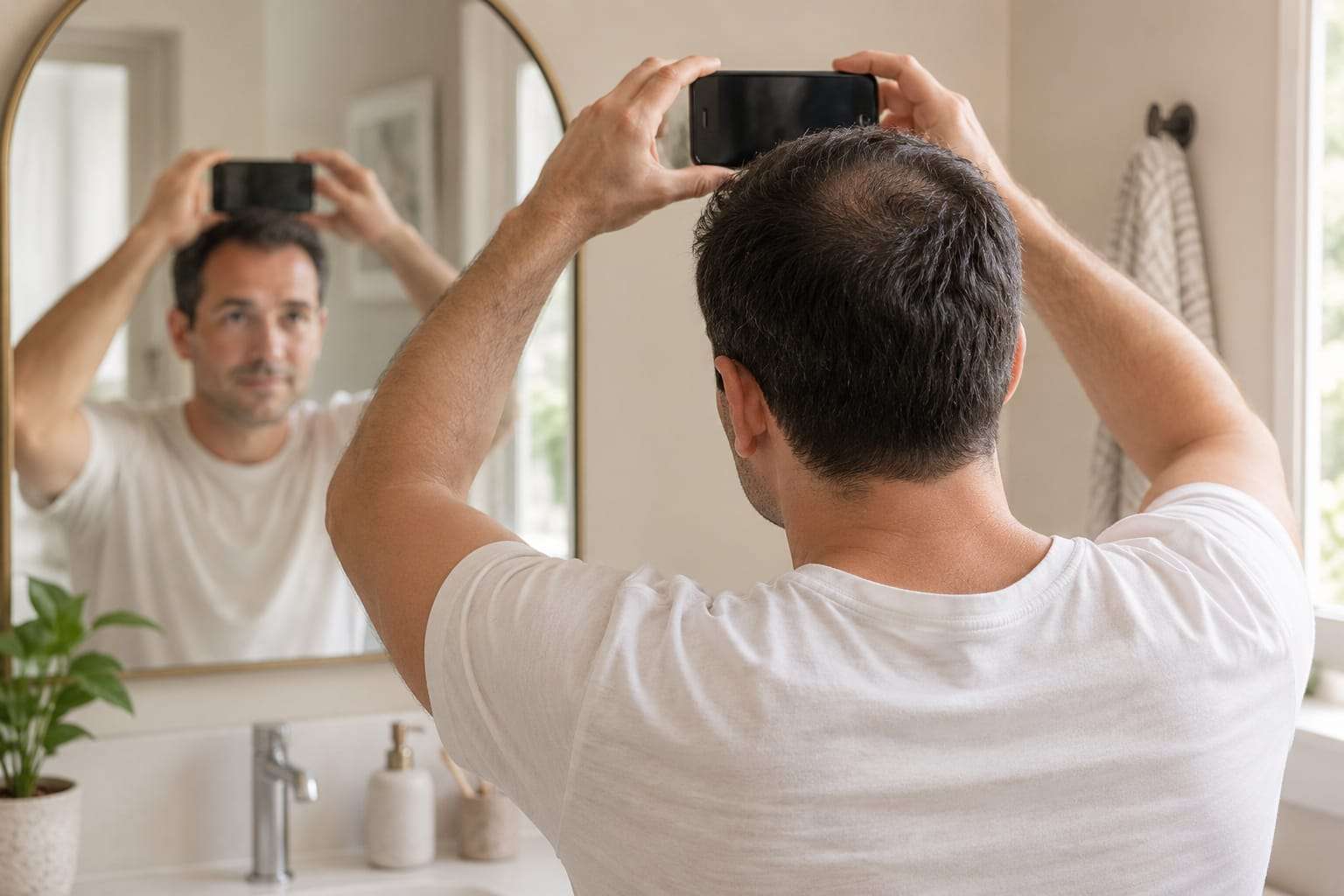
With an option whose effect, if there is one, is small, your own records matter more than usual. Three habits help. They are organising suggestions of ours, not something tested in a trial:
- Photos. The same areas once a month, in the same light, at the same hair length and from the same angle.
- A record. The exact product, what the label says it contains, the date you started and any days you missed.
- Anything you notice. Digestive symptoms, headaches or anything else new, with the date.
Decide in advance when you will look back at the photos. The placebo-controlled trials looked at 16 weeks and at 180 days. If nothing has changed by then, that is useful information, and a reason to reconsider the options with stronger evidence.