
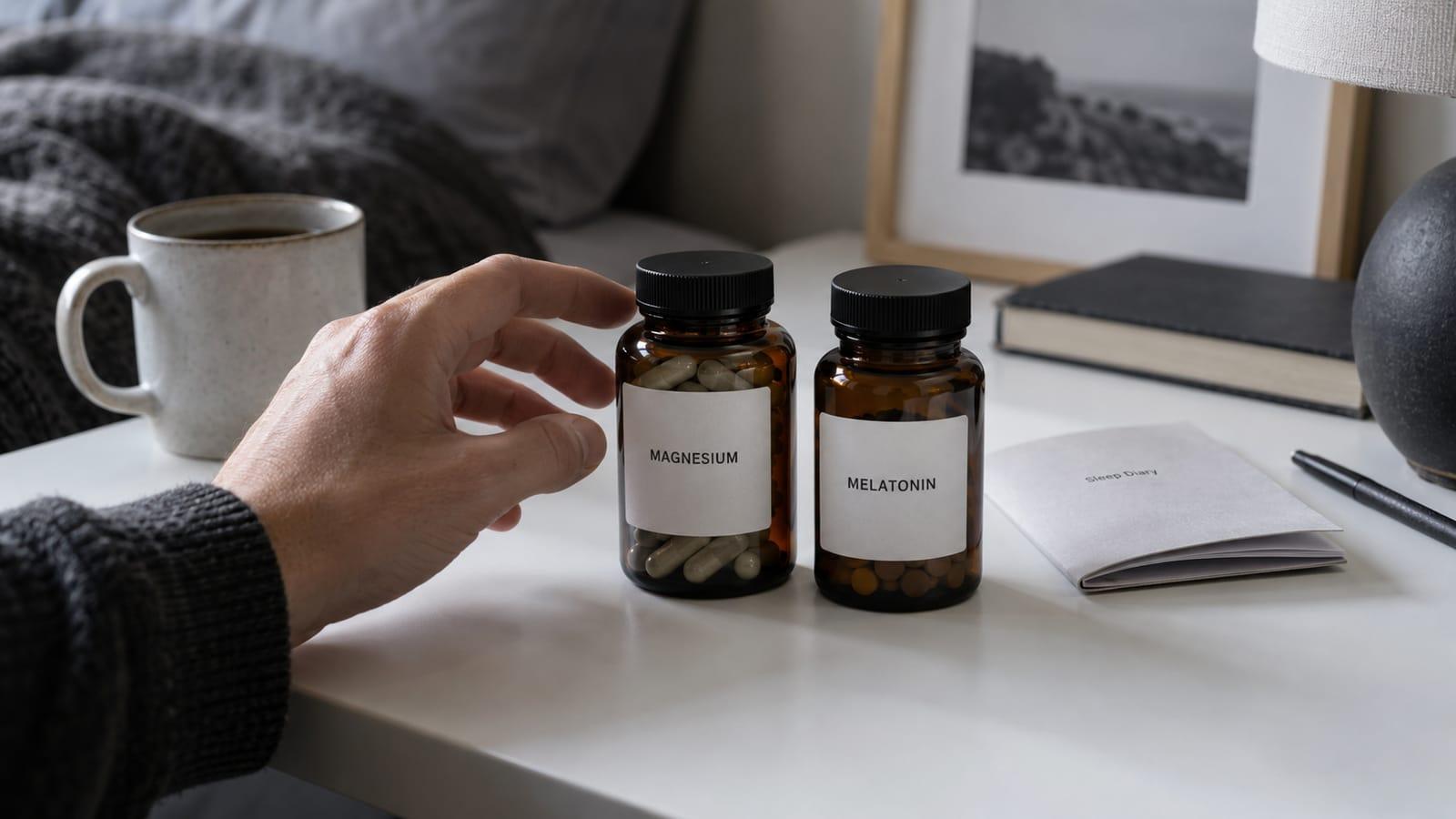
Magnesium and melatonin do different jobs
Melatonin is a hormone involved in the body’s daily sleep timing. Magnesium is an essential mineral supplied by food and, where needed, supplements. They are sold next to each other as sleep aids, but that does not make them interchangeable treatments. [1, 2]
This guide is for adults weighing these ingredients for sleep. It compares their purposes, observed benefits, product labels and risks, and answers the related question of taking them together. It does not select a personal dose or transfer adult findings to children, pregnancy or breastfeeding.
Melatonin
Magnesium
Persistent insomnia means difficulty sleeping despite having the opportunity, with consequences during the day. It needs a different discussion from wanting to sleep earlier after travel or from assessing nutrition. The main sleep guide helps identify the relevant starting point. [3, 4]
Which is the more relevant option for your sleep problem?
Melatonin has evidence for specific timing-related uses; magnesium’s sleep evidence is limited and inconsistent. For chronic insomnia, neither is established as the universal first choice. Cognitive behavioural therapy for insomnia, or CBT-I, is the first-line treatment in European and VA/DoD guidance. [5, 6, 7, 3, 4]
| The question | What melatonin evidence offers | What magnesium evidence offers | Useful next step |
|---|---|---|---|
| “Travel has shifted my sleep schedule.” | Timed use has helped jet-lag symptoms in older trials. | The magnesium trials discussed here do not establish treatment for jet lag. | Use the jet-lag guide to understand preparation and a journey-specific plan. [5, 8, 9, 10] |
| “I struggle to sleep at the required time but my schedule is consistently late.” | A selected delayed-timing trial supports melatonin with scheduling. | It is not a substitute for that timing assessment. | Explain the pattern to a clinician or sleep service; a late bedtime alone does not reproduce the trial’s selection criteria. [6] |
| “I have persistent insomnia.” | Guidelines disagree, including over prolonged-release use in older adults. | Findings do not support routine insomnia treatment. | Read how CBT-I differs from sleep tips. [3, 4, 11, 7] |
| “I worry I am not getting enough magnesium.” | Melatonin does not address mineral intake. | Magnesium adequacy has a nutritional purpose, separate from an insomnia promise. | Review diet, health conditions and medicines; poor sleep alone does not diagnose deficiency. [2] |
The table points to different questions, not a diagnostic quiz. If the problem is unclear, repeated product changes may leave its cause unaddressed.
What benefits have the studies actually measured?
A better symptom score, earlier sleep onset and more minutes asleep are different results. Comparing their numbers cannot produce a head-to-head winner.
The most recent bisglycinate example randomised 155 adults reporting poor sleep. After four weeks, reported insomnia-symptom scores fell by 3.9 points with the supplement and 2.3 with placebo, an inactive comparison product. The difference was about 1.6 points and the reported effect size was small. The preparation supplied 250 mg elemental magnesium together with 1,523 mg glycine daily. It was not compared with melatonin. [10]
One magnesium preparation: symptom-score change
Bisglycinate preparationFour-week change
3.9ISI points
PlaceboFour-week change
2.3ISI points
Larger bars mean a larger reduction in the Insomnia Severity Index, a questionnaire about symptoms and their impact. The supplement’s advantage was about 1.6 points, not all 3.9 points. The paper reports p = 0.049 and effect size 0.2; 153 entered baseline analysis and 134 completed. This is not a measure of extra sleep minutes or a comparison with melatonin. [10]
The University of Hannover institute funded the study and Biogena manufactured the capsules. One author disclosed nutraceutical research funding and honoraria. The paper gives conflicting accounts of adverse-event withdrawals; it cannot establish that no one stopped because of symptoms. [10]
Melatonin’s timing evidence asks a different question. In a selected four-week delayed-sleep trial, sleep began 34 minutes earlier than with placebo plus the same scheduling. That clock-time change is not 34 minutes less time trying to fall asleep, and it is not a comparison with magnesium. The trial was funded by NHMRC, with recruitment-advertising support from Philips Respironics and disclosed commercial relationships. [6]
For chronic insomnia, the melatonin profile explains the modest European prolonged-release medicine benefit and why guidelines still disagree. The magnesium profile shows the mixed threonate outcomes alongside the bisglycinate study. Neither establishes a dependable “deep sleep” improvement. [9, 10, 3, 11]
Dose, form and timing: what should you compare?
The milligram numbers describe different substances. A melatonin amount and an elemental magnesium amount cannot be compared as if the larger one were stronger.
What to read on each product
| Label question | Melatonin | Magnesium |
|---|---|---|
| Identity | Immediate or prolonged release; medicine or supplement; any other active ingredients. | The magnesium form and every other active ingredient in the serving. |
| Amount | Melatonin per serving, with the number of tablets or gummies in that serving. | Elemental magnesium per serving, rather than the larger weight of the whole compound. |
| Timing | Attached to the intended use and exact product. Travel and delayed timing do not share one bedtime rule. | Trial schedules differed. The studies do not select one universal best bedtime interval. |
| Local instructions | The European Circadin medicine has a defined older-adult insomnia label. US supplements have a different regulatory context. | Check total supplemental magnesium and medicine-specific interaction instructions. |
A research exposure describes what was tested; a local label describes a particular product. Neither supplies one personal regimen across all sleep problems. [13, 9, 10, 2, 1]
The magnesium label diagram shows why 2,000 mg of a threonate compound supplied only 145 mg elemental magnesium in one trial. Glycinate and bisglycinate name the same compound in the NIH chemical identity record; the name alone does not guarantee the composition of a finished product or a sleep benefit. [9, 14]
The melatonin forms and label section keeps dose, release, age and use together. A gummy is a dosage format, not proof of immediate release or a guarantee of label accuracy. [13, 15]
Can you take magnesium and melatonin together?
The combination has been studied, but the available results do not establish that adding magnesium makes melatonin work better for ordinary adult insomnia. They also do not make every dose, product or long-term combination safe.
A small 2024 crossover trial recruited 35 people with sleep disturbances and tested a melatonin-and-magnesium preparation in a coffee-pod format against placebo in four-week periods. The original abstract reports differences favouring the supplement, while average sleep-quality scores still indicated poor sleep in both conditions. It had no melatonin-only or magnesium-only comparison. Several authors had Bettery affiliations. The abstract does not give numerical outcome details or a clear account of side effects, making the size and tolerability of the benefit difficult to judge. [16]
| Directly relevant study | What it can establish | What remains unanswered |
|---|---|---|
| 2024 two-ingredient preparation versus placebo | Short-term evidence for that specific combination in a small selected sample. | Whether either ingredient alone would have given the same benefit, and long-term safety. [16] |
| 2021 four-arm trial in 84 women with polycystic ovary syndrome, lasting eight weeks | The original report describes sleep-quality improvement with melatonin alone and with the combination. | A general-insomnia recommendation or a demonstrated added sleep benefit from magnesium. Sleep disorders were excluded. Universities funded the trial and authors declared no conflicts. [12] |
| 2011 melatonin, magnesium and zinc blend in 43 older care-home residents | The abstract reports better sleep-quality outcomes than placebo after eight weeks. | The contribution of magnesium, melatonin or zinc separately, or an answer for a two-ingredient product. [17] |
A positive blend trial is useful evidence about the tested blend. It is not proof of ingredient “synergy,” a term implying that the combination adds a benefit beyond the individual ingredients. The broader sleep-supplement comparison includes a different multi-ingredient drink that did not beat placebo. Different blends need their own evidence.
Which safety questions differ?
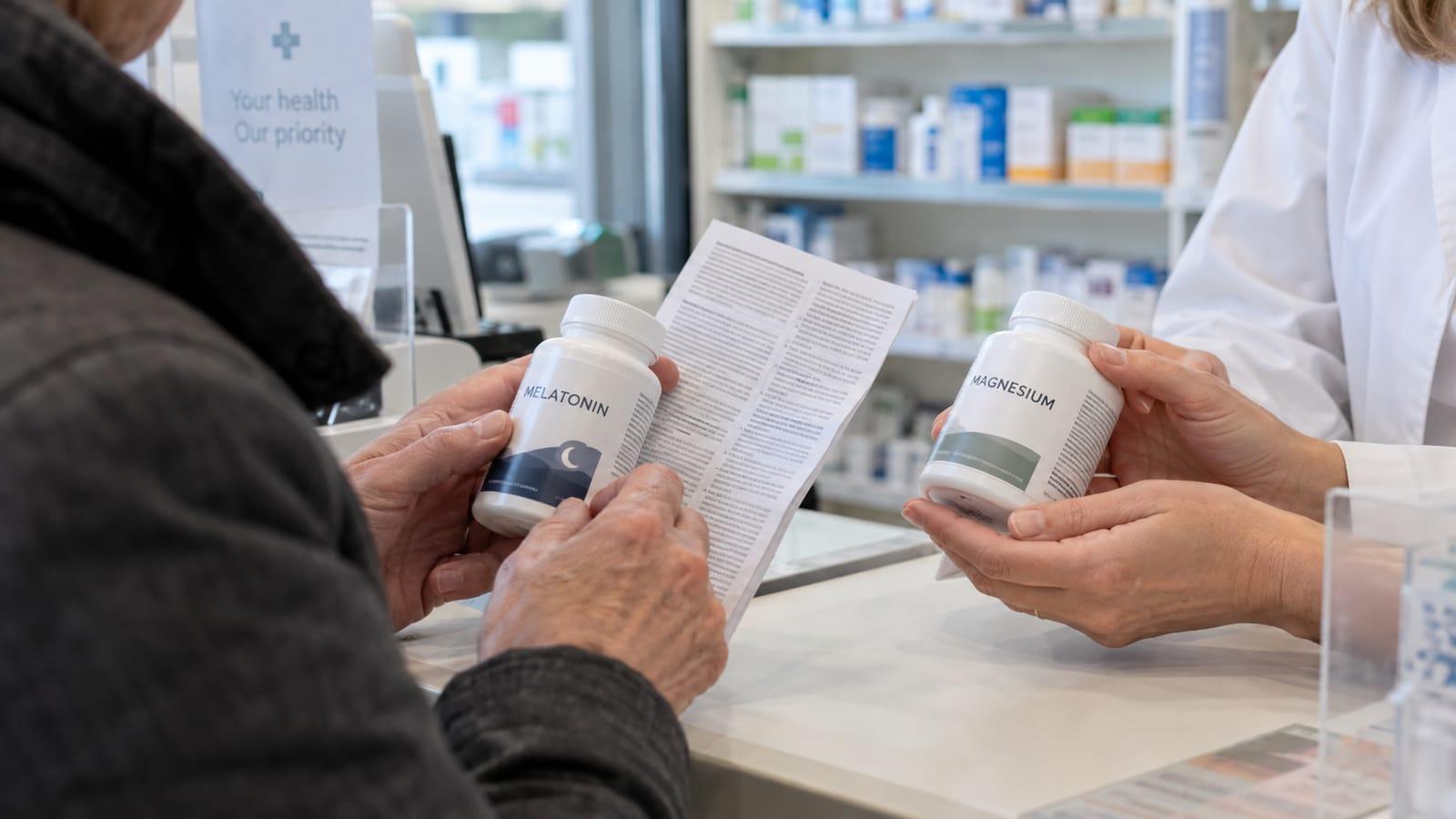
Magnesium’s main practical concerns include gastrointestinal effects, kidney function, total supplemental intake and medicine absorption. Melatonin can cause drowsiness and has its own medicine interactions. Both need a review of the actual product. [2, 1, 13]
The safety review needs different information for each
- Magnesium: total elemental intake from supplements and medicines, kidney function, and any diarrhoea, nausea or cramping.
- Melatonin: the exact release form and indication, next-day drowsiness, and medicines that affect exposure or add sedation.
- Both together: every other active ingredient and the person’s health conditions, rather than only whether the two ingredient names appear compatible.
These are practical distinctions, not proof that one is safer. Magnesium can reduce absorption of certain antibiotics and osteoporosis medicines. Melatonin interactions include sedatives and medicines affecting its exposure; the Circadin label advises against alcohol. Exact separation or avoidance instructions belong to the particular medicine. [2, 13, 1]
How long, how much effort and at what cost?
The trials above are short. Their assessment points do not identify the first useful night or show that improvement lasts after stopping. Continuing indefinitely is a separate question from completing a study period.
- Time
- Use-specificTravel, delayed timing and insomnia have different purposes and study durations.
- Effort
- Check the servingNumber of doses, timing, other ingredients and medicine instructions affect daily use.
- Cost and access
- Local comparisonCompare identified products in one market. This guide has no verified price ranking.
A larger pack or more expensive form does not establish better value. The meaningful comparison includes efficacy, evidence, risks, time, cost, effort, maintenance and access. Where studies or price data cannot settle a criterion, it stays unresolved rather than becoming an invented overall score.
What makes a useful next step?
Start with the problem and the intended improvement. A discussion about nutrition belongs with magnesium intake and forms. A discussion about travel belongs with jet lag. Melatonin’s other uses belong with its full profile. Persistent insomnia needs an assessment and access to structured insomnia treatment.
- 1
Describe the problem
Record whether the difficulty is timing, prolonged wakefulness, daytime effects or nutritional intake.
- 2
Bring the labels
Include serving size, release form or magnesium salt, amounts and other ingredients.
- 3
Describe the result
Explain what improved, what did not, and any unwanted symptoms or next-day sleepiness.
- 4
Review the next step
Use that information to discuss suitability, continued use and whether the sleep problem needs treatment.