
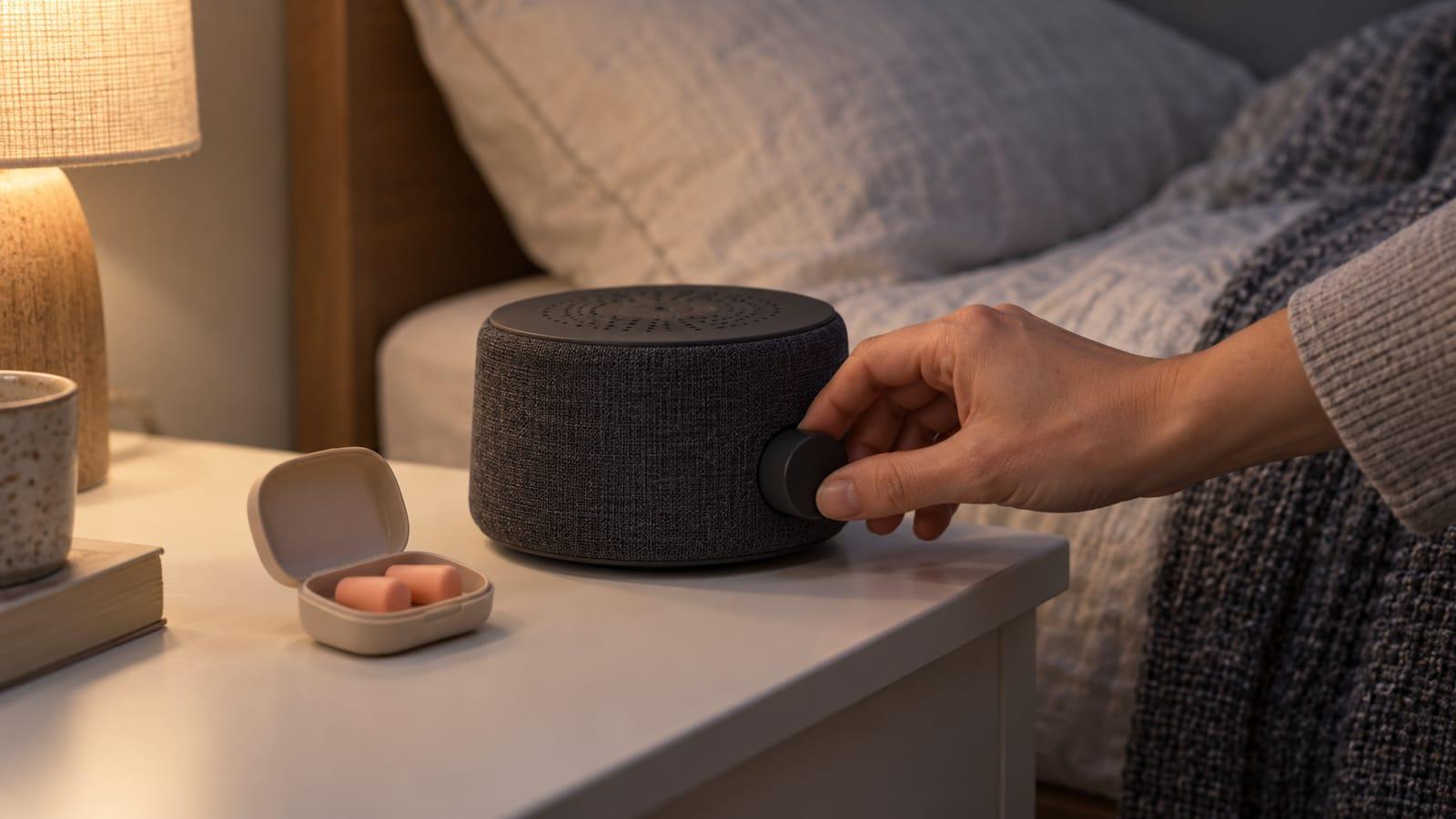
Start with the sound that is disturbing you
If noise is keeping you awake, first reduce what you can control. A television in the next room, an unnecessary notification or a rattling object is a different problem from traffic you cannot stop. Earplugs reduce sound reaching the ears. A sound machine adds a steady background intended to make other sounds less noticeable, called sound masking. These approaches change the sound environment in different ways. [1, 2]
This guide is for adults deciding between ordinary bedroom adjustments, earplugs and continuous background sound. It covers what white, pink and brown noise mean, what sleep studies have measured and how to keep comfort, hearing and important alerts in view. For a wider pattern of sleep difficulty, start with what helps you sleep better.
Reduce sound or add sound?
| Reduce the source | Use earplugs | Add steady sound | |
|---|---|---|---|
| What changes | Less of the unwanted sound is produced or enters the room | Less sound enters your ears | A new background sound is added |
| Useful first question | Can this source be turned down, moved or stopped? | Can I wear them comfortably and keep important alerts effective? | Does this actually make the disturbance easier to tolerate? |
| Main trade-off | Some outside sources are beyond your control | Fit, comfort and hearing needed sounds | The added sound may itself disturb sleep |
This is a choice guide, not a ranking of proven sleep treatments. Hearing protection and continuous-noise research address different questions. [1, 2, 3]
There is no need to add sound to an already quiet room just because a playlist is labelled for sleep. If the room feels noisy or uncomfortable in several ways, the guides to light and screens and temperature and bedding help identify the separate changes.
What white, pink and brown noise mean
The colours describe how sound energy is spread across frequencies, meaning lower and higher pitches. They are technical descriptions, not evidence grades or guarantees of relaxation. [4]
| Sound | What the name describes | What that means for the choice |
|---|---|---|
| White noise | Equal energy per equal-width frequency interval | Includes relatively more higher-frequency energy than pink or brown noise |
| Pink noise | Energy decreases as frequency rises; equal energy in each octave, a doubling of frequency | Gives lower frequencies more emphasis than white noise |
| Brown noise | Energy falls more steeply with frequency than pink noise | Gives lower frequencies still more emphasis |
These are definitions of ideal noise signals. Your preference for one sound does not show that it improves sleep or that the same setting suits another person. [4]
The important choices are therefore not only colour. They include whether you need masking at all, how much sound reaches your ears, whether it stays comfortable and whether important alerts remain effective. The sleep evidence below does not establish a winning colour or volume for every bedroom. [2, 3, 5, 6]
Which change fits your bedroom?
Choose the smallest change that addresses the disturbance you actually have. The table gives ordinary examples, rather than a tested treatment protocol.
| Situation | Practical first change | If the problem remains |
|---|---|---|
| Household television, music or notifications | Agree a quieter time, lower the source volume and silence nonessential alerts | Change where the sound is produced or where you sleep if feasible |
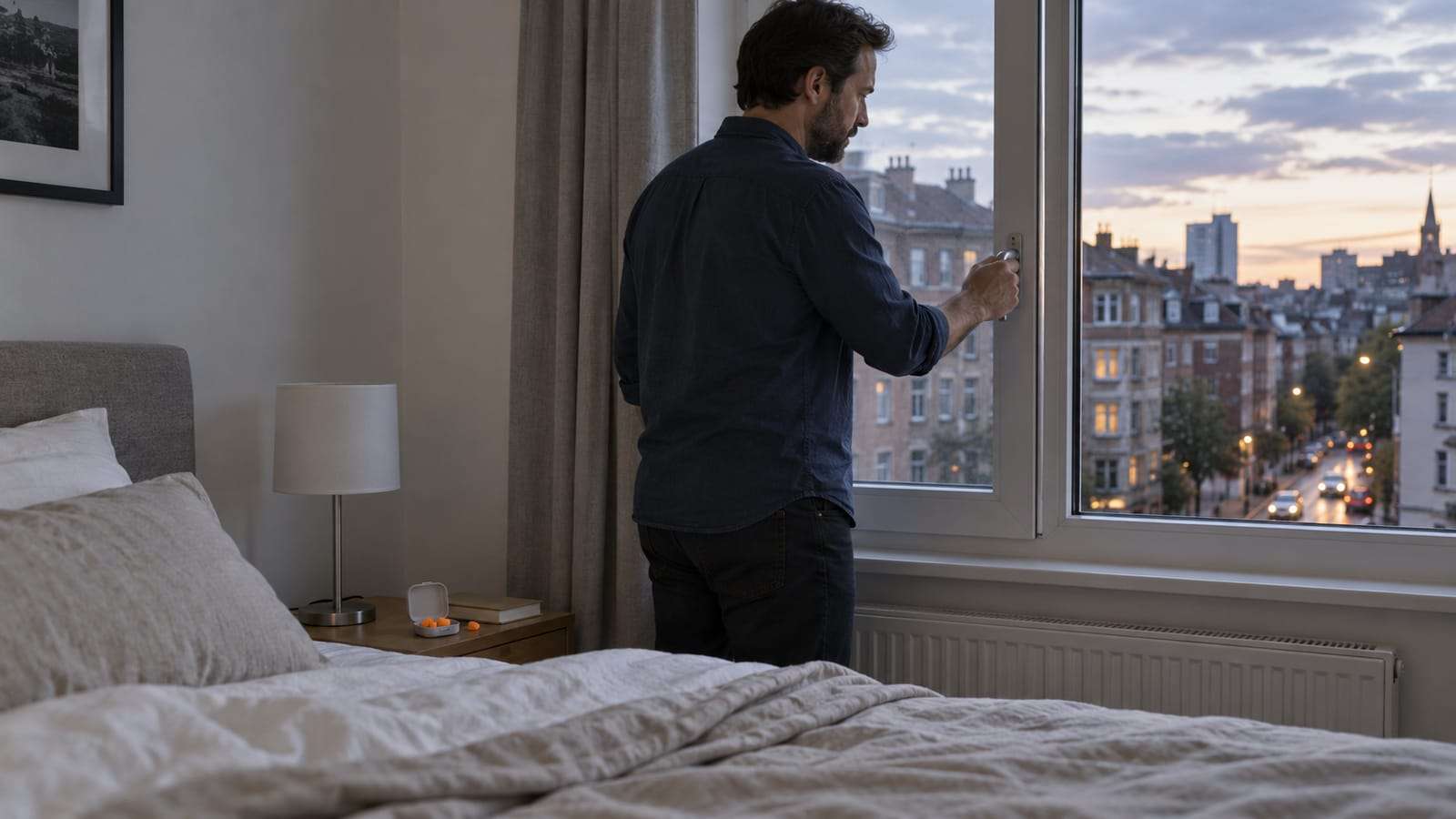
| Traffic becomes louder through an open window | Try closing it when temperature, ventilation and safety allow | Weigh comfortable earplugs or a cautious sound trial against the remaining disturbance |
| Sudden outside noises remain unavoidable | Try comfortable, correctly fitted earplugs if alert needs allow | Review fit and the source; do not force uncomfortable plugs |
| A quiet room feels easier to settle in with familiar sound | Keep it low and comfortable, and check whether sleep is actually better | Lower it or stop if it distracts, irritates or seems to worsen sleep |
| You must hear a dependent person or a critical alert | Resolve the alert arrangement before reducing or masking sound | Ask the relevant care or fire-safety service about a suitable alert system |
Source reduction, hearing protection and alarm awareness draw on the official guidance. The bedroom examples are practical applications; none supplies an individual sleep-effect estimate. [5, 1, 6]
Does continuous sound improve sleep?
Some people in noisy settings may benefit, but the studies do not support a routine recommendation for everyone. A 2021 review of 38 varied human studies found inconsistent results, including sleep improvement and disruption. The authors rated the evidence very low in quality. Its focus was continuous noise, not precisely timed experimental sound pulses. The abstract leaves the search end date and study-level details unclear. It declares no conflicts but does not identify funding. [2]
One small home study illustrates where masking might be useful. Ten adults reporting noisy New York City bedrooms had one-week baseline, white-noise and washout phases. Diary-estimated time to fall asleep and movement-estimated wakefulness after falling asleep improved. It was not a randomised comparison, and the abstract did not provide the absolute minute differences or funding and conflict details. It supports a possible benefit in that specific setting, not a promised nightly gain. [7]
What the home study can tell us
- Setting
- Noisy homesSelected adults who already reported noise-related sleep difficulty.
- Exposure
- One weekThe sound phase was short; it does not settle years of use.
- Measurement
- Diary and movementNot a laboratory recording of sleep stages.
Ten participants in a within-person baseline/device/washout study. This is not independent proof added to every review result. [7]
The home study and the next laboratory study ask different questions. A device in a noisy home cannot establish that adding sound helps a quiet bedroom; a short controlled laboratory exposure cannot establish every long-term home effect.
What did the newer pink-noise study find?
Pink noise was not consistently protective, while earplugs reduced most effects of the intermittent environmental noise tested. The 2026 study included 25 healthy adults over seven laboratory nights, including adaptation and six randomised, counterbalanced conditions. Researchers used polysomnography, a laboratory recording that includes brain activity to classify sleep stages. [3]
Pink noise alone at 50 dBA reduced REM sleep by 18.6 minutes compared with the quiet condition. REM is a recurring sleep stage with active brain patterns, often associated with vivid dreams. No other sleep-structure measure differed significantly in that particular comparison. Combined pink and environmental noise also worsened aspects of sleep architecture, meaning the pattern of sleep stages. [3, 8]
One tested condition reduced REM sleep
Pink noise alone versus quietDifference in REM duration, not total sleep time
18.6 fewerminutes
Mean reduction at the study's 50 dBA setting in 25 healthy adults; standard error 4.7 minutes, p=.0003. These are study conditions, not a home volume recommendation. The finding does not quantify chronic harm or set a target for REM sleep. [3]
The average participant was 28.5 years old. The experiment was small and short, and morning cognitive and hearing measures did not clearly differ. It was supported by the US Federal Aviation Administration; a sleep-measurement patent interest was disclosed. A related report from the same trial is not a separate replication. [3]
Do earplugs help, and how should they fit?
Earplugs can reduce unwanted sound, and they mitigated most noise effects in the laboratory study above. That does not establish the same sleep benefit for every home. Reviews of masks and earplugs in intensive-care units concern ill patients, procedures and hospital noise; their mixed findings cannot be treated as a healthy-bedroom guarantee. [3, 9]
Comfortable fit matters. Official NIDCD guidance says earplugs should feel secure and should not be painful. Follow the instructions for your type, including insertion, removal, cleaning or replacement; foam and pre-moulded products differ. Clean your hands and the plugs before insertion. Do not force a poor fit or cut foam to make it fit. A hearing professional can help if you cannot find a comfortable option. [1]
An eye mask addresses light rather than sound. A home study found small benefits in some next-day learning and alertness tasks, without demonstrating improved reported sleep duration/quality or overall stage duration. If unwanted light is the problem, use the light guide to choose an adjustment; a mask does not need to be bundled with earplugs. [11]
Keep hearing and important alerts in view
If you try background sound, begin low, keep it comfortable and avoid placing a loud source close to your ears. Lower it or stop if it is disturbing. Hearing risk depends on intensity, distance and exposure time; a colour name says nothing about those. Official hearing-risk thresholds are not sleep settings, and a device's volume percentage is not a measurement at your pillow. [5]
Before relying on earplugs or masking sound overnight, check the alert arrangement you need. That includes smoke alarms and any person or monitor you are responsible for hearing. Check audibility from the bed with the actual setup while awake, but remember that an awake check cannot prove an alarm will wake you.
This guide does not establish a sound level, earplug rating or combination that guarantees alarm detection during sleep. Resolve that practical need before treating stronger blocking or louder masking as an upgrade.
How to decide whether to keep the change
Keep a brief record of the disturbance, the change, settling and awakenings, and how you feel the next day. A useful improvement is easier sleep or less disruption, rather than simply a different sound or a higher tracker score.
- 1
Name the disturbance
Write down the source and when it bothers you. Check whether you can reduce it directly.
- 2
Try one manageable change
Reduce the source, try comfortable plugs with alerts resolved, or use low comfortable sound if you want to test masking.
- 3
Keep, adjust or stop
Check sleep, comfort and daytime function. Stop a change that creates a new disturbance; one good night cannot prove a lasting effect.
If a quieter, comfortable bedroom still leaves you persistently struggling to sleep, the next step is the broader sleep assessment and, where appropriate, structured CBT-I treatment. Continuous sound and earplugs cannot answer every cause of insomnia.
Choose your next sleep questionExplore sleep habits, light, temperature, treatment and supplement evidence.