

Can biotin, iron, zinc or vitamin D help with hair loss? The answer depends on which of two questions is being asked. This page separates the two, goes through what was studied for each nutrient, and then says where that leaves a man whose hair is thinning at the hairline or the crown.
Deficiency or regrowth: two different questions
A vitamin or mineral can matter for hair in two ways. The first is a documented deficiency: a clinician has found that the body is short of a nutrient, and correcting it has its own medical reasons. The second is taking a supplement in the hope of more hair when no deficiency has been found. Studies of the first do not answer the second. [1, 2, 3, 4, 5]
Two questions that are often sold as one
How the sources we reviewed treat each of them.
| Question | Correcting a documented deficiency | Taking a supplement for regrowthWith no deficiency found |
|---|---|---|
| The aim | Bring a nutrient back to an adequate level. | More hair, or less shedding. |
| What the sources support | Correction is clinically justified. How much the hair responds is a separate matter and is not established in the sources we reviewed. | No reliable benefit established for male pattern hair loss. |
| Who was studied | Small groups and case reports of people with a confirmed deficiency. | Healthy men, women with several kinds of hair loss, and mixed groups taking multi-ingredient formulas. |
| What settles it | A clinical assessment. A questionnaire or a list of symptoms cannot establish a deficiency. | Trials against placebo in people with the same kind of hair loss. |
| Amounts | Set in a treatment plan, with its own length. | No hair dose is established for any of the four. |
A summary of how our research separates the two questions. It does not describe any one person. [1, 2, 3, 4]
A systematic review published in JAMA Dermatology in 2022 gathered the trials of nutritional supplements for hair loss in people with no known deficiency, with a search that ran to October 2021. We read its summary and use it as a map of what has been tested, not as proof for any one ingredient. Our own review of this area was targeted, not exhaustive, and several of the studies below could be read only as published summaries. Where that is the case, we say so. [6]
This also matters for the kind of hair loss. Much of the research below is about diffuse shedding, not about the gradual thinning of male pattern hair loss. If you are not sure which one you have, the page on types of hair loss comes before this one.
The four nutrients at a glance
We found no trial in men with pattern hair loss that shows regrowth with any of the four. What each one does have is summarised here, with the detail in the sections that follow.
Biotin
- Studied in
- 10 healthy men for 14 days. 46 women for 4 weeks, in a 1966 trial.
- What was found
- No change in growth speed in the men. No significant difference from placebo in the women.
- Caution
- Can interfere with some laboratory tests.
Iron
- Studied in
- Women. A pooled analysis of 36 studies, and 200 women with shedding who took iron.
- What was found
- Lower ferritin went with hair loss. That is an association, not a regrowth result.
- Caution
- Nausea, constipation, iron overload and interactions with medicines.
Zinc
- Studied in
- Five people with shedding and a zinc deficiency. 73 women over 4 months.
- What was found
- The five improved, with no comparison group. In the women, zinc was not shown to beat 2% minoxidil.
- Caution
- Too much can upset the stomach and lower copper.
Vitamin D
- Studied in
- Women with shedding and low vitamin D. 45 women with pattern hair loss.
- What was found
- Improvement after treatment, with no untreated group. Vitamin D alone: no significant improvement in pattern hair loss.
- Caution
- Too much can raise calcium in the blood.
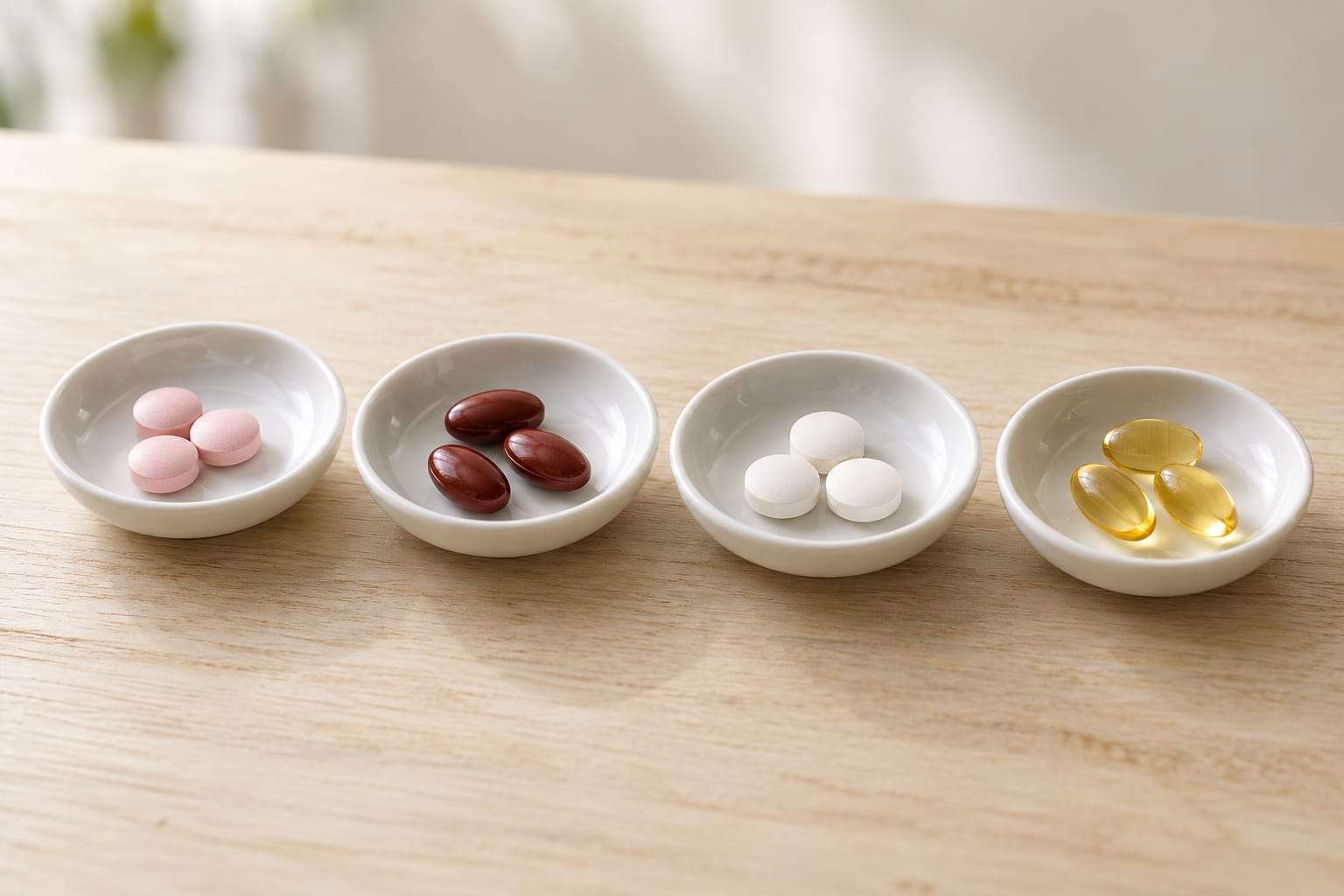
In the ingredient library all four carry the same label, "Not for your context". It means there is no basis to add them by default, and that they may become relevant with a documented deficiency. It does not mean they have been shown to do nothing.
Does biotin help with hair loss
For a closer look at this ingredient, read biotin for hair growth, including the studies in people without a known deficiency and the laboratory-test issue.
Where biotin clearly matters
Hair loss linked to a diagnosed biotin deficiency has been described as improving once the deficiency was corrected. The NIH fact sheet describes that deficiency as rare, and the evidence for biotin supplements in hair and nails as limited. Those cases say nothing about people whose biotin is adequate. [1, 7]
The trials in people with no known deficiency
The oldest trial dates from 1966. Forty-six women with diffuse hair loss took 10 mg of biotin a day or a placebo for four weeks, and no significant difference between the groups was reported. We know this trial only through a 2024 review, not from the original paper, and four weeks is short. [7]
In 2024 a small study gave 10 healthy men 5 mg of biotin a day for 14 days. The men did not have hair loss. The researchers measured how fast hair grew on a patch of one square centimetre at the back of the head, and the speed did not change. No funding or conflict of interest was declared. [8]
Hair growth speed in 10 healthy men, before and after biotin
Before biotinStart of the 14-day period
2.50mm per week
After biotin5 mg a day for 14 days
2.47mm per week
How fast existing hair lengthened, not how many hairs there were. The difference was not statistically significant. The men were healthy volunteers, so this is not a result in pattern hair loss, and 5 mg is the amount the study used, not a suggested dose. [8]
The same study had a period with 5% minoxidil on the scalp and a period with both together. Growth speed rose in the combined period, from 2.36 to 2.64 mm a week, and that before-and-after change was significant for the combination and not for either product alone. We found no verified comparison in the study showing that biotin adds anything to minoxidil, and it had no placebo. We do not read it as evidence that the two work better together. [8]
A 2025 trial tested a plant extract supplying 1.25 mg of biotin, with or without silica, against placebo in 105 adults for 90 days. Its summary reports improvements in the groups taking the extract but gives no clear comparison with placebo, and we could not confirm what kind of hair loss the participants had or whether they were short of biotin. Authors of the paper declared employment with two companies. It is not a trial of biotin on its own. [9]
Biotin and laboratory tests
Two practical details go with this. No upper limit has been set for biotin, which is not a statement that any amount is safe. [1] And labels give amounts in milligrams (mg) on some products and micrograms (µg) on others: 5 mg is the same as 5,000 µg. The same nutrient can also be in a multivitamin and a hair formula at once.
What is not known about biotin
- Whether it does anything for men with pattern hair loss who are not deficient. No trial we reviewed tested that.
- Whether it adds to minoxidil. The one study that used both reports before-and-after changes, which do not show it.
- Whether longer use changes the picture. The two trials of biotin on its own lasted four weeks and 14 days.
- That it does nothing in everyone. The trials are too small and too short to prove that either.
Iron and ferritin: what a low reading does and does not show
The iron studies we reviewed are about women. A pooled analysis of 36 studies and 10,029 participants, most of them observational, found lower ferritin in women with hair loss that does not scar the scalp. Ferritin is a blood marker used to judge iron status. An association of this kind does not show that raising a ferritin level that is already adequate regrows hair. We read this analysis in its published summary. [10]
A 2024 study followed 200 women aged 18 to 65 with telogen effluvium, a diffuse shedding of hair, who took iron. The group is described by its authors as not low in ferritin, although the summary also includes women with lower or unknown levels. It recorded how satisfied they were, not how much hair they had, and it had no untreated group to compare with. Satisfaction was associated with a starting ferritin reading of 50 or above. Its authors declared no conflicts of interest. [11]
The iron studies we reviewed
- Pooled analysis
- 36 studies10,029 participants. Lower ferritin in women with hair loss.
- Supplement study
- 200 womenSatisfaction recorded, with no untreated group.
- In men with pattern hair loss
- None reviewedNo study we reviewed tested iron in this group.
Both studies were read as published summaries. Neither measured hair regrowth caused by iron. [10, 11]
Our research does not derive a ferritin target of 50 or 70 for hair. No study we reviewed shows that reaching such a figure makes hair regrow. [10, 11, 5]
Zinc: what was studied
We reviewed two zinc studies, and neither is about men with pattern hair loss. The first is a report of five people with telogen effluvium and a documented zinc deficiency who were given zinc by mouth. All five improved or recovered, according to the authors. There was no comparison group, and the summary we read does not give the amount. [12]
The second is a trial of 73 women aged 15 to 45 with hair loss, split into four groups for four months: zinc sulphate, calcium pantothenate, both together, or 2% minoxidil solution. There was no placebo. Hair density improved most with minoxidil, and zinc was not shown to be better. The summary does not say whether the women were short of zinc, what kind of hair loss they had or how much zinc the tablets supplied. Its authors declared no conflicts of interest. [13]
So zinc has a place when a deficiency has been documented, and no established place as a routine supplement for pattern hair loss. The evidence is limited, which is different from evidence that it does nothing.
Vitamin D and hair loss: what the studies compared
Low vitamin D has been associated with hair loss. Being found together does not show that one causes the other. The three studies we reviewed were all done in women, and none of them settles the question. [14, 15, 16]
Three vitamin D studies, side by side
All in women. Two in diffuse shedding, one in female pattern hair loss.
| In the study | SheddingWomen with low vitamin D40 women, a recent study | SheddingWomen with diffuse shedding40 women, 2021 | PatternWomen with pattern hair loss45 women, 2022 |
|---|---|---|---|
| What they took | Vitamin D3 by mouth, 5,000 IU a day for 3 months | Vitamin D3 by mouth for 3 months | Vitamin D by mouth, minoxidil on the scalp, or both, for 6 months |
| Compared with | Their own starting point. 20 healthy women were measured once, for reference | Their own starting point | Each other. No placebo |
| Result | Shedding score fell from 5.50 to 1.75, on a scale of 1 to 6 | 82.5% reported as improved | Both together did better than minoxidil alone. Vitamin D alone: no significant improvement |
| Why it does not settle it | No untreated group, and this kind of shedding can recover without treatment | Summary only. No untreated group | Summary only. How the groups were assigned and the amounts used were not confirmed |
The 5,000 IU a day in the first study was a treatment amount for women whose vitamin D was low. It is above the 4,000 IU upper limit that the NIH fact sheet gives for adults, and it is not a hair dose. No funding or conflict of interest was declared in that study. [14, 15, 16, 4]
The comparison in women with pattern hair loss was read only as a summary, like the 2021 study. It suggests that vitamin D added to minoxidil did better than minoxidil alone, in women whose vitamin D was lower than that of a comparison group at the start. It does not say what vitamin D does for a man with pattern hair loss, or for anyone whose level is adequate. [16]
Other nutrients, protein, collagen and omega oils
More nutrients does not mean more hair. For two of them, too much is itself a recognised cause of hair loss. [5, 17, 18]
Selenium and vitamin A
Too much can cause hair lossThe NIH fact sheet describes hair loss as a sign of too much selenium, along with nail loss. The NIH fact sheet and a 2017 review link too much preformed vitamin A to hair loss as well. We found no verified hair benefit from adding either one when there is no deficiency. Both are in the capsule of one package described below, and selenium is in other formulas too.Vitamin B12 and folate
No default for hairThe sources we examined do not justify adding either for hair in general. A vegetarian or vegan diet raises the risk of low B12, according to the NIH fact sheet, but a diet does not diagnose a deficiency.Protein and amino acids
A diet questionToo little energy or protein, as after strict dieting, rapid weight loss or malnutrition, can contribute to shedding. That does not show that a protein powder, or single amino acids such as cystine, methionine or lysine, add anything when intake is already adequate. The trials that include them are trials of mixtures. We found no study that sets a protein intake for hair.Collagen
Hair quality, not regrowthA 2026 trial gave 3 g a day of a collagen peptide for 24 weeks to adults with damaged hair and no hair loss, and reported better shine, strength and diameter of the hair than placebo, in a summary that does not give the number of participants. A 12-week trial in 2024 of collagen with vitamin C found a hair count 27.6% higher than placebo in a subgroup of 11 and 13 people, a difference that was not statistically significant. A third study added a tablet of marine collagen, amino acids, iron and selenium to drug treatment in 83 people with pattern hair loss or chronic shedding and found better photographic scores after 12 weeks, without counting hairs. Two of its authors were company employees.Omega-3 and omega-6 oils
One formula, in womenThe one trial we have tested fish oil and blackcurrant together with vitamins E and C and lycopene, for six months, in 120 women with female pattern hair loss at grade I of the Ludwig scale. Photographs favoured the supplement. 71 of 80 women taking the supplement reported less hair loss, against 27 of 40 without it. The comparison group took nothing, not a placebo, a Cochrane review rated the trial at high risk of bias, and its first author was a company employee. It is not evidence for omega-3 on its own or for fish oil in general.
Each line describes what the sources we reviewed cover. Our screening of the wider nutrition research is not complete, so we do not claim that no other evidence exists. [5, 17, 18, 19, 20, 21, 22, 23, 24]
Hair formulas: the result belongs to the whole product
Many hair supplements are not one nutrient but a mixture: vitamins, minerals, amino acids and plant extracts in one capsule, sometimes studied together with a shampoo. Some of these products have been tested against placebo, and some of the results are positive.
The rule for reading them is simple. The trial tested the whole product, so the result belongs to the whole product. It is not evidence for any single ingredient in it, and it does not carry over to another product with a similar list. The same rule applies to the botanicals we profile: see what the saw palmetto profile says about blends and the note on oil blends that contain rosemary.

Four formulas tested in groups that included men
Four formula trials, side by side
Each column is one product in one trial. All four were compared with placebo.
| In the trial | 2021Capsules plus three scalp productsMen with pattern hair loss | 2023Apple extract supplementMen and women with mild pattern hair loss | 2025Cystine, saw palmetto, pumpkin seed and pygeum, with vitamins and mineralsMostly men with pattern hair loss | 2011Fenugreek with vitamins and mineralsMen and women with pattern hair loss |
|---|---|---|---|---|
| People | 46 started, 22 counted for the main result | 80: 40 men and 40 women | 60 with pattern hair loss (50 men, 10 women), within a trial of 80 | 62 started, 56 analysed |
| Length | 24 weeks | 180 days | 6 months | 24 weeks |
| Result | 21.0 more terminal hairs per cm² than placebo | Density from 113 to 129 hairs per cm², against 114 to 116 with placebo | Density up by 11.6 hairs per cm², against 1.4 with placebo | More hairs in the growing phase. Density: no significant difference |
| Funding | Company funded, with financial ties declared by the authors | Company funded | Company funded, with authors employed by it or consulting for it | Company sponsored. The paper states the sponsor had no role in the analysis |
| Main limit | The capsule cannot be separated from the shampoo, conditioner and serum | One trial, men and women pooled, hairs counted on very small areas | Amounts of the ingredients not reported | The positive result is not a density result |
Figures as reported by each trial. They were measured in different ways and cannot be compared with each other, or with the trials of medicines. [25, 26, 27, 28, 29]
The fenugreek column shows why the measure matters. The share of hairs in the growing phase rose by 5.9 percentage points with the formula and by 0.62 with placebo. Hair density changed by 6.5 hairs per cm² with the formula and by −7.1 with placebo, a difference that was not statistically significant. A result on one measure is not a result on another. [29]
The first column shows how easily a formula result is misread. The product was a package: one capsule twice a day, plus a shampoo, a conditioner and a serum every day. Nothing in the trial says what the capsule did alone. The capsule lists more than twenty ingredients, among them biotin, zinc, vitamin D, selenium and vitamin A, without the amount of each. [25, 26]
Terminal hairs gained over placebo after 24 weeks, with the full package
Men with pattern hair loss
22 men counted, out of 46 who started
+21 (+9.2 to +32.8)
Women with pattern hair loss or shedding
39 women counted, out of 46 who started
+30.1 (+15.1 to +45.1)
Terminal hairs are the thicker ones. The dot is the measured difference and the bar is the range the true difference plausibly sits in. These are two company-funded trials of the same package, and not everyone who started was counted: fewer than half of the men were. A later paper re-analysed the same people and is not a third trial. [25, 30, 26]
Two more details belong next to that chart. When all hairs were counted in the men, not only the thicker ones, the difference from placebo was not significant. And no side effects were reported, in groups too small to rule out rare ones. [25, 26]
A formula added to medicines
One trial tested a formula on top of treatment. In 13 centres in Italy, 225 people with pattern hair loss (165 men and 60 women) either added a daily capsule of saw palmetto, pumpkin seed, cystine, vitamin C and zinc to the hair-loss medicine chosen for them, or took the medicine alone. The people who rated the photographs after six months did not know who was in which group. [31]
- With the capsule added
- 39 of 106Reached a score of +3 on the trial's photographic scale.
- Medicine alone
- 29 of 119Reached the same score.
- Hairs counted
- NoneThe result is a rating of photographs, not a hair count.
One trial of 225 people over six months, with no placebo capsule. Two of the authors worked for the company that sells the formula. [31]
The medicines differed from person to person: about half used minoxidil, around one in twenty took finasteride tablets, and most of the others used pharmacy-made preparations. The amounts of vitamin C and zinc in the capsule were not given. The result says something about that capsule in that setting. It does not show what zinc, saw palmetto or pumpkin seed oil adds to a medicine. [31] The page on hair loss routines covers what has been tested as an addition to a medicine.
Formulas tested only in women, and pooled reviews
Other formulas we looked at were tested only in women who described their own hair as thinning, without a single diagnosis: 60 women for 90 days in one trial, 40 women for six months in another, both with company funding. Their results favoured the formulas. They do not carry over to men with pattern hair loss. [32, 33]
Two recent reviews pooled trials like these: 14 studies and 967 people in one, 19 studies and 1,658 people in the other. They combine different diagnoses, different formulas and different measures, and we have not audited them in full, so we take no ranking and no average effect from them. [34, 35]
What a formula result cannot be used for
- Crediting one ingredient. The trial cannot say how much of the result came from biotin, zinc or any plant extract.
- Adding up ingredients studied separately. Two separate results do not make a tested combination.
- Another product with a similar list. Amounts, extracts and forms differ, and often were not reported.
- A newer version with the same name. A reformulated product does not inherit the result.
What too much can do: cautions in the official fact sheets
Supplements sold for hair are easy to stack: a multivitamin, a hair formula and a single nutrient can all contain the same thing. The official fact sheets we used describe what happens at the other end, when intake is too high. [1, 2, 3, 4, 17, 18, 36, 5]
| Nutrient | What the fact sheet warns about | Upper limit recorded for adults |
|---|---|---|
| Biotin | Wrong results in some laboratory tests | None set, which is not a statement that any amount is safe |
| Iron | Nausea, constipation, iron overload, interactions with medicines | No figure recorded in the notes behind this page |
| Zinc | Stomach symptoms, lower copper, interactions with some antibiotics | 40 mg a day in the US. A European table gives 25 mg a day |
| Vitamin D | Too much calcium in the blood | 4,000 IU a day in the US |
| Selenium | Hair and nail loss | 400 µg a day in the US, 255 µg a day from the European authority |
| Vitamin A, preformed | Hair loss (with a 2017 review), liver damage, risk to an unborn baby | 3,000 µg a day in the US |
Where this leaves a man with pattern hair loss
If your hair is thinning gradually at the hairline or the crown and no deficiency has been found, the studies above give no reliable reason to expect regrowth from biotin, iron, zinc or vitamin D. Most were done in women, in people with a different kind of hair loss, or in healthy volunteers. That is why the four sit outside our ranking, under a label of their own.
What does have trial evidence in men is a short list, set out in three tiers. The page minoxidil vs finasteride compares the two that share the top tier.
1-2
Core optionsMinoxidil and finasteride
The two to weigh first. Our review does not establish a winner between them, and sharing a place does not mean they work equally well or are equally safe.
3
Conditional alternativeDutasteride
A prescription alternative for the right context. It is not placed lower because it works less well.
4-6
Limited evidenceSaw palmetto, rosemary and pumpkin seed oil
Narrow signals, each tied to the specific preparations that were studied. There is no order among the three.
The two medicines in the top tier were each tested in men against a product with no active ingredient. The UK product information reports a trial of 352 men aged 18 to 49: 5% minoxidil foam added about 21 hairs per square centimetre in the measured area after 16 weeks, against about 4 with the same foam without minoxidil. The US label reports two trials of 1,553 men with thinning at the crown: those taking finasteride 1 mg had 107 more hairs than those on placebo after 12 months, in a measured patch of 5.1 cm². Both bring conditions and side effects of their own, which the minoxidil and finasteride profiles set out, and dutasteride is a prescription alternative with a separate assessment. [37, 38]
Gradual thinning, no deficiency found
Compare the options with evidenceThe ranking puts six ingredients side by side on the same eight criteria, from benefit shown to what happens if you stop.See the side by sideA deficiency has been diagnosed
A plan of its ownIts correction has its own amounts and its own length, set by whoever diagnosed it, and it stays separate from a hair routine. Whether the hair improves afterwards is a different question from whether the deficiency is corrected.Sudden shedding, patches or a sore scalp
An assessment firstThese are not the pattern this page is about, and they should not lead straight to a vitamin or to a pattern hair loss treatment. Questions about deficiencies belong in that assessment.Types of hair lossAlready taking a hair formula
What is in it mattersThe name of the product and the amount of each nutrient are useful to have to hand, for a doctor and for a laboratory. The same nutrient can be in two products with different names.
Educational examples, not personal recommendations.
Where to go next
If you came here to find out what is worth trying for pattern hair loss, the next page is the comparison, not another supplement.
Male pattern hair loss treatments, rankedSix ingredients in three tiers, compared on eight criteria. The guide to male pattern hair lossWhat it is, what can be done, and how the options differ.For how the pieces fit together, read what to combine and what to choose between, or the shorter section on building a routine without adding everything. If you would like to be pointed to the relevant part, take the short hair questionnaire. It does not diagnose hair loss or a deficiency. How we weigh evidence is on the methodology page.