

Microneedling means passing a roller or a pen fitted with short needles over the scalp. The claim that travels with it is that it makes minoxidil work better. That claim is not just an anecdote: the combination has been tested in trials. The trials are small and short, though, and their reporting has problems.
This page sets out what those trials did and found in men with male pattern hair loss, what trials in women found, and what has not been tested. It describes studies. It is not a guide to using a derma roller, and it gives no needle length, schedule or timing to follow.
What microneedling is
Microneedling is a procedure, not a medicine or a supplement. In the trials we read, a device carrying short needles was passed over the thinning areas of the scalp until the skin turned slightly red or showed pinpoint bleeding. That was the point at which a session ended. [1, 2, 3]
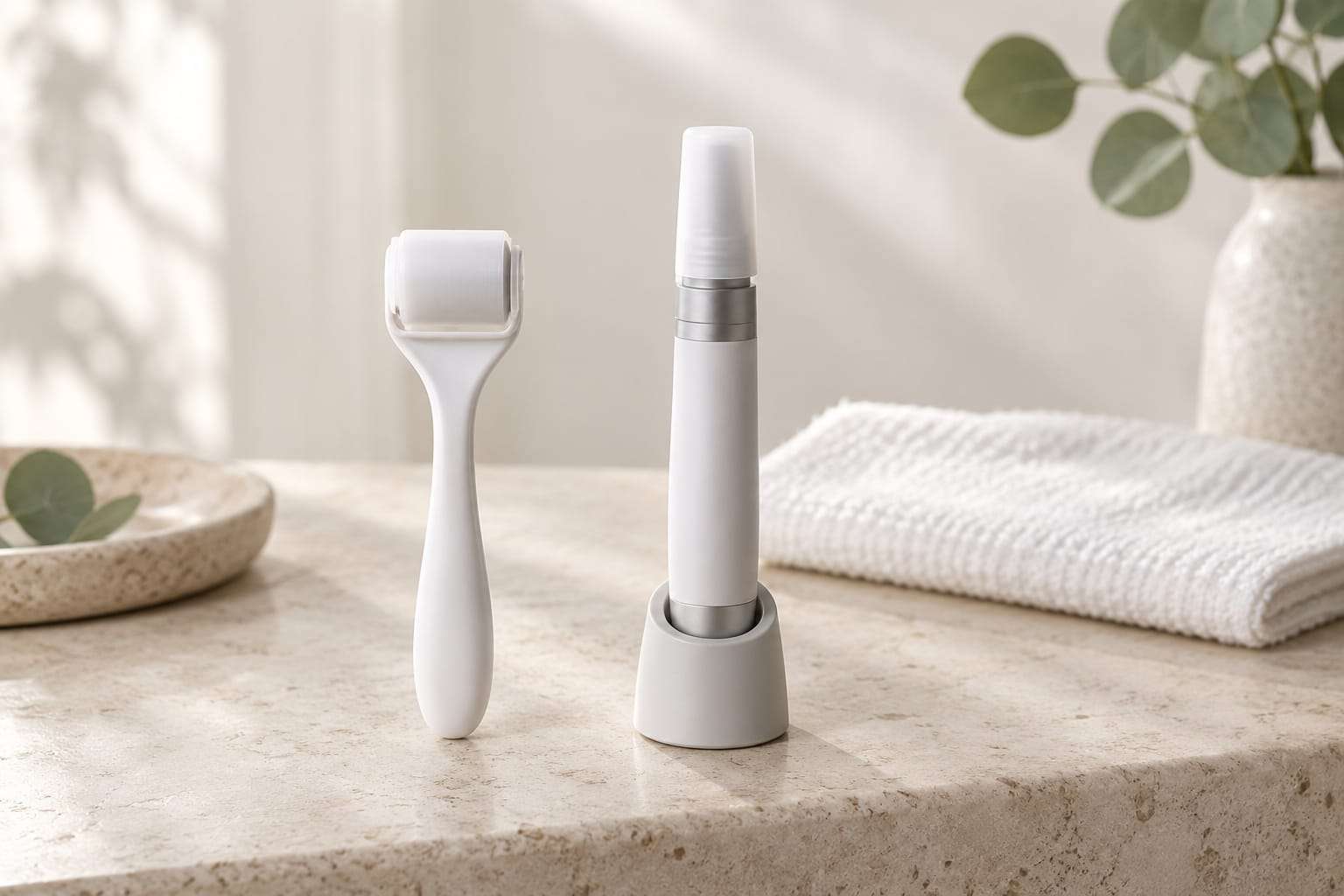
The devices were not all the same. Two of the men's trials used a derma roller, a small hand roller studded with needles. Other trials used motorised devices, and some added radiofrequency energy, which makes it a different procedure. A needle length printed on a device does not make a roller and a motorised pen interchangeable: we found no data showing that pressure, needles, operator and the depth actually reached are equivalent. [1, 2, 4, 5]
We do not explain here how microneedling might act on the hair follicle. The trials counted hairs and recorded side effects, and those are what a decision depends on.
Where it sits in our comparison
Our ranking compares six ingredients. Microneedling is not one of them. It is a procedure, so it is assessed separately and listed with the other procedures and devices in the library, next to light devices and PRP, a procedure that uses a preparation made from the person's own blood.
- Kind of option
- A procedureNot an ingredient, so it has no position in the ranking of six.
- Label in our library
- ConditionalRelevant when a specific question applies. Here, whether to add something to minoxidil on the scalp.
- Role in a routine
- Optional additionSomething a professional might add to minoxidil. Not a base treatment, and not a replacement for one.
It is the first procedure we explain because of the add-on question, not because it has been shown to be better than light devices or PRP.
What a procedure does on its own and what it adds to a medicine already in use are separate questions. Almost all the evidence below is about the second. The routines page shows how this sits next to the other pairings, and the methodology page explains the labels.
What our search found
On 29 September 2026 we searched PubMed, a public index of medical journals, for minoxidil together with microneedling or derma rollers. We set no filter on language, type of study or result. The search returned 140 records, and every one was given a decision.
What the 140 records turned out to be
Outside the questionAnimal and laboratory work, other conditions, other treatments or comparisons
61records
Reviews and commentaryUseful for orientation. They add no new participants
42records
Candidates for closer readingComparisons in people with pattern hair loss, including packages with other treatments
18records
Cases and series with no comparison group
10records
Too little information to decide
5records
WithdrawnThree retracted articles and one retraction notice
4records
One search of one database, so this is a documented search and not a complete systematic review. Each record was screened once, and a separate check re-read 24 of the decisions against the original records. The 18 candidates are publications, not 18 separate trials.
Of the 18 candidates, we read seven in full, ten only as published summaries and one only as a title with its disclosures. The three retracted articles are not used for anything on this page. The sections below keep the full-text trials apart from the summaries, because a summary leaves out most of what is needed to judge a trial.
The trials in men: microneedling added to minoxidil
Three of the trials we read in full ask the question that matters here. In men with pattern hair loss who all use the same minoxidil, does adding microneedling bring more regrowth? All three lasted 12 weeks, and in all three the comparison group simply used minoxidil. None had a pretend ("sham") procedure, so the men could tell which group they were in. [1, 2, 3]
Three trials in men, three protocols
What each study did, as part of the study. No column is a guide for use at home.
| In the trial | 2013Hospital trial, India100 men, 12 weeks | 2018Hospital trial, India68 men, 12 weeks | 2024Hospital clinic trial, Indonesia36 men, 12 weeks |
|---|---|---|---|
| Assessed | 94 men aged 20 to 35: 50 with microneedling, 44 without | 60 men aged 18 to 40: 31 with microneedling, 29 without | All 36, aged 26 to 51: 18 in each group |
| Minoxidil | 5% lotion, 1 mL twice a day | 5% solution, 1 mL twice a day | 5%, twice a day. The amount was not reported in what we read |
| Needling | A 1.5 mm roller, once a week | A 1.5 mm roller: four weekly sessions, then four more two weeks apart | 0.6 mm at weeks 0, 4 and 8. The device was not described in what we read |
| A session ended at | Mild redness | Pinpoint bleeding | Pinpoint bleeding or mild redness |
| Around a session | Minoxidil left out that day and restarted 24 hours later | Minoxidil left out that day and restarted 24 hours later | Anaesthetic cream before, an antibiotic cream after, minoxidil 24 hours after the session |
| Hair counted | On photographs of a marked spot at the crown | In one square inch at the crown | Per square centimetre at the front of the scalp |
| Funding | Declared as none | Declared as none | A university grant |
Each column is that trial's own protocol. The antibiotic cream in the third trial was fusidic acid. These are records of what was studied in India and Indonesia, not instructions from a US or UK product label. [1, 2, 3]
What each trial recorded
All three recorded more regrowth in the microneedling group, and each paper reports the difference as statistically significant. We do not print the hair counts, because each paper has a problem in the way it reports them.
The result of each trial, and why we give no hair count
| Trial | 2013, 100 men | 2018, 68 men | 2024, 36 men |
|---|---|---|---|
| Hair count | A larger rise with microneedling than with minoxidil alone. | A larger rise with microneedling. The authors called the gain not cosmetically significant. | A larger rise in hair density with microneedling. |
| Why no figure | The counted area is described as a spot 1 cm across in one place and as a square centimetre in another, so the count cannot be turned into a density. | The summary, the results table and the discussion give three slightly different values for the same gain. The area was a square inch, not a square centimetre. | The results section and the discussion give two different figures for the gain with microneedling. |
| Other measures | 41 of 50 men with microneedling and 2 of 44 without rated their own improvement above 50%. They knew which treatment they had. | 4 of 31 men with microneedling and none of 29 without rated their own improvement at 50%, the highest rating given. | Hair thickness rose by 18 micrometres with microneedling and 6 without. |
| Weak points | Groups were allocated by tossing a coin. All six men who dropped out were in the minoxidil-only group. | The eight men who dropped out were left out of the analysis. The men were not blinded. | A small sample, and the microneedling group was older on average. |
Twelve weeks in each trial. A statistically significant difference means the gap is unlikely to be chance. It says nothing about whether the gap is large enough to see in a mirror. [1, 2, 3]
Read together, the three agree on the direction and on little else. The second trial repeated the direction of the first and not its size, and its own authors described the gain as not cosmetically significant. [2] The counts also cannot be lined up against the gains in the trials of minoxidil on its own or of any other medicine to produce a ranking. The areas, the methods and the men are different.
Other comparisons, read only as summaries
Four more reports compare groups of people but were available to us only as published summaries. They add detail, and one of them is the only test we found of microneedling on top of minoxidil and finasteride together. [6, 4, 7, 8]
Four reports we could read only in summary
The first column is each trial's own protocol, as far as the summary states it.
| Report | What was compared | What the summary reports | What we could not check |
|---|---|---|---|
| Two needle lengths | 60 people aged 18 to 45, 12 weeks: 5% minoxidil lotion alone, with needling at 1.2 mm, or with needling at 0.6 mm. | The 0.6 mm group gained more in hair count and hair thickness than the group on minoxidil alone. It "tended" to do better than 1.2 mm, and the summary gives no test of that difference. | How often the needling was done: the summary says "biweekly", which can mean two things. Also whether the groups were randomised, the participants' sex, the size of the gain and the side effects. |
| A motorised device, first report | 60 men, 24 weeks, 20 per group: 5% minoxidil 1 mL twice a day; 12 sessions two weeks apart; or both, with 2 mL of minoxidil delivered during each session. | A larger average gain in hair density with the combination than with either alone. The significance test covers all three groups together. | Whether the combination beat minoxidil alone when tested on its own, the needle length, drop-outs and funding. |
| A motorised device, second report | 71 men who completed 24 weeks: 23 on 5% minoxidil twice a day, 23 on eight sessions three weeks apart, 25 on both. | The combination is described as doing better than either alone. No figures are given. | How many men started, the needle length, side effects, funding, and whether some of these men are also in the first report. |
| On top of minoxidil and finasteride | 45 men, 15 per group: 5% minoxidil; minoxidil with finasteride; or both with microneedling. | Both finasteride groups did better than minoxidil alone. Adding microneedling to the pair made no significant difference to hair density or thickness. | How long it ran, the finasteride dose, the microneedling protocol and whether the groups were randomised. |
A detail missing from a summary is unknown, not zero. The two motorised-device reports share a first author, and we could not establish whether they describe separate groups of men, so we do not add their participants together. [6, 4, 7, 8]
The search also returned studies in which microneedling came as part of a package, with PRP, a growth factor or radiofrequency. A result for a package belongs to the whole package and cannot be credited to the needling. [9, 10, 11, 5] For the pair that the last row builds on, see minoxidil and finasteride together.
What the trials in women found
This site's comparison is written for men, and results in women do not carry over automatically. The trials in women still matter here, for two reasons. One is the largest trial in our search, which we read only as a summary, and it found no significant extra benefit. Two others show that the men's protocols are not the only way the procedure has been done. [12, 13, 14]
Three trials in women with pattern hair loss
Each column is that trial's own protocol. All three ran for 24 weeks.
| In the trial | Summary only2026 trial245 women | Read in full2022 trial120 women, three groups | Read in full2022 trial40 women |
|---|---|---|---|
| Completed | 234 of 245 | 38 on minoxidil alone and 40 with microneedling | All 40, 20 in each group |
| Minoxidil | 2% | 5%, 1 mL once a day | 2%, 1 mL twice a day |
| Needling | A 36-needle cartridge at 500 to 550 micrometres, every two or every four weeks | A motorised device at 0.7 to 1 mm, every two weeks | 260 micrometres, once a week |
| Around a session | Not stated in the summary | 1 mL of minoxidil applied before the needling, then none for 24 hours | 1 mL of minoxidil applied during the needling, then none at home for 24 hours |
| Result | Every group improved. No significant difference between the groups in the count of all hairs except the finest | Hair density rose by about 30 hairs per cm² with microneedling and about 10 without | Hair count went from about 85 to 122 per cm² with microneedling and from about 84 to 96 without |
| Funding | Part-funded by a company, which the paper says had no role in the design, the analysis or the manuscript | A science foundation grant | No specific funding |
A micrometre is a thousandth of a millimetre. The 2022 trial of 120 women had a third group taking spironolactone tablets, which is not shown. None of the three used a sham procedure. [12, 13, 14]
The 2026 trial does not prove that microneedling adds nothing. We read only its summary, which gives no figures for each group, and it used 2% minoxidil with its own needling protocol. It does not cancel the results in men. What it does is rule out the idea that adding a procedure is bound to help. And because the two earlier trials in women did record more hair with microneedling, the evidence cannot be reduced to "it works in men and not in women".
Why no depth or schedule can be called best
Every table above shows a different protocol. That is the main reason these trials cannot be turned into a routine.
Needle length
- Not shown
- That deeper is better, or which length is best.
Time between sessions
- Not shown
- A best interval, how many sessions are needed, or whether top-up sessions are needed later.
Minoxidil around a session
- Not shown
- A time after which every scalp is ready for minoxidil again. The labels we checked give none.
The form of minoxidil matters too. Where the form is stated, the trials paired the procedure with a minoxidil lotion, solution or tincture. None is described as using a foam, so the result cannot be assumed for foam, which has its own base and its own label. The two forms are compared on the page about minoxidil foam and liquid. [1, 2, 3, 13, 14]
Side effects and safety: what was recorded
Safety was recorded less carefully than regrowth. Only the smallest of the three men's trials counted side effects in each group. [3]
Side effects recorded over 12 weeks, 18 men in each group
Men with a side effect
6 of 183 of 18Redness after a session
1 of 180 of 18
The 2024 trial of 36 men. The trial was paid for by a university grant. Itching was the most common complaint, with eight reports across the two groups, and the paper says it was felt mainly at the start of minoxidil use. No man dropped out. Numbers this small cannot show how often less common problems happen. [3]
The other two say less. The 2018 trial notes mild pain and discomfort during the procedure, tolerated by all the men, without counting how many felt it. The 2013 trial states that there was no significant side effect in either group and gives no table. [2, 1]
Bleeding was part of the procedure, not an accident. One trial needled until pinpoint bleeding appeared, one until pinpoint bleeding or mild redness, and one until mild redness. None of the three papers mentions an infection among its participants, although two of them did not list side effects group by group. In the 2022 trial of 120 women, one woman in the microneedling group had swelling and pain at a tattooed spot on the scalp after her first session. It was recorded as an infection and settled with treatment. No infection was recorded in the group on minoxidil alone. [2, 3, 1, 13]
Who the trials left out
Men who were not enrolled, so the trials say nothing about them
- A bleeding disorder or blood-thinning medicine. Excluded from the 2018 trial.
- An active infection or a skin condition in the area. Excluded from the 2018 trial. The 2024 trial excluded skin infection in the balding area.
- A history of keloid, a kind of raised scar. Excluded from both of those trials. The 2018 trial also excluded a family history.
- A known illness affecting the whole body. Excluded from the 2013 trial.
- Recent hair-loss treatment. Finasteride or another anti-androgen in the previous six months in the 2013 trial. Minoxidil, finasteride or a hair procedure in the previous one to three months in the 2024 trial.
These exclusions come from the papers themselves. [1, 2, 3] The trials also enrolled only men with pattern hair loss. Their results do not carry over to other kinds, which are set out on the page about types of hair loss.
What was not recorded
About a hundred men had the procedure across the three trials, each for 12 weeks. That is too few, for too short a time, to put a number on uncommon or long-term harm. Pain was mentioned and not measured. None of the three papers reports a check for lasting marks after the trial ended. The side effects of minoxidil itself are covered on the page about minoxidil side effects.
Home rollers and what the trials did
Two of the men's trials used a derma roller. They used it as a scheduled procedure in a hospital department, on a scalp cleaned beforehand, with the men seen again at set visits. The third added an anaesthetic cream and an antibiotic cream. None of that describes a man rolling his own scalp at home, and none of the three tested it. [1, 2, 3]
One report in our search did test a device made for home use. Twenty-nine people were allocated at random to the device alone, to 5% minoxidil solution alone or to both, for six months. The summary notes an improvement in hair count in the combination group, but no difference reached statistical significance, within any group or between the three. The patients' own ratings did not differ significantly either. One person using the device alone reported mild, short-lived itching. We read only the summary, which does not make clear the needle length, how often the device was used, the participants' sex or who funded the trial. [18]
"Roll straight over freshly applied minoxidil"
Not what the three men's trials read in full didIn the three men's trials read in full, minoxidil was kept off the scalp around the session. One men's trial we read only as a summary, and two trials in women, delivered it before or during the procedure in a clinic, with other devices, and the women's trials then paused it."Needling makes minoxidil go several times deeper"
Not measuredThe trials counted hairs. Dividing one group's gain by the other's is not a measure of absorption."There is a standard needle length and a standard schedule"
Not establishedThe trials used different lengths and intervals, and none was tested as the best. The one summary that compared two lengths found only a tendency.
Three claims we checked against the trials. Our search does not measure how widely home microneedling is practised, and popularity is not evidence for a needle length, an interval or a same-day routine.
What a session costs
The only price we recorded is from one UK clinic's published price list, read on 29 September 2026: £200 for a 60-minute microneedling session for hair regrowth, or £550 for three. The list appears to date from late 2025, so the price may have changed, and consultation fees are not stated. It does not give the depth or the schedule, or say whether minoxidil is part of it, so it cannot be matched to any trial. We did not work out a yearly cost, because no number of sessions a year is established. We recorded no price for a home roller.
What is not established
- What microneedling does without minoxidil. Our search was built around minoxidil, so it was not designed to find trials of microneedling alone. At least three of the reports we looked at closely had a microneedling-only group, and none compared that group with a sham procedure or with no treatment. In a fourth, read in full, which declares no outside funding, 92 men had a course of microneedling alone, the same course with daily 5% minoxidil, or PRP. Two months after the last session, density had risen by about 17, 17 and 21 hairs per cm², with no significant difference between the three. No group used minoxidil alone. [4, 7, 18, 19]
- Whether it adds anything to finasteride. One summary of 45 men found no significant gain from adding microneedling to minoxidil with finasteride. Our search, built around minoxidil, returned no trial of microneedling with finasteride on its own. [8]
- Whether it works with minoxidil foam. No trial we read is described as using foam.
- The long term. The three men's trials of microneedling added to minoxidil that we read in full ran for 12 weeks, and the longest treatment period on this page was about six months. None of those three reports hair counts from after the sessions stopped, and none tested top-up sessions. One of the 2022 trials in women followed its participants for a further 12 weeks while they kept using minoxidil. Its summary says the combination had better results during treatment and follow-up, and we have no follow-up figures. That says nothing about what happens without minoxidil. [14]
- Applying minoxidil on the same day. The protocols disagree, and the labels we checked give no restart time.
- A best needle length or interval. No trial we read establishes one.
- Whether the two multiply each other. The trials compared minoxidil with and without the procedure. That measures what the addition did in those conditions, not how the two interact.
Where to go next
If you are weighing a procedure rather than an ingredient, the procedures comparison puts needling alongside light therapy and PRP, keeping each study and protocol separate.
Microneedling is an optional addition, and the trials only tested it on top of minoxidil. If the base treatment is not settled yet, that comes first: the ranking puts the six ingredients in an order of consideration, and the minoxidil profile gives its trial numbers and label instructions. If a clinic offers the procedure, the useful next step is to have the device, the depth, the interval, the form of minoxidil and the plan for minoxidil around each session in writing.
The main guide covers where procedures and devices fit in general.
Hair loss routines: what to combine and what to choose betweenWhere microneedling, light devices and PRP sit next to the pairings of medicines. How to use minoxidilLabel instructions, amounts, shedding in the first weeks and how long it takes. The hair questionnaireA few questions that point to the relevant page. It does not diagnose hair loss or prescribe anything.