
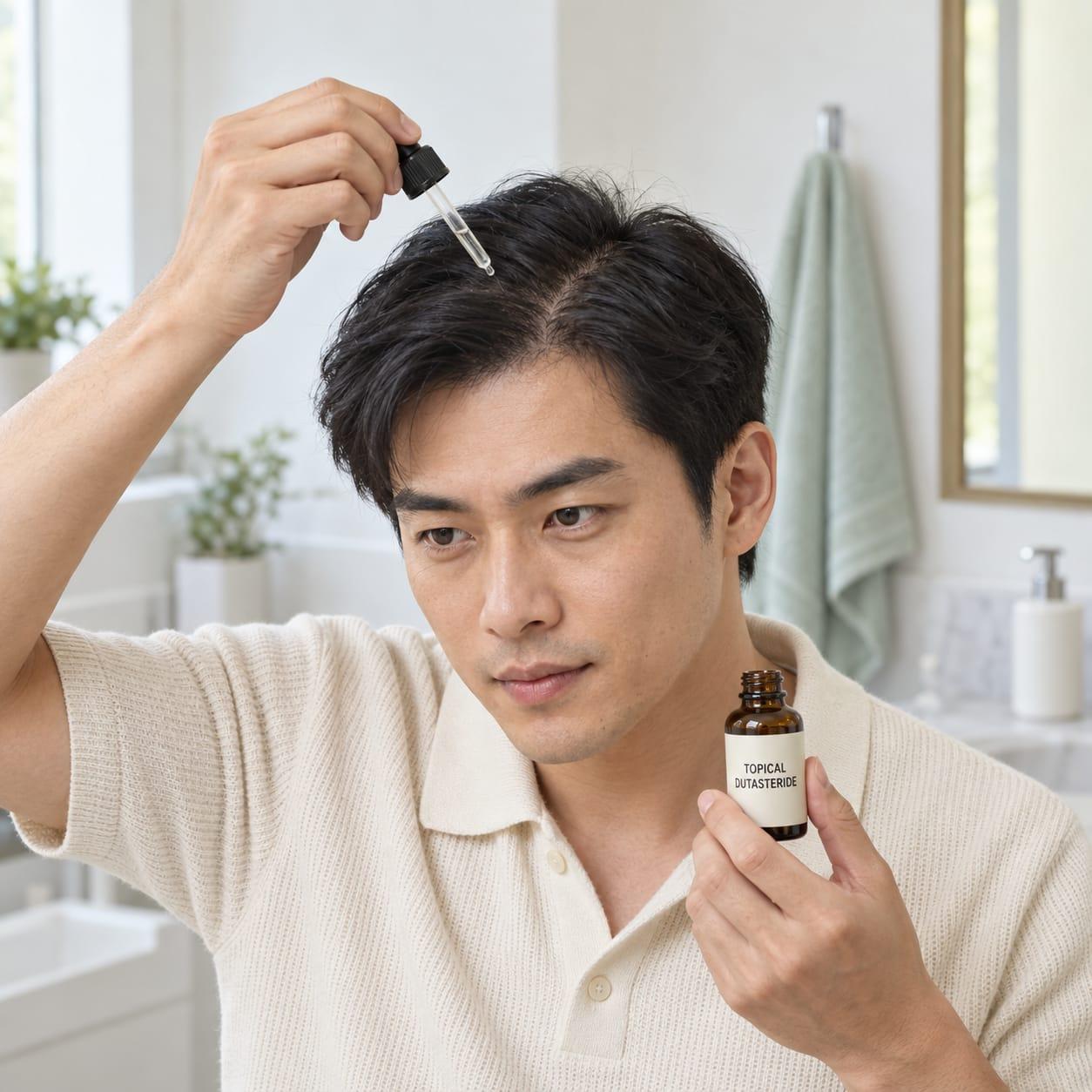
What is topical dutasteride?
Topical means applied to the skin. Topical dutasteride is a liquid containing dutasteride that is applied to the scalp, rather than swallowed as a capsule. It is being studied for adult men with male pattern hair loss. A scalp application is a different way of delivering the medicine, and some of it can still reach the bloodstream. [1]
This guide explains what the solution is, whether it helps hair grow, how it differs from the capsule and what to ask about a product being offered. We treat it as investigational, meaning it is still being studied and does not have the same established evidence as oral dutasteride. The dutasteride profile covers the capsule.
Scalp solution
Oral capsule
The main practical distinction is between a studied solution and another product carrying the same ingredient name. The research reviewed here gives a useful starting point for discussing the first; assessing another bottle also requires knowing exactly what is in it and how it is intended to be used. [1, 2, 3]
Does topical dutasteride help hair grow?
A specific solution increased hair count more than finasteride tablets in one small trial. It enrolled 135 men with male pattern hair loss at six centres in India. Eligibility covered ages 20 to 60. It compared three strengths of topical dutasteride, 0.01%, 0.02% and 0.05% by weight per volume, with oral finasteride 1 mg and placebo, inactive comparison treatments. The study used matched dummy treatments, so the comparison was between alternatives rather than taking both medicines together. [1]
This was a phase II trial, an early-stage study of effectiveness and safety. Shilpa funded it, its authors were company employees and the formulation was patented. The 0.05% dutasteride and finasteride groups each began with 30 men. The main result table included 29 men in each of those groups. The 135 men were spread across all five groups; the key comparison involved these two much smaller groups. [1]
The two groups behind the headline result
| Topical dutasterideSpecific 0.05% solution | Oral finasteride1 mg tablet | |
|---|---|---|
| Randomised | 30 men | 30 men |
| In the result table | 29 men | 29 men |
| Study use | 1 mL once daily on a small target area | 1 mg once daily, with dummy scalp treatment |
| Main count | After 24 weeks | After 24 weeks |
Study regimens, not instructions for a product on sale. The paper reports 127 completers overall, while its main result table totals 128. That discrepancy remains unresolved in the source reviewed. Shilpa funded the trial. [1]
The result supports further study of that solution. For someone choosing a treatment now, the main limitation is that a small, short trial with reporting discrepancies cannot tell us how reliably another product will work or whether it is a suitable replacement for finasteride. For the more mature tablet comparison, see finasteride versus dutasteride.
How much difference did it make?
In a measured area of one square centimetre, the adjusted average hair-count increase was 75.52 with the 0.05% solution and 41.21 with finasteride 1 mg. The paper reported an adjusted between-group difference of 34.3 hairs per square centimetre at 24 weeks. It favoured the solution in this trial. [1]
These are hairs counted in a small area, not percentages, whole-head gains or the proportion of men who thought their hair looked better. A count can answer whether the measured patch changed while leaving the size of a visible cosmetic difference uncertain.
Change in target-area hair count at 24 weeks
Studied dutasteride 0.05% solution29 men in the result table
+75.52hairs per cm²
Finasteride 1 mg tablet29 men in the result table
+41.21hairs per cm²
Adjusted mean changes in a 1 cm² measurement area from one 135-person phase II trial. Shilpa funded the study, its authors were employees and the formula was patented. The reported overall completer count is 127 but the result table totals 128. These data do not describe every topical dutasteride preparation. [1]
The number does not belong beside a different trial's hair count as though both trials tested the same people, area and methods. Finasteride has been measured in other trials with different study areas, populations and follow-up. The finasteride results guide explains what its hair counts mean for expectations over time.
We found no independent repeat of this exact solution's result in the sources reviewed. A repeat by another research group and longer follow-up would help show how dependable the result is. [1]
Why does the exact solution matter?
The percentage on a bottle is only part of the product. The liquid base, amount and area of application also matter. In the trial, 1 mL was applied once a day to a target scalp area of 1.9 cm² and left for six to eight hours. The hair-count measurement used a 1 cm² area. The first number describes where treatment was applied; the second describes where researchers counted. They are not interchangeable. [1]
Nominally, 1 mL of a 0.05% weight-per-volume solution contains 0.5 mg of dutasteride. That calculation describes medicine placed on the scalp. It does not mean the person absorbed the equivalent of a 0.5 mg capsule. The paper also uses non-identical concentration representations in its formulation table, so it is not a sound basis for reconstructing a compounding recipe. [1]
The studied vehicle, meaning the liquid mixture that carries the medicine, contained dehydrated alcohol, medium-chain triglycerides and castor oil. The active ingredient and percentage are only part of that description. A serum, spray or different solvent mixture cannot claim to be the trial product solely because its percentage matches. [1]
Does topical dutasteride enter the bloodstream?
Yes, some can. The study found measurable dutasteride in some blood samples from a subgroup of 16 men, although most readings were near or below the measurement limit. Applying it to the scalp therefore does not keep all of the medicine out of the rest of the body. [1]
Finding drug in the blood and measuring side effects answer different questions. This trial did not compare the solution with dutasteride capsules, so it cannot tell us which is safer. It was also too small and short to settle uncommon problems affecting sexual function, mood or fertility, or symptoms that persist after stopping. [1]
Absorption question
Safety question
The distinction is familiar from topical finasteride, but its numbers cannot be transferred here. A finasteride spray trial tested a different medicine, a different formulation and a different delivered amount. Neither scalp route should inherit the other's measured exposure or event rate. [4, 1]
What are the possible side effects?
Scalp irritation is described in the study, but its reporting is inconsistent. The paper also says no adverse or serious adverse events occurred. These conflicting accounts mean it cannot provide a dependable side-effect rate or support a claim that the solution has no risks. [1]
Specifically, the report pairs a count of 29 with 16.96%, an inconsistent denominator. Its overall completion count also conflicts with the total in the result table. That is why the statement about no events needs to be read alongside the skin findings. [1]
What the safety data do not establish
- A zero risk of sexual or mood symptoms.
- Lower risk than dutasteride capsules.
- The frequency of uncommon events or symptoms continuing after stopping.
- Long-term reproductive safety.
- Tolerability of another concentration, vehicle or treated scalp area.
The dutasteride side-effects guide describes capsule trials, the US capsule label and oral regulatory warnings. Those deserve attention when discussing the medicine, but their precise percentages must remain attached to oral use. They cannot be relabelled as measured risks of the scalp solution. [2, 5, 1]
The same separation applies to the UK mood precaution added in 2026. That communication concerns oral dutasteride. It is neither a trial finding about this solution nor evidence that topical exposure has no psychiatric risk. [5]
Is topical dutasteride approved for hair loss?
Approval depends on the country and the exact preparation. We could not verify a US or UK authorisation or product label for the studied topical solution in the sources reviewed. A prescriber or supplier would need to identify the local status of the particular product being offered. [1]
The oral labels answer a different question. The checked US and UK Avodart capsules are authorised for an enlarged prostate, while Japan's Zagallo label covers male pattern hair loss. None of those capsule labels authorises the topical solution or supplies its instructions. [2, 3, 6]
Evidence, authorisation and supply are separate questions
| Question | What this evidence can answer | |
|---|---|---|
| Trial evidence | Was a preparation tested? | Yes, one named topical formulation has the phase II result described here. |
| Local authorisation | Does it have a label in my country? | No US or UK topical authorisation was verified in the sources reviewed. |
| Product match | Does a supplied product match the study? | The ingredient name or strength alone cannot establish that. |
The trial and three oral product labels answer different questions. Local product identity and authorisation need their own documentation. [1, 2, 3, 6]
A compounded solution is one prepared to order. For such a product, the useful question is how its concentration, liquid base and instructions compare with the preparation studied. The label for a capsule or for another scalp medicine does not answer that. The main hair guide introduces the options with better-defined product instructions.
Can it be combined with other hair treatments?
The trial compared topical dutasteride with finasteride tablets as alternative treatments, using dummy versions to preserve blinding. It did not test taking oral finasteride and applying active dutasteride together. Describing it as evidence for that combination would reverse the study design. [1]
It also does not validate dutasteride applied after microneedling, scalp injections or a mixture with minoxidil. Those are separate treatment packages. The microneedling guide describes the procedures actually studied, while the hair-loss procedures guide separates procedures from medicines.
For a treatment plan that already contains other medicines, the unresolved issue is the whole proposed combination: its exact ingredients, doses, route and safety support. The hair-loss routines guide explains why adding products is not automatically adding proven benefit.
What should you ask about a topical product?
The evidence supports a promising result in a defined test area at 24 weeks. It leaves open independent replication, clearer safety reporting, longer follow-up, what happens after stopping and how any supplied preparation matches the study. Those are the most useful gaps to discuss, rather than assuming that more intensive use will reproduce the headline number. [1]
A productive product discussion has concrete questions: the exact formulation and country, the reason for considering it, the evidence for that preparation, and how benefit and tolerability would be assessed. These questions remain useful even if the seller calls the product personalised or advanced; those descriptions do not answer them.
For the starting comparison, read the hair treatment ranking. Its dutasteride position rests on oral treatment and does not promote the investigational scalp solution into the same evidence category. For recording a treatment already agreed with a prescriber, tracking hair growth explains how to keep photographs and treatment changes interpretable.