
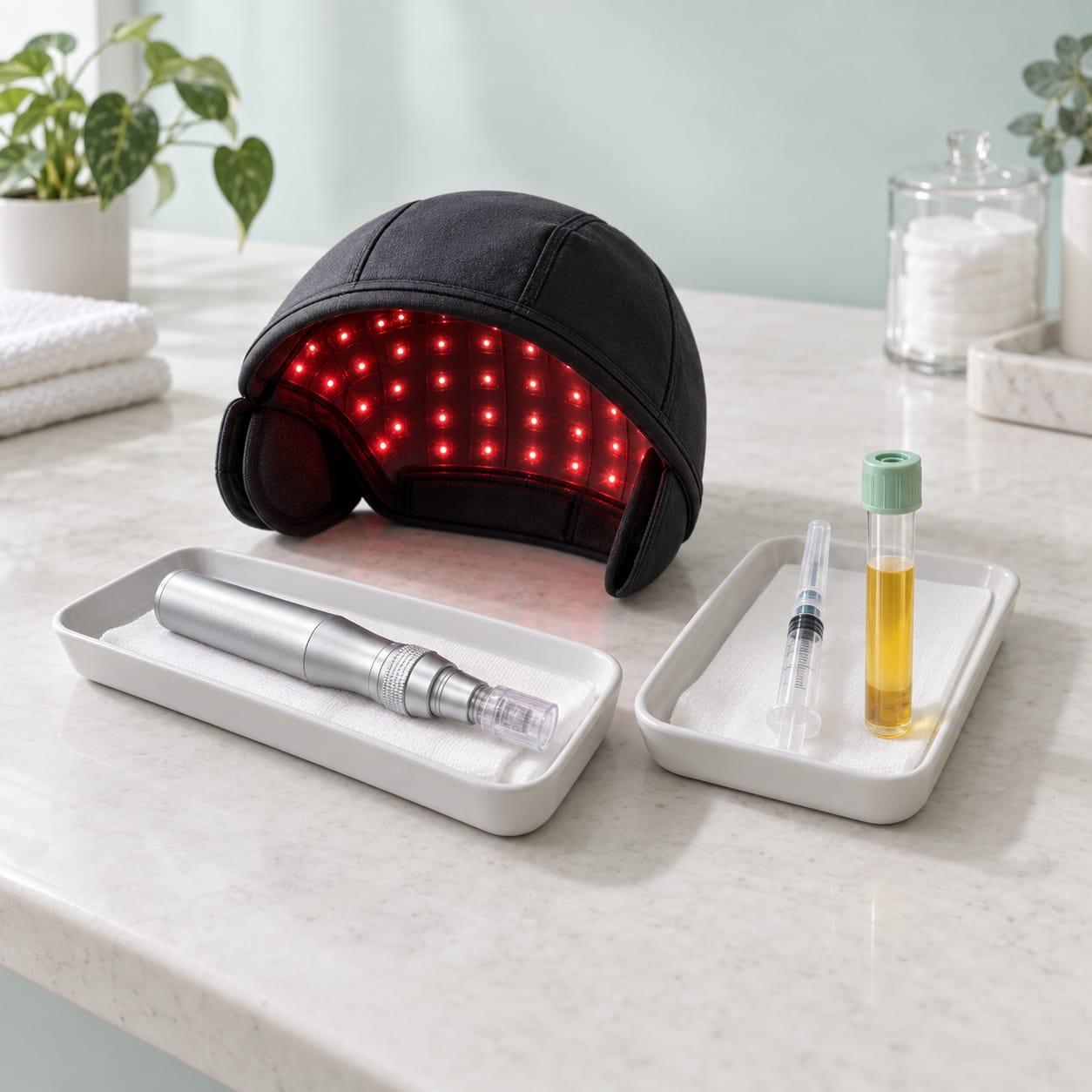
Which hair loss procedures this comparison covers
Here, hair loss procedures means treatments delivered in sessions on the scalp: microneedling, light therapy and PRP injections. They are options to consider beside the main medicines for adult male pattern hair loss. They involve different commitments, and the studies reviewed do not establish one best choice. [1, 2, 3, 4, 5]
Microneedling
Light therapy
PRP injections
These descriptions explain the treatment types, rather than how to perform them. Rollers and pens can differ, as can light models and PRP preparations. Their results need to be tied to the treatment actually studied. [1, 6, 7, 2, 8, 3, 4]
Transplant surgery is outside this comparison. The hair loss types guide helps explain whether pattern loss describes the problem being discussed. Procedures sit outside the ranking of six ingredients, which compares minoxidil, finasteride, dutasteride, saw palmetto, rosemary and pumpkin seed oil.
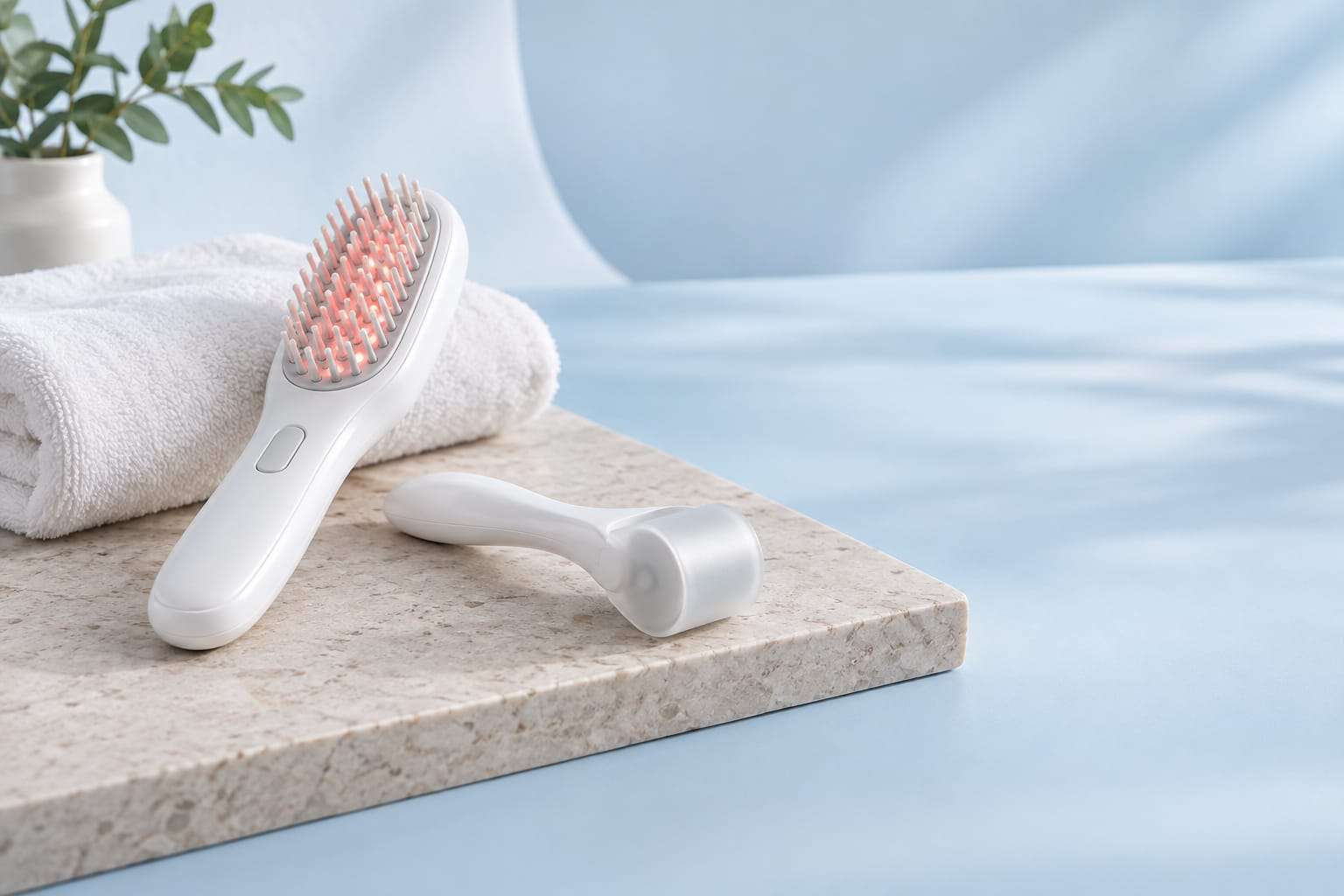
How the options differ in everyday use
The useful starting question is whether you want to add to a medicine or consider a different kind of treatment. Microneedling has mainly been studied as an addition to minoxidil. Light devices have evidence when used on their own, and PRP has been tested both on its own and in packages. These results answer different questions. [1, 6, 9, 2, 3, 4, 10, 11]
How the three options compare in practice
The treatment, possible benefit and commitment matter together.
| What matters | Microneedling | Light devices | PRP |
|---|---|---|---|
| What it involves | A roller or pen with short needles used on the scalp | Repeated use of an identified light device | Blood collection, preparation and professional scalp injections |
| Where it may help | An addition to minoxidil; small trials in men reported more regrowth | A non-drug option; particular combs increased hair counts | A possible density gain, but controlled studies have mixed results |
| Main uncertainty | How much extra visible benefit, and which needling course | How another model performs, or how much it adds to medicines | The chance of a response to a particular preparation and course |
| Practical burden | Sessions and a plan for when scalp medicines are used around them | Repeated sessions and an initial device purchase | Repeated visits, injections and per-session or package costs |
| Maintenance | No optimal top-up schedule established | Best frequency beyond the studied period unresolved | No universal booster course established |
Selected evidence in men, with some relevant female trials discussed in the dedicated microneedling guide. None of these columns certifies every commercial device or service. [1, 6, 9, 2, 12, 3, 4]
The routines guide explains the difference between a base treatment, an alternative and an addition. There is no need to assume all three procedures belong in a routine: each proposed addition needs a reason, including what it is expected to add to treatment already in use.
Microneedling: mainly an addition to minoxidil
Microneedling may improve regrowth when added to minoxidil, but the size of the extra visible benefit is less clear. Three small trials in men, of 100, 68 and 36 participants, compared 5% minoxidil with and without microneedling over 12 weeks. Each reported more regrowth in the combination group. They used different needle lengths and schedules, and each has a reporting problem that prevents a dependable comparison of their hair-count gains. [1, 6, 9]
The first trial describes the measured area inconsistently. The second gives slightly different count values in different parts of the paper. The third reports conflicting density changes. The first two declared no funding; the third reported a university grant. These details matter more than choosing the largest number that appears in a summary. [1, 6, 9]
There are also boundaries to generalisation. A 2026 trial in 245 women, read only as a summary, found no significant difference between 2% minoxidil with and without microneedling at 24 weeks. It was partly funded by Shanxi Zhendong Anxin Biopharmaceutical. A separate summary involving 45 men found no significant extra density or thickness benefit when needling was added to minoxidil and finasteride together; funding was declared not applicable. Neither result proves equivalence. [13, 14]
The full microneedling guide explains the studies, their funding and their differing timings. It also distinguishes hospital protocols from a home roller. The studies are not a demonstrated routine for an unassessed scalp and an unspecified household device.
Light therapy: evidence for identified models
Particular laser combs have increased hair counts in controlled trials. They were compared with a sham device, a look-alike comb without the active laser. The key Lasercomb report brought together four trials with 269 men and women overall. The male studies randomised 128 men and analysed 103. At 26 weeks, the active devices increased terminal hairs, the thicker hairs, more than the comparison devices. Lexington partly funded the research and supplied devices; two authors disclosed fees. [2]
A separate study compared a light device with 5% topical minoxidil in 91 men, with 75 completing six months. The summary reported no significant difference. We reviewed only that summary and did not verify funding. It does not prove that the two approaches are equivalent, or that a device adds a known amount to minoxidil. [12]
The useful evidence
The limit on transfer
The commitment also differs from a clinic procedure. The Lasercomb protocols used three sessions a week for 26 weeks, lasting 15, 11 or 8 minutes according to the model. Those timings are records of the study, not universal settings. The best frequency or duration beyond the trial remained unresolved. [2]
The red-light therapy guide shows each sham comparison and the limits of the safety reports. It is the place to examine a device claim before using it as evidence for a purchase.
PRP: what an injection course may achieve
PRP can improve density, but controlled studies have produced mixed results. In one trial, 23 people were enrolled and 20 men analysed. PRP and placebo, an inactive comparison treatment, were injected into separate areas of each man's scalp. At three months, after three sessions 30 days apart, total density had increased by 45.9 hairs per cm² in the PRP area and decreased by 3.8 in the placebo area. [3]
A different pilot randomised 30 men, 20 to PRP and 10 to saline, with 28 completing treatment. Five sessions four to six weeks apart did not produce a significant benefit for count or diameter. Both papers denied conflicts of interest; separate funding was not identified in the texts reviewed. Neither was a comparison against minoxidil or finasteride. [3, 4]
- Positive split-scalp trial
- 20 analysedTwo scalp areas from each man, not 40 independent patients.
- Pilot without benefit
- 30 randomisedA separate PRP course with a saline comparison.
- One success percentage?
- Not establishedPreparation, schedule, design and outcomes differed.
The trial findings must be kept separate. A positive mean density change is not the percentage of people who will be satisfied. [3, 4]
There are also reports of PRP on top of minoxidil, including a study of a package with injected PRP, topical plasma and microneedling. Those reports provide limited additional information, but they do not identify a precise benefit for every component or every medication background. The PRP guide separates them from the placebo comparisons. [10, 11]
What a direct procedure comparison can and cannot tell us
The direct comparison reviewed here did not establish a winning procedure. Leonik and colleagues studied 92 men: 31 received microneedling, 31 microneedling with 5% minoxidil, and 30 PRP. All completed the trial. Each group had three monthly procedures, with assessment two months after the final one. The report declared no external funding and no conflicts of interest. [5]
Hair-density change in one direct procedure trial
Microneedling31 men
+16.8hairs per cm²
Microneedling with 5% minoxidil31 men
+17.1hairs per cm²
PRP30 men
+21.1hairs per cm²
Leonik 2024, Table 9. Ninety-two men, three monthly procedures, measured two months after the third. The overall between-group test was not significant, p = 0.299. No sham, untreated or minoxidil-only group was included. Groups differed in starting age and allocation details were incomplete. No external funding or conflicts were declared. The bars do not establish a winner or equivalence. [5]
The average PRP bar is larger, but the study did not demonstrate a significant difference across the groups. That is not proof that they are equal. The absence of a sham or untreated group also prevents attributing every before-and-after change to a procedure, while the absence of minoxidil alone prevents an estimate of what needling added to that medicine. [5]
This illustrates why a chart needs its study design beside it. A number can be accurately copied yet answer the wrong question. The methodology page explains why we keep the outcome, comparison, follow-up and uncertainty attached to every trial result.
Why results from separate trials cannot make a league table
Hair gains from separate trials cannot reliably tell you which treatment is best because the studies measured different things in different people. The Lasercomb report counted thicker, terminal hairs; the positive PRP trial reported total density; the key microneedling reports have incompatible or inconsistent count descriptions. Their printed gains do not belong in one ranking. [2, 3, 1, 6, 9]
Keep the outcome the same
Total density, terminal-hair density, hair diameter and a photographic score describe different things. Shared hair-loss language does not make them interchangeable.Keep the comparator visible
Against sham, against an active treatment and added to an active treatment are different clinical questions.Keep the clock visible
A measurement during treatment differs from one made after the final procedure. The time counted from the first session also differs from time counted from the last.Keep the sample visible
Analysed participants, randomised participants and two areas of the same scalp cannot be counted as the same kind of sample.
The same caution applies when a clinic combines several treatments. The trial result belongs to the tested package until a design isolates its components. The minoxidil and finasteride page deals with that medicine combination, whose evidence cannot be added numerically to an unrelated procedure result.
Safety and medicine timing need separate attention
All three have reported unwanted effects, and the available studies cannot reliably rank their overall safety. The Lasercomb report recorded dry skin and itching, but did not make clear how many people its safety percentages covered. PRP reports describe pain and local redness, swelling, bleeding or bruising, with incomplete counts. Microneedling reports include itching and procedure pain. [2, 4, 9, 6]
When a procedure accompanies a scalp medicine, the plan needs to cover both. In particular, a trial's pause around microneedling does not override a medicine's instructions about healthy skin. The minoxidil-use guide explains those instructions and the forms of treatment they apply to.
Compare the commitment and the quotation
A procedure decision is also a decision about time and follow-up. The trial schedules differed, and none establishes a universal ongoing plan for all three options. Device sessions, clinic visits, topical-treatment timing and uncertain boosters should be considered before turning a price into an annual total. [1, 6, 9, 2, 3, 4]
What a usable offer needs to specify
| Question | A light device | A clinic procedure |
|---|---|---|
| What is being supplied? | An exact model and its own instructions | A defined procedure and, for PRP, the preparation |
| What does the price cover? | The purchase and any stated additional costs | The visits, consultation and reviews actually included |
| What is the background treatment? | Any medicines being used alongside it | Medicines, other procedures and the agreed timing around sessions |
| How will it be reviewed? | A clear outcome and a record of actual use | A clear outcome, visit record and reassessment plan |
These are questions for making an offer understandable, not a claim that every supplier includes the same services.
An initial cost and a cost per session are not directly comparable. A total becomes meaningful only after the actual proposed course is known. If maintenance is uncertain, that uncertainty should remain visible in the comparison instead of being replaced by a guessed number of annual visits.

How to judge a result and choose what to read next
Consistent photographs and a dated record can document progress without claiming to prove its cause. The record is most useful when it includes the procedure or device, actual sessions, background treatments and any interruptions. Starting several things at once leaves the contribution of each uncertain, even if the photographs improve.
The hair-growth tracking guide explains the photographic side. It cannot replace a controlled comparison, but it can stop changing light, angle or hairstyle from dominating a personal assessment. A clinic's review plan should also say whether it is judging hair counts, appearance, symptoms or satisfaction.
The questions to leave this page with
- Is the offer an alternative, an addition or a package of several interventions?
- Does the cited trial study the same device, preparation and background treatment?
- Is the claimed outcome hair density, hair thickness, appearance or satisfaction?
- Are the visit burden, unwanted effects, price and uncertain maintenance course clear?
The answer may be to investigate one defined option further. It does not need to be a more elaborate routine. These procedures stay separate from the main male-pattern-hair-loss guide, where the underlying treatment choices are introduced.
Build a routine around the actual comparisonWhat to combine, what to choose between and where optional devices and procedures fit.