
What a sleep watch or ring measures
A sleep tracker estimates your sleep from signals recorded while you wear it. It can make patterns easier to notice, such as changes in sleep timing or estimated duration. The record is useful context, but its stage chart and score are not a direct measurement of how well your brain slept. Combine it with your own experience and daytime functioning. [1, 2]
Many wrist and ring trackers use movement and optical pulse sensors. Software looks for patterns associated with sleep and wakefulness, then may assign stages. A sleep-lab study, called polysomnography or PSG, records brain activity through an EEG, along with eye and muscle activity and other signals. Those recordings provide a different basis for classifying stages. [2]
Two routes to a sleep-stage display
Similar-looking charts can come from different signals and methods.
A typical watch or ring estimate
Body signals
Movement and optical pulse signals
Device software
An algorithm recognises patterns
Sleep display
Estimated sleep, wake and stages
A sleep-lab stage recording
Recorded signals
Brain activity, eye movements and muscle activity
Clinical scoring
Signals are scored using sleep-stage criteria
Sleep stages
N1, N2, N3 and REM classification
A conceptual comparison of typical sensor-based estimates and laboratory staging. A watch or ring does not become an EEG recording because its chart uses the same stage names. Exact sensors and features vary by device. [2]
This guide concerns adult consumer interpretation. It does not rank brands or evaluate every medical feature. The studies below tested named wrist devices, so their percentages do not establish the performance of every ring, newer model or software version.
What the stages, minutes and sleep score mean
The numbers describe different things. Time asleep, time awake and the proportion assigned to a stage should not be treated as interchangeable measures of recovery. A proprietary sleep score combines information according to the maker's method; the World Sleep Society recommends using tracker data as supplementary context rather than a stand-alone clinical answer. [1, 2]
| Display | What it is describing | How to interpret it |
|---|---|---|
| Estimated sleep duration | How much of the recorded period the device classified as sleep | Compare with your opportunity to sleep and diary. Quiet wakefulness can be counted as sleep. |
| Awake time or awakenings | Periods the device classified as wake | It may miss waking, and its count need not match what you remember. |
| Light, deep and REM sleep | Categories assigned by the device's software | Treat them as estimates, not a diagnosis of a stage deficiency. Stage categories can differ between devices. |
| A sleep or recovery score | A summary created by that product | Check what contributes to it. A score from one product need not mean the same thing on another. |
The main sleep stages are N1 and N2, often grouped as light sleep; N3, commonly called deep sleep; and REM, a stage with rapid eye movements. Their pattern changes through the night. The main sleep guide explains that pattern. A tracker estimate is not enough to decide that you need more of one stage or a supplement to increase it. [3, 1, 2]
How accurate are the estimates?
Accuracy depends on the model, software, person and outcome. Recognising that someone is asleep is a different task from recognising wakefulness or identifying a particular stage. A high percentage for one task does not establish that the entire night's chart is correct. [6, 2]
One 2025 study compared six wrist trackers with simultaneous PSG in 62 adults over one laboratory night. The sample included 27 people without sleep apnoea and 35 with different severities of it. Each person wore two to four devices, and usable recordings differed by device. [2]
Sleep and wake detection were different tasks
Range of device averages across six wrist trackers in one 2025 validation study.
Sleep correctly identified
Among segments scored as sleep by the lab
91.68 to 96.27%
Wake correctly identified
Among segments scored as wake by the lab
29.39 to 52.15%
Common scale: proportion of lab-defined sleep or wake segments correctly classified.
Sleep detection ranged from 91.68 to 96.27%; wake detection from 29.39 to 52.15% across the six device averages in Table 7. These are ranges across devices, not confidence intervals or one overall accuracy score. The study tested Fitbit Charge 5, Fitbit Sense, Withings Scanwatch, Garmin Vivosmart 4, Whoop 4.0 and Apple Watch Series 8. It covered one lab night, with different sample sizes per device, and does not rank today's market. VLAIO, a Flemish public innovation agency, funded the study; authors declared no financial or nonfinancial conflicts. [2]
In plain terms, the devices recognised most segments the laboratory classified as sleep, while identifying a much smaller proportion of wake segments correctly. That helps explain how a watch can report a long sleep even when you remember lying awake. It does not mean every night has the same error. Stage agreement also varied across the tested models. [2]
An older validation in healthy young adults found the same broad distinction: good sleep detection alongside weaker wake detection and inconsistent stage classification. Both studies concern their tested hardware and algorithms. They do not demonstrate that buying or checking a tracker improves sleep. [6, 2]
Why your memory and the tracker can disagree
Disagreement is not proof that you imagined a difficult night. The tracker and the diary use different information: one applies software to signals, while the other records your experience. Both can add something to the discussion. Neither should erase the other. [1, 2, 7]
You remember being awake, but it counted sleep
Stillness can resemble sleep to a sensor-based system. Record the prolonged wakefulness rather than replacing your diary with the app's duration.Two devices show different stages
Their algorithms and stage categories may differ. One device's extra deep-sleep minutes do not show that your body produced extra deep sleep.You feel tired despite a good score
Describe the tiredness or sleepiness and whether it affects daily life. A favourable score does not exclude a sleep disorder.
These are interpretations of measurement limits, not diagnoses from the disagreement. [1, 2, 7]
If long periods awake remain a problem despite enough opportunity to sleep, CBT-I provides structured insomnia treatment. A tracker is not required before seeking it. If the pattern is a time-zone journey, timing matters independently of the stage score.
How to use trends alongside a diary
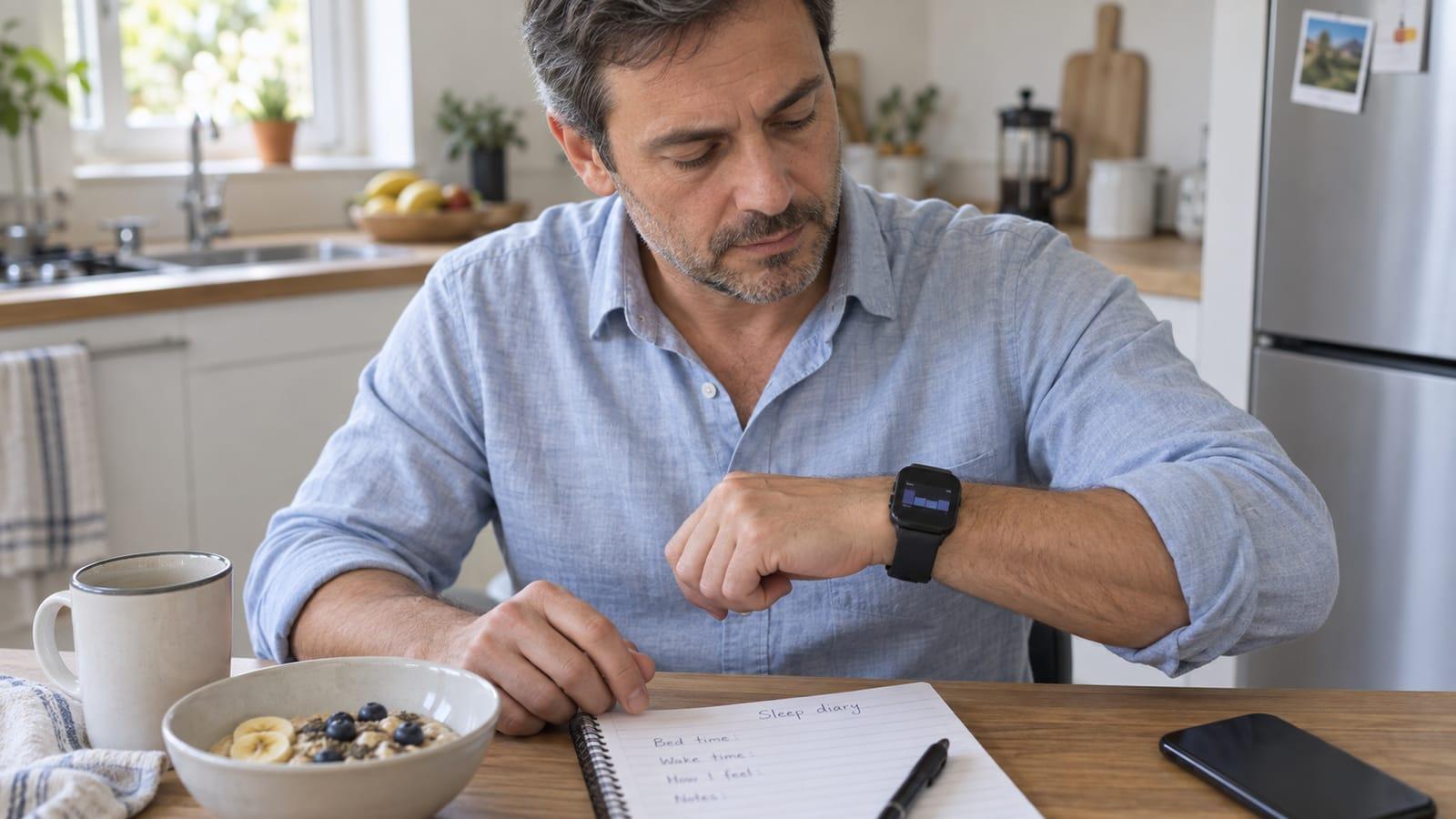
Use the tracker to help answer a specific question, then compare its pattern with a simple diary and how you feel during the day. The World Sleep Society's consumer guidance supports that contextual approach. It does not turn a home record into a controlled experiment or diagnostic test. [1]
- 1
Choose the question
For example: does the schedule leave too little time to sleep, or is a repeated disturbance keeping you awake? Start with that question rather than the overall score.
- 2
Keep a short morning record
Note bedtime and getting-up time, estimated long periods awake, naps and daytime sleepiness. Add a relevant change, such as caffeine timing or a bedroom disturbance.
- 3
Compare several nights
Look at the same device's pattern alongside the diary. Check whether estimated timing, your experience and daytime functioning tell a consistent story.
- 4
Act on the relevant pattern
Protect sleep opportunity or address a clear disturbance. If difficulty persists or safety is affected, take the record to a clinician rather than trying to perfect a stage percentage.
A blank comparison you can copy
| Night or date | Diary: sleep opportunity and long periods awake | Device: estimated timing and duration | Daytime function and relevant context |
|---|---|---|---|
| Your first entry | |||
| Your next entry | |||
| Another entry |
The table is an observation aid, not a validated symptom scale. Fill it in approximately in the morning. Use the NIH sleep diary if a fuller form helps, or the form your provider supplies. Avoid repeatedly watching the clock overnight to obtain perfect data. [8, 9, 10]
If noise is the repeated disturbance, noise and sleep addresses reducing it versus adding background sound. For evening brightness or an uncomfortable sleep setting, use the light and screens or bedroom temperature guide. A practical change should fit the problem, not merely the lowest app score.
What to do when a score changes suddenly
Check the record's context before assuming your sleep biology changed. A new device, an algorithm update or missing data can affect comparisons. The 2025 validation reported lost or incomplete recordings even in the laboratory, and its authors noted that software updates complicate comparisons over time. [2]
| What changed? | Useful first response |
|---|---|
| A missing or partial night | Mark the gap; do not treat it as zero sleep or quietly average it into a trend. |
| A new watch, ring or software update | Note when it changed. Avoid treating the before-and-after stage values as automatically comparable. |
| A different schedule or travel | Record the new sleep opportunity and timing alongside the estimate. |
| Symptoms became persistent | Describe the symptoms and seek assessment, even if the device's summary looks normal. |
These are practical ways to preserve context, rather than rules that repair a device's accuracy. Follow the actual product's wearing and recording instructions; this guide cannot supply one fit or setup procedure for every tracker. [1, 2, 7]
Are medical notifications different from a sleep score?
Yes. Some exact wearable features have a regulated medical purpose. That authorisation applies to the feature and its intended use; it does not automatically validate every stage, score or function on the same device. [12, 1]
For example, the US FDA-cleared Apple Sleep Apnea Notification Feature, documented in 2024, analyses patterns suggestive of moderate-to-severe sleep apnoea. Its indication concerns adults aged 18 or over without a previous sleep-apnoea diagnosis. The label says it is not intended to diagnose, treat or manage sleep apnoea, and no notification does not establish that sleep apnoea is absent. This is an example of a feature's scope, not a current compatibility or buying recommendation. [12]
If your device issues a medical notification, follow that feature's instructions and discuss the result with a qualified clinician. Check its intended users, compatible hardware and country-specific availability rather than assuming the feature exists on every model. Clinical assessment remains relevant for symptoms regardless of notifications. [12, 1, 7]
When symptoms matter more than the numbers
Breathing pauses, gasping and marked daytime sleepiness warrant assessment, even with reassuring tracker data. Do not drive when sleepy. Persistent difficulty sleeping despite opportunity also deserves attention; a device's deep-sleep graph cannot determine the cause or rule out an important problem. [7, 13, 1]
What to take to an appointment
- Your experience
- Symptoms firstDescribe what happens at night and how it affects the day.
- Your record
- Diary and trendsBring the relevant period, including gaps or major changes.
- The device
- Model and featureIdentify the actual device, version or notification being discussed.
A useful discussion aid, not a required device test before seeking help. [7, 1, 2]
The next step should match the difficulty. The main sleep guide helps distinguish sleep opportunity, ordinary disturbances and assessment needs; CBT-I explains structured treatment for persistent insomnia.