
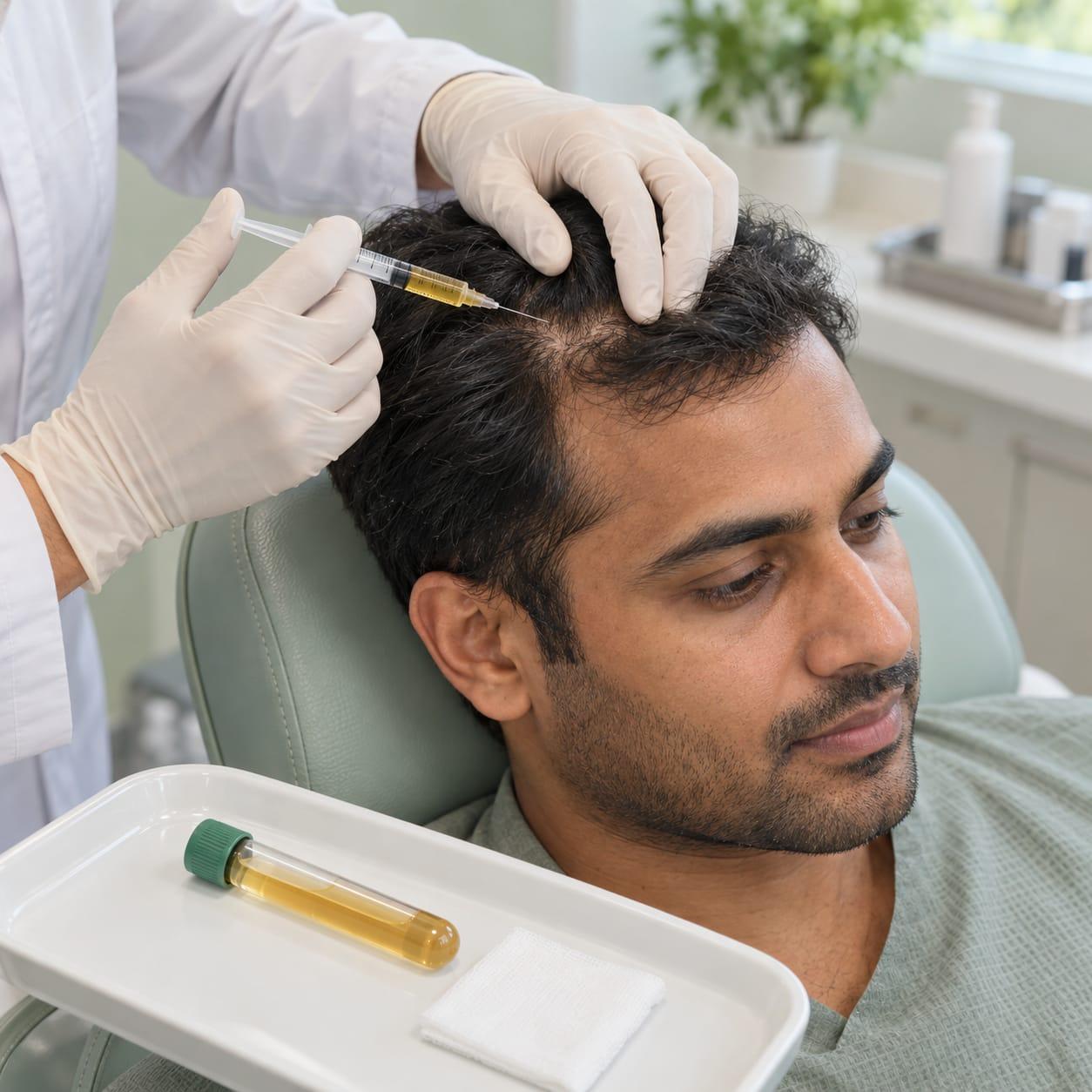
What PRP for hair loss involves
PRP stands for platelet-rich plasma, a preparation made from your own blood. For hair loss, a professional collects the blood, prepares the PRP and injects it into the scalp. Treatment involves a course of visits. The preparation and number of sessions can differ between services and studies. [1, 2]
PRP can improve hair density in male pattern hair loss, but the results are mixed. One small controlled trial found an increase in density; another did not find a significant benefit over saline injections. A course is a possible additional option, with pain, repeat visits and uncertain maintenance to weigh against the possible gain. [1, 2]
This page explains the treatment, the courses studied and the questions that make a clinic's offer easier to assess. It concerns pattern hair loss in adult men. The guide to hair loss types explains the distinction when the cause of thinning is unclear.

Where PRP fits in the treatment comparison
PRP can be offered on its own or as part of a package with medicines or microneedling. The distinction matters: a course of PRP injections and a package containing several treatments are different offers. Improvement after a package does not reveal how much each part contributed. [1, 2, 3, 4]
PRP is an optional procedure alongside the main treatment choices. It has not been shown to outperform minoxidil or finasteride in the studies reviewed here. The two placebo-controlled trials below compared PRP with an inactive injection, rather than with either medicine. [1, 2]
- PRP alone
- An injection courseBlood collection, preparation and scalp injections over several visits.
- PRP in a package
- Several treatmentsSome reports combine injections with minoxidil, topical plasma or microneedling.
- After the course
- A review planThe treatment offer should say how results and any proposed boosters will be assessed.
The preparation, accompanying treatments and session plan define what is being offered. [1, 2, 3, 4]
The routines guide explains where an optional procedure fits beside a base treatment. Our ranking compares six ingredients, so PRP is assessed separately. The decision includes variable results, repeat visits and uncertainty about maintaining a benefit.
How many sessions were actually studied?
PRP involves several appointments, but the studies reviewed do not establish one best number. One trial used three sessions 30 days apart; another used five sessions four to six weeks apart. These are examples of professional research courses, useful for understanding the commitment and comparing it with an offer. [1, 2]
Two research courses, not one standard schedule
| Study detail | Gentile 2015 | Gressenberger 2020 |
|---|---|---|
| Number of sessions | Three | Five |
| Interval | 30 days apart | Four to six weeks apart |
| Comparison | PRP and placebo areas within each man | Separate groups receiving PRP or saline |
| Result discussed here | Total density at three months | No significant benefit for count or diameter; follow-up extended to six months after the last treatment |
| Optimal maintenance? | Not established | Not established |
These are source-specific research protocols in men. A month counted from starting and a month counted from the final session are different time points. [1, 2]
This is why a statement such as “results at six months” needs a starting point. It may mean six months after the first visit or six months after the course ended. The appointment sequence, assessment date and background treatment should all be clear before comparing that claim with a study.
The trials reviewed do not establish a universally optimal annual or six-monthly booster schedule. A clinic may offer a maintenance plan, but its proposed plan and the research supporting it are separate things. Nor does an initial response demonstrate that the result will be permanent. [1, 2]
What the positive placebo-controlled trial found
PRP increased total hair density more than placebo in one small trial. Gentile and colleagues enrolled 23 people and analysed 20 men in their 2015 trial. Each man's scalp was split into treatment and control areas: PRP on one side and placebo on the other. This allowed a comparison within the same person. It did not create two independent groups of 20 men. [1]
After three sessions, 30 days apart, total hair density at three months had increased by 45.9 hairs per cm² in the PRP area and decreased by 3.8 hairs per cm² in the control area. The paper denied conflicts of interest; a separate funding statement was not identified in the text reviewed. [1]
One scalp, two treated areas
Gentile 2015: 23 enrolled, 20 men analysed.
| At three months | PRP area | Placebo area |
|---|---|---|
| Total hair-density change | +45.9 hairs per cm² | −3.8 hairs per cm² |
| Whose scalp? | The same 20 men | The same 20 men |
| What this establishes | A favourable result for this preparation and course | A concurrent placebo comparison, not another independent patient group |
Three sessions 30 days apart. Conflicts were denied; separate funding was not identified in the text reviewed. Total hair density is not the same outcome as terminal-hair density, and neither is a whole-head count. [1]
The size of the average change is not a success rate. It does not say that a specified percentage of men will be satisfied, or that a man starting with a different pattern will obtain the same gain. It also gives no basis for comparing this number directly with a different treatment's study, even when both happen to use hairs per square centimetre.
The placebo-controlled trial that did not find benefit
A different small trial did not find a significant benefit for hair count or hair diameter, the width of a hair. Gressenberger and colleagues randomised 30 men in their 2020 pilot study: 20 to PRP and 10 to saline. Twenty-eight completed treatment. The course involved five sessions, four to six weeks apart. Conflicts of interest were denied; separate funding was not identified in the text reviewed. [2]
For someone considering a course, this means more injections do not guarantee a better result. This study used more sessions than the positive trial, yet did not show a benefit. It used a different preparation and design, so the contrast cannot tell us whether three or five sessions is better. [1, 2]
The size of the 2020 placebo-controlled pilot
PRP
20men randomised
Saline control
10men randomised
Gressenberger 2020. Thirty men were randomised and 28 completed treatment, after a course of five sessions four to six weeks apart. No significant benefit for hair count or diameter was found. These bars show allocation, not improvement. Conflicts were denied; separate funding was not identified in the text reviewed. [2]
The small size also matters. The result does not establish that every PRP preparation is ineffective. Taken together, the studies support discussing a possible benefit, while leaving the chance and size of an individual response uncertain. Neither identifies which difference in preparation or measurement explains their disagreement. [1, 2]
Does PRP add to minoxidil or finasteride?
Adding PRP to minoxidil has been studied, but the reports reviewed do not give a dependable estimate of the extra benefit from the injections alone. Some test several additions together; others provide too little detail to separate the effects clearly. [3, 4]
One report by Jha included 93 participants, 31 per group: minoxidil solution alone, the solution with PRP, or the solution with PRP and microneedling. We reviewed its published summary; funding was not verified and conflicts of interest were denied. The summary's overall comparison does not supply adequate isolated pair-by-pair estimates, and full procedural and safety details were unavailable. It should not be converted into a precise claim about the contribution of PRP alone. [4]
A comparison with a PRP addition
A procedure package
The second report, by Shah, studied 50 men over six months. Both groups used 5% minoxidil solution; one also received the procedure package. It was open-label, meaning treatment was known, and it did not isolate the contribution of the injected PRP from the other additions. The full text declared no funding or conflicts of interest; its image-based outcome tables were not available to us. A reported benefit for the package remains a package-level finding. [3]
For PRP added to minoxidil foam or finasteride, the selected sources do not provide a verified estimate of extra benefit. The minoxidil and finasteride guide covers that medicine pairing, while the microneedling page explains the other procedure sometimes included in a PRP package.
Side effects and the limits of the safety reports
PRP injections can be painful and can cause local swelling, redness, minor bleeding and bruising. Gressenberger reported these effects as reversible, but did not give a count for each symptom. No serious events were reported. Gentile reported no adverse events. The small trials leave uncommon and long-term harms uncertain. [1, 2]
What was reported
Pain and local effects such as redness, swelling, bruising and minor bleeding in the 2020 pilot. Event-specific frequencies were not supplied.What the studies cannot quantify
An uncommon or long-term harm may not appear in a small trial. No serious event observed is not the same as a measured zero risk.What belongs to the service
The particular preparation, procedure and individual assessment need to be explained by the professional providing it. A result from one study does not validate every service.
Safety reporting from the two placebo-controlled trials. The descriptions do not establish identical risks across different protocols. [1, 2]
The fact that the preparation comes from the person's own blood describes its origin. It does not cancel the need to assess an invasive procedure. Similarly, the absence of a daily tablet does not mean there is no treatment burden: the blood collection, injections and repeated visits are part of the comparison. [1, 2]
Cost, boosters and what a quotation should contain
PRP prices are attached to visits or packages, so a single session price does not reveal the cost of the proposed course. A quotation is easier to assess when it says which preparation and procedure are included, how many visits are planned, when the result will be reviewed and which costs fall outside the package.
A yearly price would also require an assumption about boosters. Because the studies here do not establish an optimal maintenance schedule, multiplying a session price by a guessed annual frequency would create a number without a sound clinical basis. A package labelled as a course is not automatically a year's treatment. [1, 2]
Questions that make an offer comparable
- Does the quotation describe PRP alone or a package with medicines and microneedling?
- Which preparation and session protocol is being proposed, and which study matches it?
- How many visits are included, and are consultation and later reviews included?
- Are boosters part of the price, and what evidence supports their timing?
- What result will be assessed, and what will happen if the response is unsatisfactory?
The answers give the quotation a useful meaning: a particular course, with defined visits and reviews. They also make it easier to compare the commitment with a light-device purchase, where the price and pattern of use are different.
How to judge progress without attributing everything to PRP
A consistent record separates what happened from what caused it. Comparable photographs and a dated account of visits, medicines and other changes make a review more useful. If several treatments start together, photographs can show the course of hair loss, but they cannot by themselves identify which treatment produced the change.

The tracking guide describes consistent photographs. The comparison of hair procedures puts PRP beside microneedling and light devices without turning unrelated study results into an efficacy ranking.
Where to go next
PRP is worth understanding as a possible course of treatment, with a possible density gain and a real commitment to visits and injections. A clear proposal identifies the preparation, accompanying treatments, full cost and review plan. The studies support neither a guaranteed result nor one ideal maintenance schedule. [1, 2, 3, 4]
How an optional procedure fits into a hair-loss routineSeparate a base treatment, an alternative and an addition before judging a larger package.