
What is red-light therapy?
For hair loss, red-light therapy uses a device to shine low-level light onto the scalp, with the aim of encouraging hair growth. You may also see it called low-level light therapy, low-level laser therapy or LLLT. Photobiomodulation is the broader technical name for this type of light treatment. It uses red or near-infrared light, rather than ultraviolet light. [1, 2]
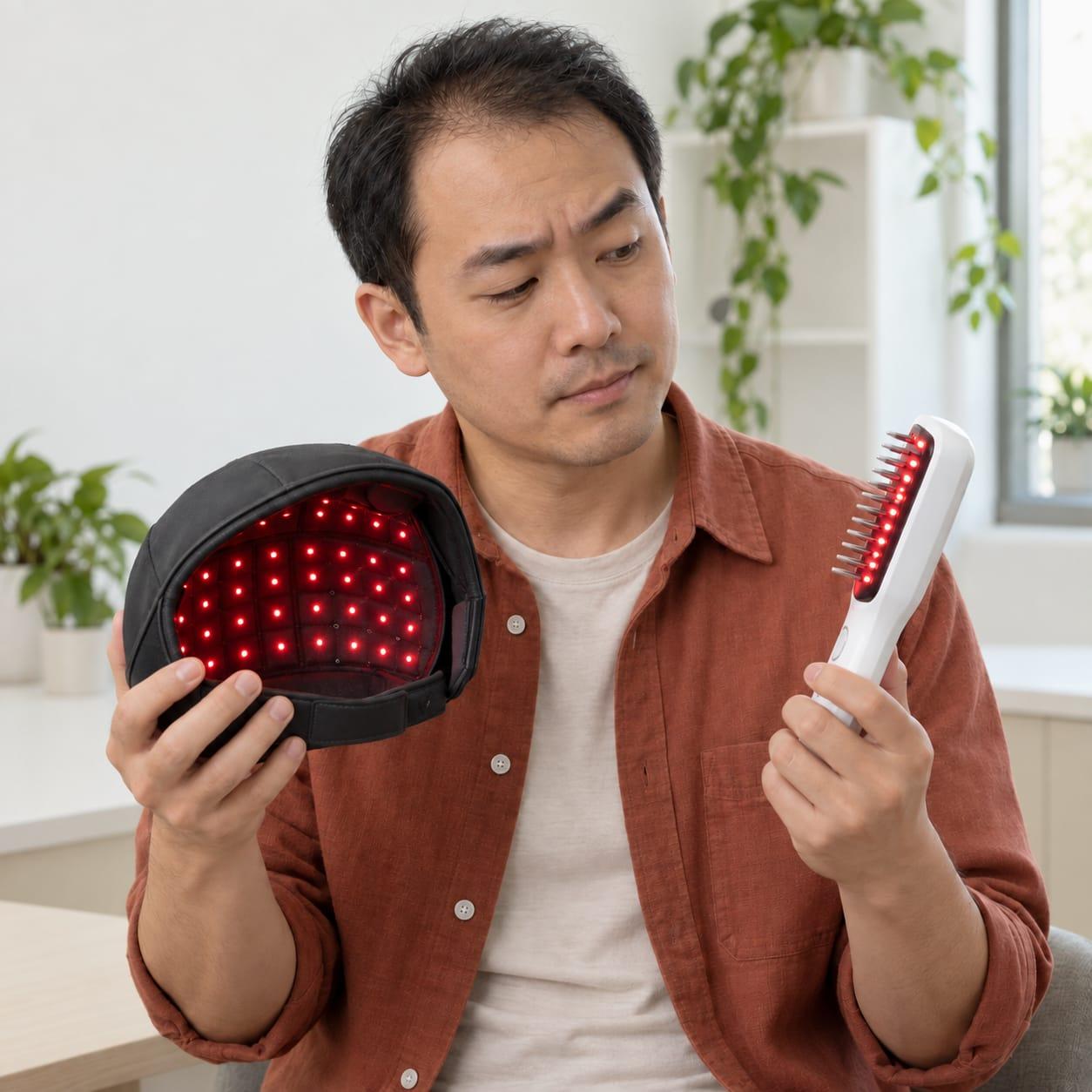
For hair loss, the treatment is delivered through devices such as caps, helmets and handheld combs. Some use lasers and some use light-emitting diodes, or LEDs. The purpose is to stimulate the hair follicles, the structures in the skin where hair grows. This proposed action does not tell us how well a particular product works; that needs testing in people. [2]
This guide is about male pattern hair loss, the gradual inherited thinning that commonly affects the hairline and crown. It is not a guide to every cause of shedding. If that does not describe what you are seeing, start with the guide to hair loss types.
Caps, combs, helmets and panels: what is the difference?
There are two separate things to compare: how the device is used and what produces the light. A cap or helmet is worn on the head; a comb is handheld. Laser and LED describe the light source, not the shape. A product name such as “red-light cap” does not answer both questions. [1, 2]
What the device names tell you
A practical distinction, not a ranking of effectiveness.
| Device | What it is | What still needs checking |
|---|---|---|
| Comb | A handheld device used over the scalp. | Whether the exact model was studied, and how it was used. |
| Cap or helmet | A wearable device that positions lights over the head. | The light source, model and hair-loss trial behind its claims. |
| Panel or skin device | A different format, often sold for skin concerns. | Evidence for scalp hair growth, rather than evidence for another use. |
These formats are described by the American Academy of Dermatology. The detailed hair-count results below concern laser combs; they cannot establish which format is best. [1, 2]
We cannot name a winning format from the trials reviewed here. More lights, a longer session or a higher price is not a substitute for a study of the actual product. A useful comparison identifies the device, its treatment instructions and the hair-growth result measured in its trial.
Where a light device fits beside medicines
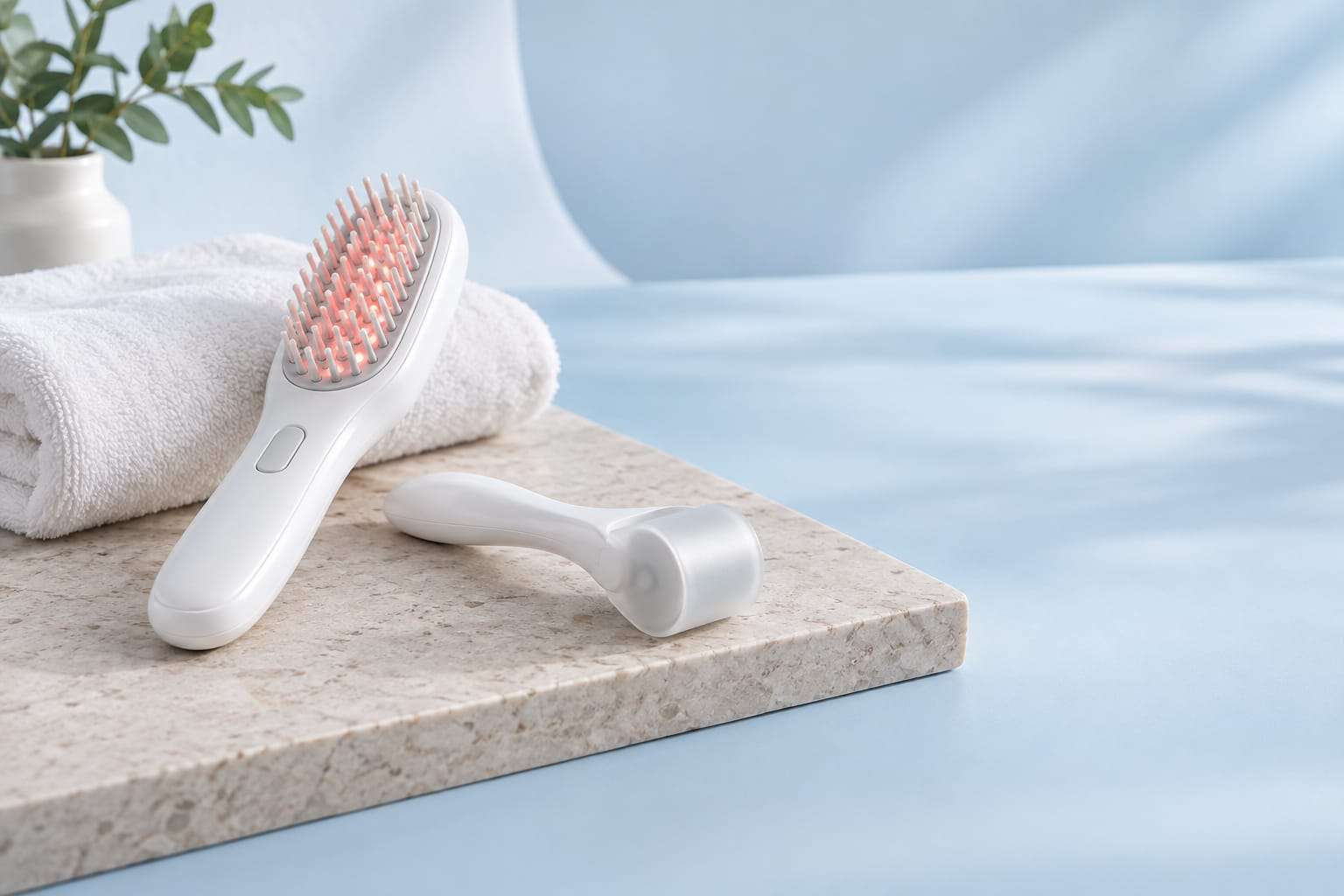
A light device may appeal to someone who wants a treatment without a tablet or scalp lotion. It still means buying a device and using it regularly. In the main comb trials, treatment involved three sessions a week for 26 weeks. That schedule belongs to the models tested, rather than every light device. [1]
We treat light therapy as an optional device-based treatment and compare it separately from the six ingredients in the ranking. The important practical question is whether its possible benefit justifies the cost and repeated sessions for you.
- Type of option
- A deviceThe model matters as much as the phrase red light.
- Practical commitment
- Regular sessionsThe main studies ran for about six months.
- Main finding
- More hairs countedThe tested combs outperformed look-alike devices without the active laser.
The trial evidence below concerns the specified combs and a separate light-device comparison with minoxidil. [1, 3]
For a reader weighing a device because medicines are inconvenient or unwelcome, the minoxidil and finasteride comparison explains the alternatives. Preferring a device is a practical preference. It does not establish that the device provides the same benefit or has no risks.
What the sham-controlled trials found
The tested laser combs increased hair density more than the comparison devices. Those comparisons used a sham: a look-alike comb that did not deliver the active laser treatment. This lets researchers test whether the treatment itself makes a difference. [1]
Jimenez and colleagues reported four randomised trials in 2014, involving 269 men and women overall. The male studies randomised 128 men and analysed 103. They measured terminal hairs, the thicker hairs, per square centimetre. The chart keeps the male results together without treating all 269 participants as men. [1]
At 26 weeks, each active comparison showed a larger gain than its sham comparison. Lexington partly funded the research and supplied the devices; two authors disclosed fees. Losses to follow-up and the way missing results were handled limit the confidence we can place in the estimates. These are results from that report, not a forecast for any current device. [1]
Terminal-hair gains at 26 weeks in the male comparisons
Seven-beam model
18.41.6Nine-beam model
20.99.4Twelve-beam model
25.79.4
Average gain in terminal hairs per cm². The male studies randomised 128 men and analysed 103; the entire four-trial report included 269 men and women. Each row retains its own sham comparison. The repeated sham value is not an additional independent group to count twice. Lexington partly funded the research and supplied devices, and two authors disclosed fees. [1]
The chart does not identify a best model. The seven-beam and nine- or twelve-beam comparisons were not one clean contest to choose a winner. Even the sham groups changed by different amounts. Subtracting those values, or choosing the largest active bar, would not establish which current product a man should buy.
There is also a difference between a measured gain and a visible transformation. These are average counts within measured scalp areas. They do not give the probability of a result that a particular man will notice in a mirror, and they are not a count of new hairs over his whole head.
Does it work as well as minoxidil?
We cannot yet say that it works as well as minoxidil from the comparison reviewed here. A trial can fail to detect a difference without proving that two treatments are equally effective.
One later trial compared low-level light therapy with 5% topical minoxidil in 91 men. Seventy-five completed six months. Its published summary reports no significant difference between the groups. We read the summary, not the full paper; it does not provide the confidence intervals needed here to judge how much uncertainty surrounds the comparison. Funding was not verified. [3]
That result does not establish equivalence. Failing to detect a difference can leave several possibilities open, including a meaningful difference that a study could not estimate precisely. It also does not compare a light device with finasteride, or with minoxidil and finasteride together.
What was tested
What stays open
The full minoxidil profile describes its own trials and separates solution, foam and tablets. None of those forms should silently be substituted for the comparator in this device study. Similarly, the finasteride results page covers a different treatment and different outcome measurements.
Which comb, cap or helmet has the evidence?
The older report used HairMax Lasercomb models with seven, nine or twelve beams. The specified sessions differed by model. That matters when a product page quotes the trial but sells a device with a different shape, arrangement of lights or set of instructions. The paper cannot verify every later commercial model. [1]
The schedules studied by Jimenez and colleagues
A record of the research, not instructions for another device.
| Trial detail | Seven-beam comb | Nine-beam comb | Twelve-beam comb |
|---|---|---|---|
| Session length | 15 minutes | 11 minutes | 8 minutes |
| Frequency | Three times weekly | Three times weekly | Three times weekly |
| Treatment period | 26 weeks | 26 weeks | 26 weeks |
These are the named study models' protocols. The paper does not establish that any helmet, panel or comb can use the same timings. [1]
The paper identifies devices that were FDA-cleared in the United States at that time. This is a historical statement about those devices. It does not certify every device now sold in the US or establish a current UK product's status. The model and its own instructions need to be identified before a meaningful comparison can be made. [1]
An evidence claim is more useful when it links the product actually being sold to the device actually studied. A study of the broad technology may be informative, but a shared phrase such as “red light” does not complete that link. This page therefore gives no best-brand list or universal setting.
How long results and maintenance take
Think in months rather than days. The main comb studies followed treatment for about six months, with hair measurements during that period. [1]
The Lasercomb trials assessed results at 16 and 26 weeks. Those are study measurement points, not a guarantee of visible improvement at either visit. They also do not establish the best frequency or duration to retain a response beyond 26 weeks. A course measured in months is not evidence for a permanent effect. [1]
When the Lasercomb trials measured hair
Studied combs
Repeated use during the trial
Assessment points from the Jimenez report. They do not specify when an individual will first notice a change or how long to continue after a response. [1]
The practical distinction is between a trial's end date and a maintenance plan. A seller's suggestion to use a device indefinitely might be an instruction for that product, but the trial above does not by itself prove that this is the optimal maintenance schedule. Conversely, its end date is not evidence that stopping then preserves the gain.

The hair-growth tracking guide explains how to keep photographs comparable. A short record of the device used, the sessions actually completed and any other treatment changes gives the later photographs context. This is a way to organise an assessment, not a method of increasing the device's biological effect.
What side effects were reported?
Dry skin and itching were among the side effects reported in the main comb trials. No serious events or treatment withdrawals caused by side effects were reported. Dry skin was listed at 5.1% and itching at 2.5%. The paper does not clearly identify which participants those percentages use as their base, so they should not be read as precise risk estimates for men. [1]
Those observations are reassuring within the study's limits. They do not measure every uncommon or long-term risk, and they cannot guarantee the safety of another device. The absence of a daily medicine is a difference in treatment burden, not evidence that the intervention is free of unwanted effects.
If the reason for considering a device is a problem with a medicine, the minoxidil side-effects page and finasteride side-effects page keep those separate questions clear. A device study cannot determine the cause of a symptom on another treatment or settle the decision to change it.
What it adds to an existing routine
The distinction between an alternative and an addition is central. A device beating sham shows benefit in that comparison. A device compared with minoxidil asks which of the two performs better under the trial conditions. Neither design measures the added benefit of placing the device on top of a particular medicine routine. [1, 3]
We did not carry out an exhaustive search of every light-device combination. The selected comparisons here do not establish an extra gain with minoxidil foam, minoxidil solution or oral finasteride. This is a limit of the evidence we reviewed, not a claim that no combination study exists.
What a proposed addition needs to explain
- Which exact device and current instructions are being proposed?
- Is the supporting trial against sham, against a medicine, or on top of that medicine?
- Were the background medicines and their forms the same as the proposed routine?
- How will response, unwanted effects and the time commitment be reviewed?
The routines guide separates supported pairings from optional additions. The more detailed minoxidil and finasteride page covers that medicine combination. Its result cannot be added numerically to a device trial's hair gain to predict a combined result.
Cost and the commitment behind a purchase
An initial device price is only one part of the choice. The studied approach also required repeated sessions. Our reviewed trials do not establish how long a purchased device will remain useful or the optimal maintenance course, so dividing a purchase price by a presumed treatment lifetime would give a misleading impression of certainty. [1]
Identify the product
The model being purchased should be clear, together with the particular evidence claimed for it. A technology label is not a model number.Count the practical burden
The product's session instructions belong beside its price. A lower purchase cost does not establish a lower time commitment or an equivalent result.Keep maintenance uncertainty visible
A promise about the number of months or years a purchase will cover needs its own support. The trial end date does not settle the lifetime of the benefit.
These questions are also useful when comparing a device with visits for PRP or microneedling. The procedures involve different work, different comparators and different uncertainty. A larger hair-count number taken from another trial would not resolve the choice.
Where to go next
Red-light therapy can help some men with male pattern hair loss grow more hair. The useful next step is to evaluate a particular device: the study behind it, the required sessions and its cost. The reviewed evidence does not establish a best model, an equal substitute for minoxidil or an ideal long-term schedule. [1, 3]
Compare hair loss procedures and devicesMicroneedling, light devices and PRP compared by their evidence, practical burden and unanswered questions.