
What female pattern hair loss means
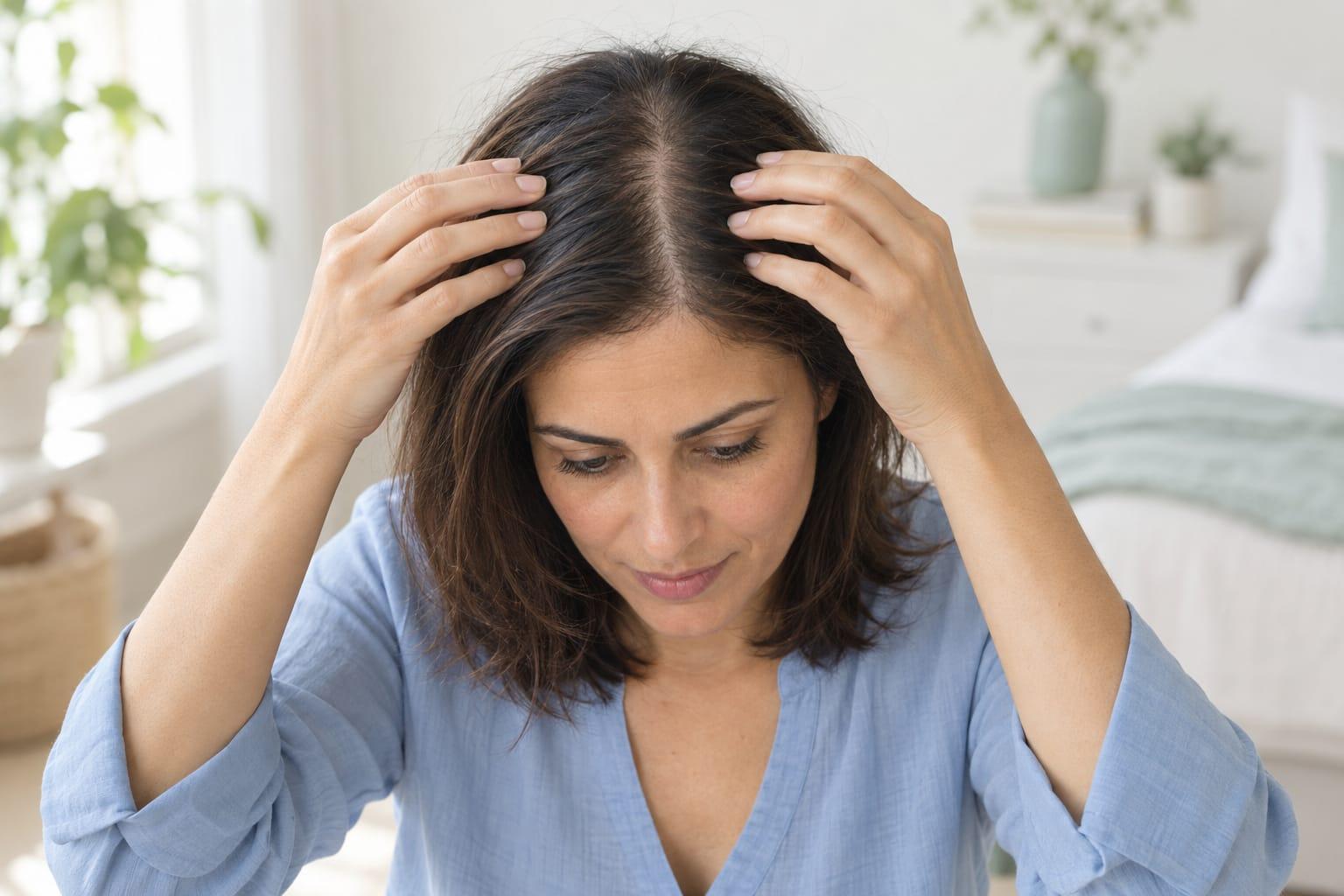
Female pattern hair loss, or FPHL, is a gradual reduction in hair density, usually most visible along the central part and over the top of the scalp. Affected follicles produce finer, shorter hairs, a process called miniaturisation. The front hairline often remains relatively preserved. It is also called androgenetic alopecia. [1]
It is a long-term condition rather than a single episode of shedding. Treatment can improve coverage or slow further thinning, but it does not reliably restore the original density. A widening part is a reason to investigate, not a diagnosis from a photograph or quiz. [1, 2] This guide explains the options for adult women with FPHL and the next step when that diagnosis is uncertain.
Three distinctions that change the next step
- Pattern
- Gradual thinningCentral and top-of-scalp thinning can fit FPHL, but other causes can look similar.
- Treatment
- Form mattersMinoxidil foam, liquid and tablets have different evidence, instructions and risks.
- Context
- Pregnancy mattersPregnancy plans and breastfeeding change which medicines can be considered.
Orientation, not a diagnostic test or a treatment ranking. [1, 2, 3, 4]
Could this be shedding or another condition?
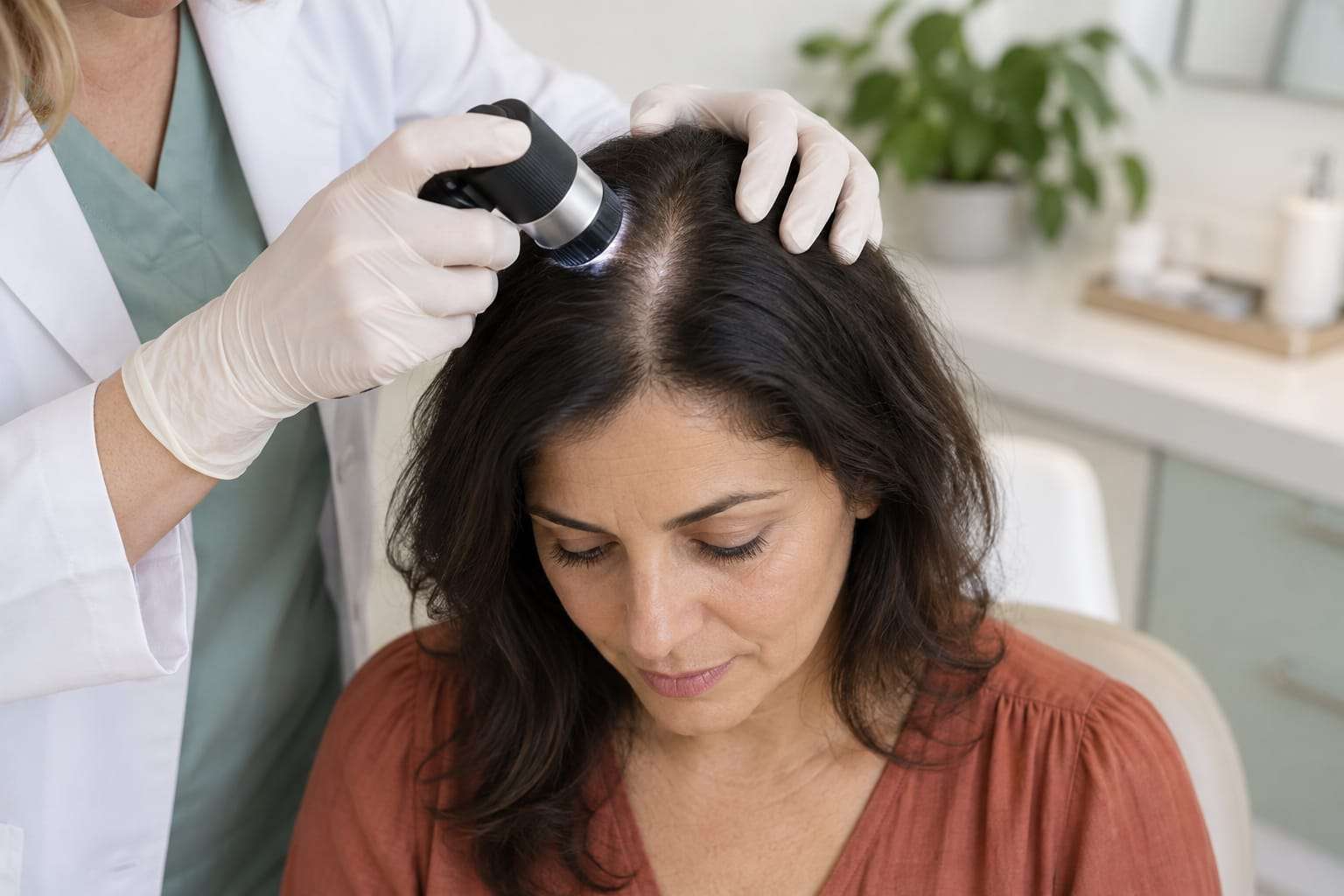
Yes. Increased shedding and pattern loss can overlap, and similar-looking thinning can have different causes. A clinician asks about the timing, examines the scalp and hair, and may order tests when the history suggests a deficiency, hormonal condition or another disease. Blood tests are not an automatic package for every widening part. [5]
| What you have noticed | What the distinction means |
|---|---|
| Slowly widening part or reduced density over the top | Compatible with FPHL, but confirmation depends on the history and examination. [1] |
| A sudden increase in shedding across the scalp after illness, major weight loss or childbirth | Can fit telogen effluvium, where more hairs enter the resting and shedding phase. It may become noticeable about three months after a trigger. FPHL can coexist. [6] |
| Distinct patches, a painful or inflamed scalp, or an unclear cause | These do not belong in a self-selected pattern-loss treatment pathway. The US women's minoxidil labels exclude sudden, patchy and unexplained loss and an irritated or painful scalp. [3, 4] |
| Hair breaking or thinning where a hairstyle pulls | Hair-shaft damage or traction may need different changes from a regrowth medicine. [7, 8] |
The existing guide to types of hair loss explains these other causes, although its main framing is for men. The distinctions in this section apply to this female pathway too.
Does it mean I have high androgen levels or PCOS?
No. FPHL on its own is a weak predictor of high androgen levels in the 2023 international polycystic ovary syndrome guideline. Androgens are hormones present in women as well as men. Irregular periods, acne or increased facial/body hair can make a broader hormonal assessment relevant; a hair quiz cannot diagnose PCOS. [9, 1]
Which treatments have relevant evidence?
Topical minoxidil, meaning minoxidil applied to the scalp, is the established starting point in the sources reviewed here. Some women discuss oral minoxidil or an antiandrogen with a prescriber when a scalp treatment is unsuitable or insufficient. An antiandrogen reduces the action of androgen hormones; these medicines do not all have the same evidence or risks. [2, 10, 11]
Options to understand before choosing a product
| What it offers | Use and trade-offs | |
|---|---|---|
| Topical minoxidil | Female trials support hair growth from specific scalp formulations. | Regular scalp applications and continued use; irritation and unwanted facial hair are relevant risks. Product labels determine access and use. |
| Oral minoxidil | A prescribed alternative; small female trials do not establish superiority over topical treatment. | Hair-loss use is off-label in the US and UK. Body-wide exposure brings blood-pressure, swelling and heart-related considerations. |
| Spironolactone | A possible prescribed antiandrogen, with limited controlled female evidence. | Off-label for FPHL in the UK. Pregnancy potential, other medicines, blood pressure, kidney function and potassium matter. |
| Cosmetic coverage | Fibres, hairpieces and wigs change visible coverage without waiting for regrowth. | They do not treat follicle miniaturisation. The choice can accompany treatment or stand on its own. |
A map of options, not a ranking or a personal regimen. Evidence below separates preparations and comparisons. [1, 12, 13, 3, 4, 14, 15, 10, 16, 17]
Foam and liquid are alternatives delivering the same medicine. A tablet is a different route, not a stronger version of a scalp dose. The minoxidil profile explains the forms, but its ranking and most trial examples concern men; the female evidence and label amounts are below.
What scalp minoxidil can achieve
Both 2% solution and 5% foam have evidence in women against a preparation without active minoxidil. Their results do not promise complete regrowth or tell us which form will work best for an individual. [12, 13]
The 5% foam versus an inactive foam
In a 24-week trial enrolling 404 women, once-daily 5% foam improved target-area hair counts and perceived scalp coverage more than the same foam base without minoxidil. The UK product information gives the following adjusted mean changes. A target area is a small measured scalp patch, not the whole head. [13, 18]
Hair-count change at 24 weeks in women
5% minoxidil foam once dailyUK efficacy table: n = 200
+13.4hairs per cm²
Inactive foam once dailyUK efficacy table: n = 197
+4.3hairs per cm²
Counts exclude the finest hairs. The difference was 9.1 hairs/cm², p below 0.0001. The table's 397 participants are not the 404 enrolled. We have the original abstract and product-information table, not a complete appraisal of attrition or the article's funding and conflicts. These were not verified as absent. [13, 18]
The 2% and 5% liquid solutions
A different trial randomised 381 women to 2% solution, 5% solution or inactive liquid, applied twice daily for 48 weeks. The 2% solution improved counts and investigator assessments relative to inactive liquid, but the women's own growth assessment was not significantly different. The 5% solution beat inactive liquid on all three main measures and 2% on self-assessed treatment benefit, with more itching, irritation and unwanted hair growth. That does not establish a hair-count advantage for every higher-strength product. [12]
This result comes from the original abstract; funding, detailed event counts and confidence intervals were not verified. In particular, 5% solution is not 5% foam. A trial regimen also does not establish the authorised instructions in your country. [12, 3, 4]
Is once-daily foam as effective as twice-daily liquid?
The direct studies leave uncertainty. A 113-woman trial reported that 5% foam once daily was not worse than 2% solution twice daily over 24 weeks, with less local intolerance. We could verify only its abstract, not the detailed statistical margin or funding. [19]
The larger 2016 trial randomised 322 women and found very similar average gains at week 24: 23.9 versus 24.2 hairs/cm². But it did not meet its planned test of whether foam was no worse by more than an acceptable amount. The difference was −0.3 hairs/cm², with a 95% confidence interval from −6.0 to +5.4; the permitted lower limit was −5.0. Close averages therefore do not establish equivalence. The registry identifies Johnson & Johnson Healthcare Products Division of McNEIL-PPC, Inc. as sponsor; complete funding/conflict statements were not available in the abstract. [20, 21]
How the women's product labels differ
The amount and frequency come from the exact product and market. These examples were checked on 3 October 2026. They are not interchangeable instructions for other brands, compounded preparations or countries. [3, 4, 18]
| Product and market | Amount on its label | If there is no regrowth or improvement |
|---|---|---|
| US Women's Rogaine 2% solution, adults 18 and over | 1 mL with the dropper, twice daily, onto the affected scalp | Stop and ask a doctor at four months. [3] |
| US Women's Rogaine 5% foam, adults 18 and over | Half a capful once daily, onto the affected scalp | Stop and ask a doctor at six months. [4] |
| UK Regaine for Women Once a Day 5% foam, ages 18 to 65 | 1 g, equivalent to half a capful, once daily across the total affected area | Stop if there is no improvement after 24 weeks. [18] |
For the UK foam, hair and scalp should be dry before application and hands washed afterwards. The US foam also specifies handwashing. The medicine belongs on the scalp, rather than coating the hair; more or more frequent application does not improve results. The US foam warning includes avoiding fire, flame and smoking during and immediately after use. Full handling and application instructions remain in the product's enclosed leaflet. [18, 4]
The US 2% solution contains propylene glycol; the listed US foam ingredients do not. That difference may matter to tolerability, but foam can still irritate. [3, 4] The minoxidil side-effects guide explains the distinction between scalp reactions and systemic symptoms; its male trial percentages are not female risk estimates.
How long it takes, and what happens after stopping
Expect months rather than days, with a review point tied to the product or prescriber. The US women's foam label says results may appear at three months, while some women need at least six months. That does not override its instruction to stop and ask a doctor if there is no regrowth at six months, or the different deadlines in the table. [4]
Continued topical minoxidil use is needed to retain the benefit. Stopping allows hair loss to resume; a successful course is not a permanent cure. [3, 4] For practical documentation, the tracking guide offers repeatable photographs and a product history. Its example treatment deadlines are mainly for men, so the female label table here remains the relevant reference.
Cost includes repeated supplies, the time needed to apply them and, for prescribed treatment, appointments or tests. Comparing the price of a pack without its expected duration gives an incomplete picture. We have not collected a current female-product price comparison for different markets.
When oral minoxidil enters the discussion
Oral minoxidil can be considered with a prescriber when topical treatment is difficult to use or tolerate. Its US and UK tablet indications are for hypertension, so prescribing it for hair loss is off-label. That means outside the authorised indication, not an over-the-counter alternative. [11, 16, 17]
The female trials are smaller than the main topical trials. In the original thesis for the Ramos trial, 52 women were randomised to 1 mg orally daily or 5% solution once daily for 24 weeks; 50 completed. Total density increased by 12.2% and 7.2%, respectively, with no statistically significant difference between groups (p = 0.09 in the thesis). This did not establish that the treatments were equivalent. The final journal letter was not fully available; the thesis and letter describe the same study. Funding was FUNADERSP, and one author disclosed oral-minoxidil patents and company interests. [14]
A separate 72-woman, nine-month study of 0.25 mg oral minoxidil versus 2% solution also reported no significant difference in density trajectories. The publisher provides its abstract and disclosures: funded by Mashhad University of Medical Sciences, with no conflicts declared. Detailed use and participant accounting remain unverified. Neither trial supplies a personal dose or proves that a tablet is more effective. [22]
Selected side effects in the 52-woman Ramos trial
| Oral 1 mg daily26 randomised | 5% solution daily26 randomised | |
|---|---|---|
| Unwanted hair growth | 7 of 26 | 1 of 26 |
| Shin swelling | 1 of 26 | Not quantified here |
| Itching | Not quantified here | 5 of 26 |
From the trial's thesis, 24 weeks. A small trial cannot estimate rare serious harms, and these counts do not describe every dose or formulation. [14]
The oral prescribing information warns about fluid around the heart and other cardiovascular problems at its hypertension indication. Those frequencies cannot be transferred to low hair-loss doses. The international prescribing consensus discusses blood pressure, cardiovascular and kidney history, other medicines and monitoring; it is not proof of comparative efficacy. [16, 11] The oral minoxidil guide adds context, while keeping its male trial results separate.
What about spironolactone and other antiandrogens?
Spironolactone is a possible prescribed option, but its controlled evidence is less conclusive than a simple “it works” claim suggests. A Thai pilot randomised 48 premenopausal women to spironolactone 100 mg daily or placebo, both with 3% minoxidil solution twice daily, for 24 weeks. The efficacy analysis included 43 women who completed follow-up: 21 on spironolactone and 22 on placebo. The increase in thicker, terminal hairs was 9.48 versus 5.32 hairs/cm²; the difference was not statistically significant (p = 0.063). More women reached moderate or marked photographic improvement with the combination: 8 of 21 versus 2 of 22 (p = 0.034). The broader photographic score comparison was not statistically significant. [15]
The trial was small, restricted to premenopausal Thai women and funded by Srinakharinwirot University's Faculty of Medicine; no conflicts were declared. Menstrual irregularities occurred in 9 of 24 on spironolactone versus none of 24 on placebo, and two women stopped for this reason. These findings concern an add-on regimen, not spironolactone alone or an optimal dose. [15]
Other hormone-directed medicines need their own evidence, not a class-wide assumption:
| Option or comparison | What the reviewed female evidence permits |
|---|---|
| Bicalutamide added to oral minoxidil | In 74 women over 24 weeks, adding 25 mg bicalutamide to 1 mg minoxidil did not demonstrate extra density improvement over minoxidil plus placebo: gains 18.1 versus 21.5 hairs/cm², p = 0.86. Sixty-four completed. Funded by FUNADERM; no conflicts disclosed. A short trial does not settle long-term liver safety. [23] |
| Bicalutamide versus spironolactone alone | A 2026 trial randomised 204 women; 188 completed 24 weeks. Some magnified scalp measurements favoured bicalutamide, but clinical outcomes were not significantly different. Only the abstract was available; per-protocol analysis, short follow-up and unverified funding limit interpretation. It does not establish the best or safest antiandrogen. [24] |
| Finasteride | In 137 postmenopausal women, 1 mg daily for 12 months did not improve growth or slow thinning versus placebo. The abstract does not resolve other doses, premenopausal use or dutasteride; funding was not verified. The men's benefit cannot simply be imported. [25] |
For PCOS-associated FPHL, the international guideline's antiandrogen suggestion is a consensus recommendation that acknowledges limited specific evidence. It highlights fetal-development concerns, serious liver risks with flutamide/bicalutamide and meningioma risk with higher-dose cyproterone. These are specialist decisions, not a reason to change contraception or add a medicine yourself. [9]
Pregnancy, postpartum shedding and menopause are different contexts
Pregnancy or pregnancy plans change the treatment conversation. The AAD advises avoiding minoxidil when pregnant or planning pregnancy, and while breastfeeding. For antiandrogens, the PCOS guideline calls for counselling on fetal risks and effective contraception whenever pregnancy is possible. The appropriate plan depends on the actual medicine and clinical situation. [2, 9]
Breastfeeding is a separate prescribing question from the cause of shedding. A postpartum date cannot establish either the diagnosis or a medicine's suitability. A clinician or pharmacist can check the exact product against the reproductive context, rather than treating “not currently pregnant” as sufficient clearance. [5, 2]
FPHL is more common after menopause, but menopausal status alone does not choose a medicine. The negative finasteride trial above is specifically postmenopausal; it is a useful reminder that a plausible hormonal explanation does not guarantee treatment benefit. [2, 25]
Do supplements, devices or procedures help?
Supplements make most sense when there is a relevant nutritional problem to correct. An iron, zinc or biotin deficiency is a different question from treating FPHL in someone whose levels are adequate. The AAD recommends these supplements when a deficiency is found, rather than as a routine addition for everyone with hair loss. [5] The vitamins guide separates deficiency correction from trials of specific formulas, and the biotin guide explains laboratory-test interference. [26]
Other options require distinct questions:
- Light devices: specific laser-comb trials included women, but a result for one device is not evidence for every cap or comb. The light-therapy guide explains device and population limits. [27]
- Microneedling: some female studies tested it with topical minoxidil. That does not establish that home needling alone works, or a universal depth or frequency. The microneedling guide distinguishes those protocols. [28, 29]
- PRP: injections prepared from a person's own blood have a developing and heterogeneous evidence base. The PRP guide explains why results depend on preparation and trial scope; it is not a validated female regimen. [1]
- Hair transplantation: an assessment may be relevant for selected women, but diffuse thinning can leave insufficient donor hair. It is not a general solution for every female pattern. [2] The transplant guide explains donor assessment, techniques and their limits.
A useful next step, even without a diagnosis
If the cause is unclear, the useful outcome of this guide is a better assessment conversation. It is not necessary to select a treatment first. The scalp examination, timing of loss and relevant health history help determine which evidence applies. [5]
Questions to take to an appointment
- Does the pattern fit FPHL, shedding, breakage or more than one cause?
- Does my history suggest a specific test, rather than a general hair-loss panel?
- Which formulation is appropriate under the local label, and what review point applies?
- What changes with pregnancy plans, breastfeeding, other medicines or an irritated scalp?
- What benefit is realistic, what symptoms need attention, and what does continued treatment involve?
A dated photo sequence, symptom notes and the names of medicines and supplements already used can make that conversation more concrete. The tracking template can organise those details. Return to the Hair hub for the wider set of questions; this guide does not route female hair loss into the men's ingredient ranking.