
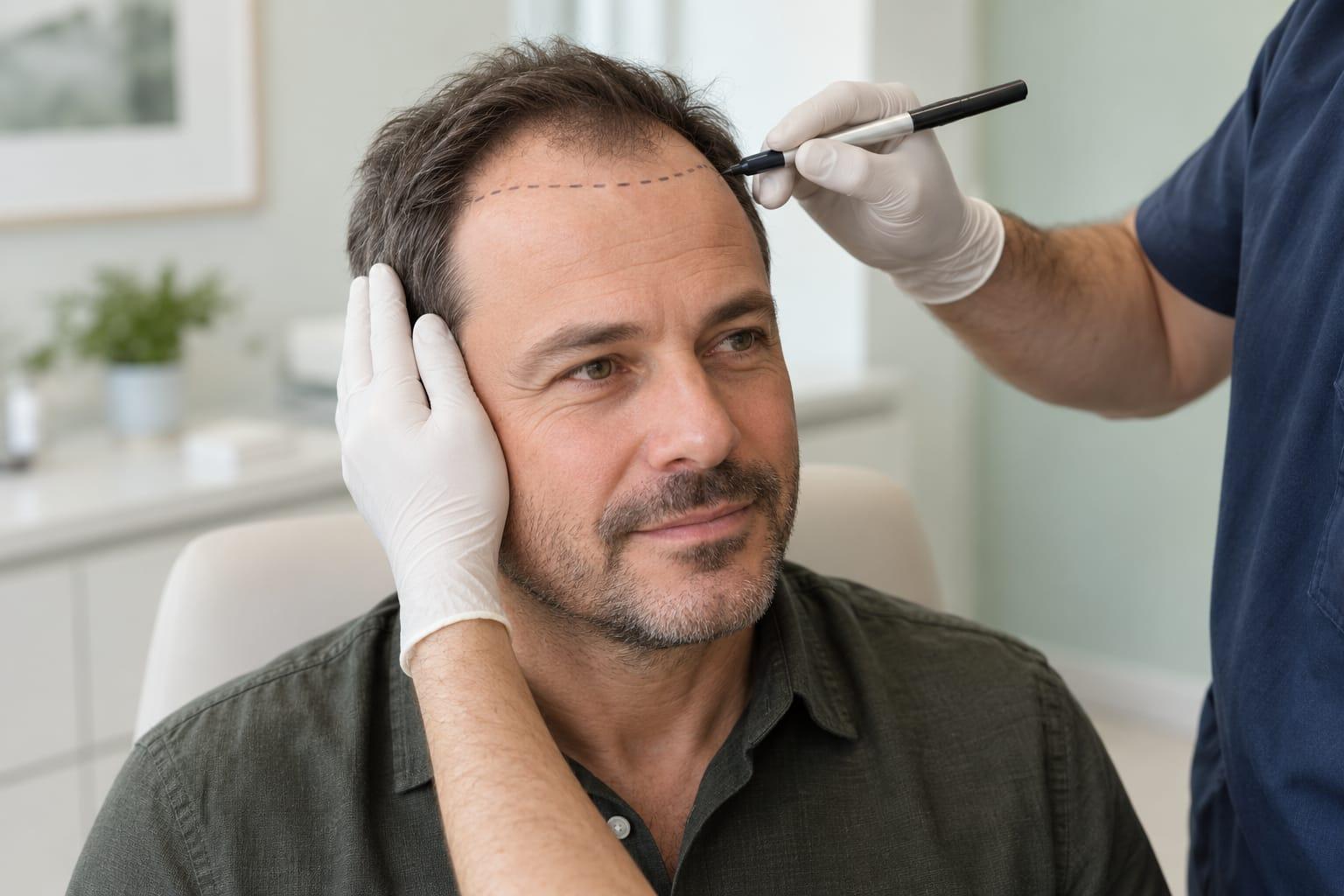
What a hair transplant changes
A hair transplant moves living hair follicles from a donor area into an area with less hair. A follicle is the structure in the skin that produces a hair. The aim is better coverage where it matters, using hair that the person already has. It does not manufacture a new, unlimited supply. [1, 2]
The donor area is usually at the back or sides of the scalp. A graft is a small piece of transplanted tissue; it commonly contains a follicular unit, the natural grouping in which one or several hairs grow. Consequently, a quotation for 2,000 grafts is not the same as a quotation for 2,000 hairs. Hairline design, the direction of placement and the balance between area and density all affect the appearance. [2]
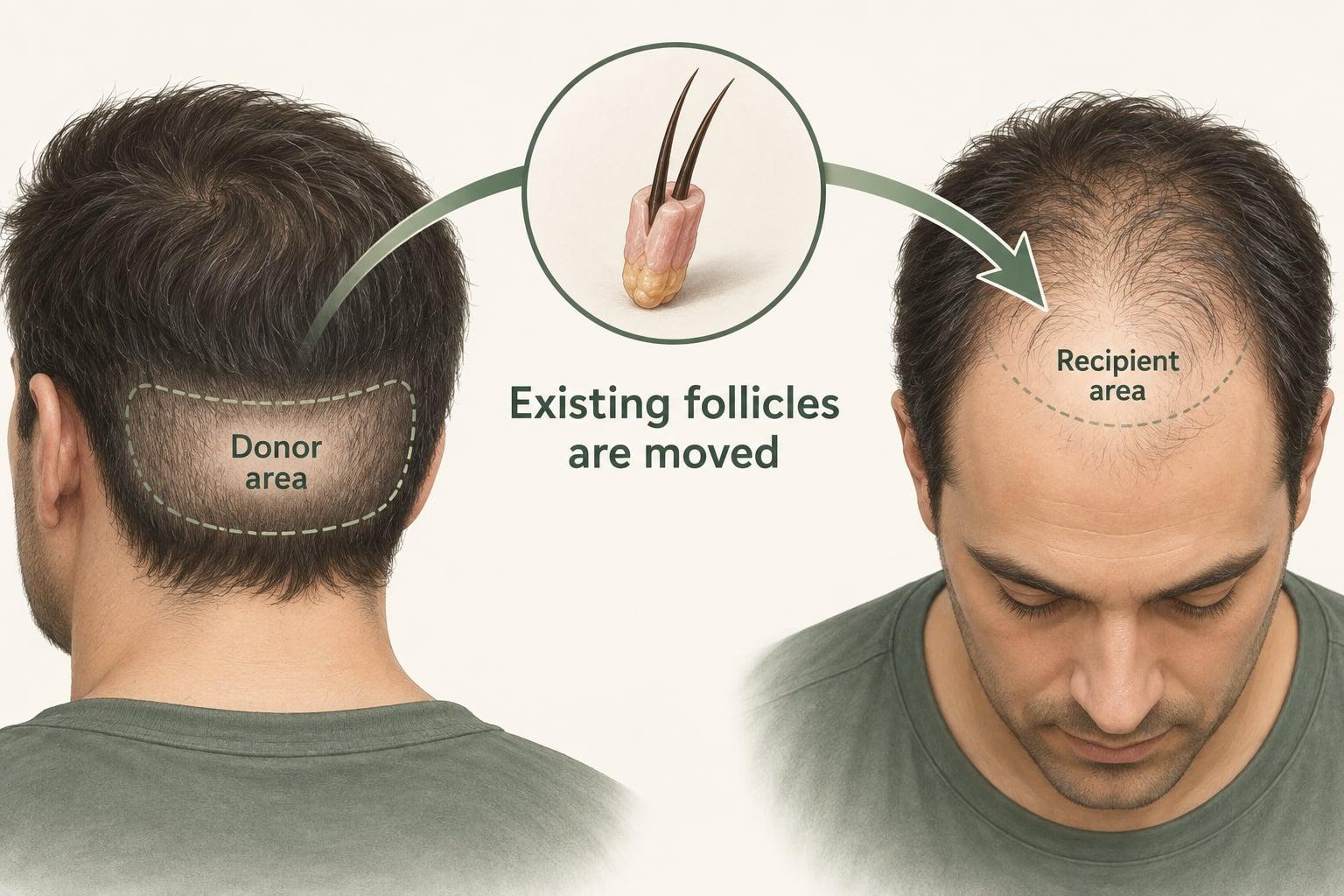
Read the illustration as two views of the same person's head. The follicles being moved come from their own donor supply. The remaining hair at the back must still provide coverage, while the grafts are distributed across the agreed recipient area. That is why the donor assessment comes before a promise about how many grafts can be used. [3, 2]
- Donor area
- Where hair comes fromIts quality and remaining coverage constrain the plan.
- Recipient area
- Where grafts goThe thinning area the surgeon and patient agree to cover.
- Native hair
- Hair left in placeIt can continue to thin around a successful transplant.
These are different parts of the same long-term plan. [1, 2]
This guide concerns scalp surgery, mainly for adult pattern hair loss. It also explains why women, diffuse thinning and scarring conditions need their own assessment. Sudden shedding, patches, pain or inflammation can change the question entirely: the guide to types of hair loss is the better starting point when the cause is unclear.
Explore the hair transplant collection
Read this overview for the whole decision, or choose the question you are working through now.
FUE, FUT and DHI
Who can be a candidate?
Recovery and shedding
Results and permanence
Choosing a clinic
Costs and quotes
FUE, FUT and DHI describe different parts of surgery
The first distinction is how donor grafts are collected. FUE means follicular unit excision, also commonly called extraction. Strip FUT means removing a strip of hair-bearing scalp and dividing it into grafts. Both are surgery and both leave scars. The abbreviation FUT can also be used more broadly for follicular-unit transplantation; here it means the strip collection method. [4, 3, 5]
| Question | FUE | Strip FUT |
|---|---|---|
| How are grafts collected? | Small punches release individual follicular units. | A strip is removed and divided under magnification. |
| What happens to the donor area? | Small scattered wounds heal with dot-like scars. Too much removal can leave visible thinning. | The wound is closed, leaving a linear scar that can widen. |
| What may influence the choice? | A preference to avoid a linear scar, limited scalp flexibility, or selected use of non-scalp donor hair. | Suitable scalp flexibility and a donor-zone shape or hair-length preference that favours a strip. |
| Does it require shaving? | Often, although selected unshaven approaches exist. | The donor strip can be trimmed without shaving the whole scalp. |
| Does the name guarantee a better result? | No. Donor planning, graft handling and placement still matter. | No. Those same steps still matter. |
These are planning trade-offs from society guidance, not a trial ranking. Neither method is scar-free, and a very short haircut can expose scars from either. Some people may have both methods across their treatment plan. [3, 5]
Where DHI and sapphire fit
Placement is a separate stage. Grafts may be placed with forceps into prepared sites or with an implanter. A dull implanter uses a premade opening; a sharp one makes the opening and places the graft. DHI, meaning direct hair implantation, is used inconsistently for sharp-implanter placement or implantation soon after collection. It is therefore possible to have FUE collection and an implantation approach advertised as DHI in the same operation. [4]
“Sapphire” usually refers to a blade used to make recipient sites. It does not replenish donor hair or identify a separate biological treatment. The meaningful question is what a specific instrument changes in the surgeon's hands, and whether a fair comparison measured a result that matters to patients. [4, 6]
- 1
Assess and plan
Establish the diagnosis, inspect donor hair and agree the intended coverage.
- 2
Collect donor grafts
Use individual-unit removal, strip harvesting or a planned combination.
- 3
Prepare and place
Prepare the recipient area and handle and position each graft carefully.
- 4
Review healing and growth
Follow the surgical aftercare plan, then assess the developing result over months.
The sequence follows the society descriptions of assessment, harvesting and implantation. [3, 5, 2]
The FUE, FUT and DHI comparison explains the practical trade-offs, unshaven options and what the comparative studies can tell us about implanters, sapphire blades and robotic assistance.
Who can benefit and who needs assessment first
Someone with diagnosed pattern hair loss, adequate healthy donor hair and achievable expectations may benefit. The assessment needs to consider the likely future pattern, not only today's empty area. Age alone cannot settle suitability: younger adults with evolving loss may be advised to wait while the pattern and treatment response become clearer. [1, 3]
Women with pattern hair loss
Women can be candidates. The cause of thinning and the quality of the donor area need checking; a diagnosis cannot be made from the width of a parting alone.Diffuse thinning
Thinning over the top is different from thinning throughout the proposed donor area. If the donor hair is also becoming finer, moving it may offer poor coverage and leave the donor region depleted.Scarring or inflamed scalp
A stable scar after injury or surgery is a different problem from active disease that damages follicles. Some resolved conditions can be assessed for transplantation; active disease needs diagnosis and control first.Patchy or temporary loss
Alopecia areata and reversible shedding are not interchangeable with pattern baldness. Surgery may be inappropriate even when the visible patch is large.
Suitability boundaries, not a diagnosis checklist. [1, 3, 5, 2]
An assessment also includes health, medicines, healing and scarring history. Hair calibre, curl and direction affect how much coverage a given number of grafts can produce. A selected beard or body donor may supplement scalp hair, but it is another limited source with different hair characteristics, not a guarantee that a poor scalp donor can be overcome. [3, 5, 7]
For the treatment options studied in women before considering surgery, see our female pattern hair-loss guide.
Our candidate and donor-area guide takes these questions further, including donor regrowth, hairline planning and what to bring to an assessment.
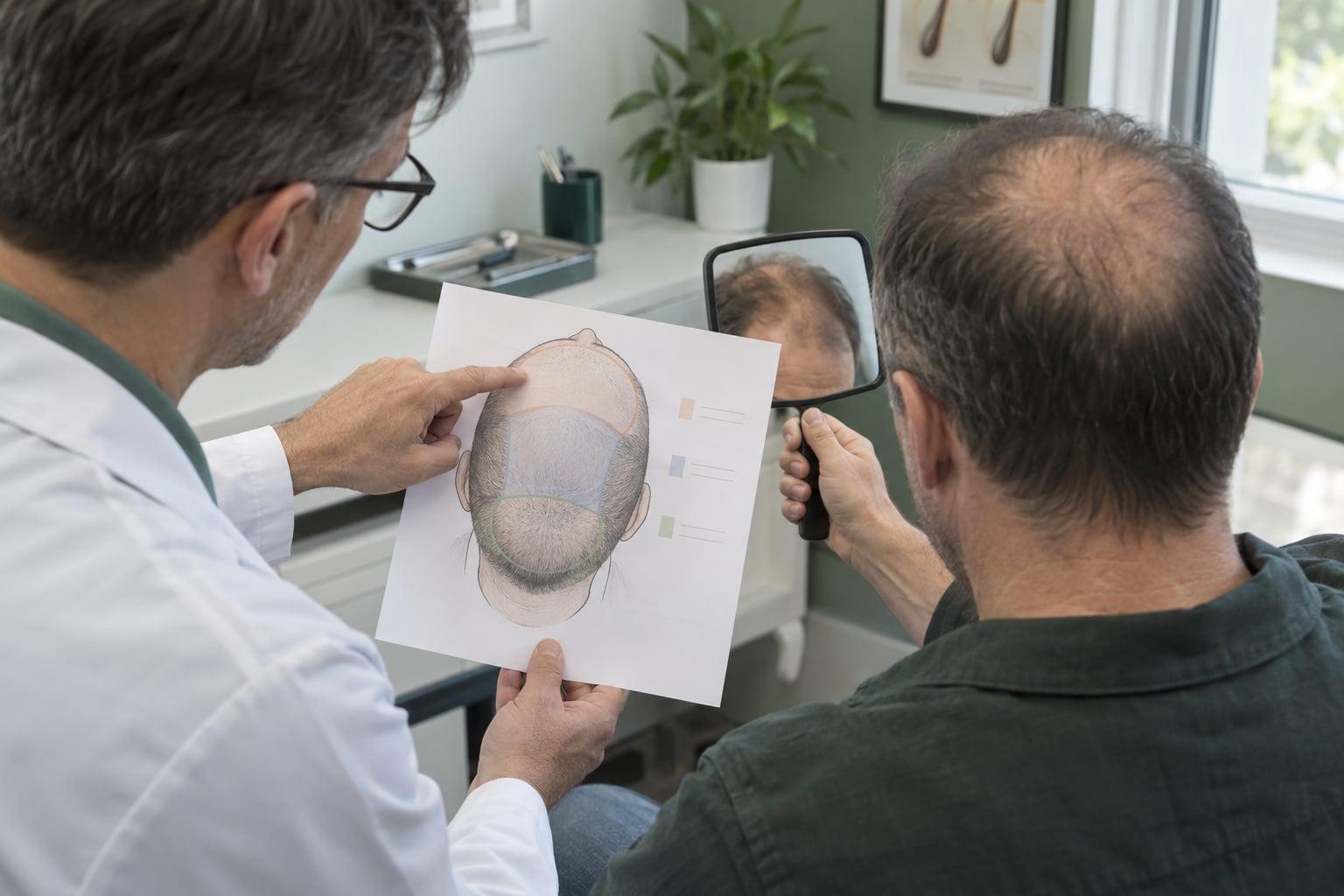
Agree which area and which outcome matter most
A plan to frame the face with a hairline is different from a plan to cover a large crown. The surgeon and patient need to agree the treated area, the intended fullness and what will remain thin. Using a limited supply across a larger area can require different priorities from concentrating it in one smaller region. [3, 2, 7]
| Part of the plan | A useful answer sounds like |
|---|---|
| Treatment area | A clearly identified region, rather than a graft number alone. |
| Expected appearance | An explanation of achievable coverage in that region and its limits. |
| Hair left in place | A discussion of continuing native hair loss and how the design would look if it progresses. |
| Future options | What donor supply remains, whether more sessions are planned and what is outside the first quotation. |
These are ways to make a consultation specific, not predetermined answers for a particular person. The results guide explains how appearance, satisfaction and graft survival differ; the quote worksheet helps record the scope being priced. [1, 3, 2, 7]
What results are realistic
A transplant can improve visible coverage, but “success” needs a definition. Graft survival, photographs, satisfaction and the need for another operation measure different things. A high number for one cannot be substituted for another. The studies below illustrate that distinction; they cannot calculate an individual's chance of a satisfactory result.
In one retrospective series of 820 men with advanced pattern baldness, the authors reported that 94% were satisfied at 12 months, while 62% wanted another sitting to increase coverage or density. This was a selected group at one private centre, without a comparison group. The authors declared no funding or conflicts. [7]
Satisfaction and wanting more coverage can coexist
Satisfied with the result
94%reported at 12 months
Wanted another sitting
62%reported at 12 months
Two overlapping outcomes in one observational series of 820 selected men, not opposite groups or graft-survival rates. The paper does not separately detail the 12-month questionnaire response flow. Only 207 completed follow-up at 24 months, limiting conclusions about durability. No funding or conflicts declared. [7]
The practical lesson is to agree what the first operation is intended to achieve. A result can meet the initial plan while still leaving a wish for denser coverage. A consultation should distinguish a planned second stage from repair of an unsatisfactory result.
The results and permanence guide explains how to read before-and-after photographs, interpret success rates and discuss a possible second procedure.
Does transplanted hair last forever?
It can last for years, but an unchanged appearance is not guaranteed. In one small long-term study, photographs of 112 men after strip FUT were compared at years one and four. Only 10 were judged to have unchanged density. This was a selected, uncontrolled photographic follow-up, without individual graft tracking or a clear original-cohort follow-up flow; the authors declared no funding. It cannot establish that a particular percentage of grafts died, explain why density changed, or supply a general failure rate. Medication associations were not statistically significant. [8]
What newer techniques can actually promise
As of 3 October 2026, the newer claims we checked do not remove the need for diagnosis, donor planning and careful surgery. They also sit at different stages of development.
Robotic assistance is a tool, not an independent surgeon
A 2024 randomised comparison used robotic collection on one side of the donor scalp and hand-held powered FUE on the other in 13 men. It found no significant difference in regrowth or satisfaction at 12 months. This small, expert-surgeon study of a specific robot version does not establish equivalence or superiority. It was supported by Shanghai public science, health and hospital programmes. [9]
A separate 2025 multicentre Chinese trial reported 55 completers and improvement with both methods at nine months. We could check only its original abstract, not funding, full participant flow or detailed analysis. Together, these reports support evaluating a particular device and operator, not paying a premium on the assumption that “robotic” guarantees better growth. [10]
Sapphire comparisons need a fair test
A recent observational paper reported favourable sapphire outcomes, but its groups also differed in implantation technique, coverage and staging. We could read the published abstract and a public manuscript draft, not the final full article. The draft described non-random allocation and a six-month assessment, but contained inconsistent participant totals and results; funding and complete follow-up remained unverified. It does not establish that blade material caused a better result, so its percentages are not a reliable expected benefit of “sapphire FUE”. [6]
| Development | What the evidence checked actually represents | What it does not establish |
|---|---|---|
| Cultured hair-follicle cell injections | A 2023 uncontrolled human study of 36 people followed cosmetic outcomes for 12 months. We read the abstract and disclosures: several authors were Shiseido employees or reported Shiseido research support. A January 2026 correction clarified company affiliations, without changing the reported results. Study funding and attrition were not verified. [11] | Unlimited new follicles, equivalence to surgery or a routine substitute for a donor transplant. |
| Laboratory-grown follicles, sometimes described as cloning | A February 2026 paper reported follicle-regeneration experiments involving cultured cells and mice. The abstract and disclosures were checked; commercial support and a pending patent were disclosed. [12] | A proven human scalp procedure, an individual result or a reliable availability date. |
| Exosome products | Products promoted using cell-derived material, with research and regulatory questions distinct from moving intact follicles. The FDA alert checked in October 2026 states that no exosome products are FDA-approved. [13] | Approval through a trial registration, or evidence that an add-on replaces transplantation. The FDA statement is specific to the US. |
The FDA also challenged hair-growth marketing in a May 2025 warning letter about particular unapproved products. Calling something “research” or “investigational” did not resolve the product's regulatory requirements. A registry entry, a clinic offering and a demonstrated clinical benefit are separate facts. [14]
Likewise, PRP research for hair loss does not automatically prove that a PRP add-on improves graft survival during surgery. That claim needs evidence from the actual surgical protocol and comparison.
Recovery is quicker than the final result
The wounds can heal long before the visible result develops. A typical operation takes several hours under local anaesthetic, sometimes with sedation; a large treatment may be staged. The surgical team should provide individual aftercare and a contact for problems. [1, 15]
| Stage | Broad expectation |
|---|---|
| First days and weeks | Swelling, tenderness and scabbing can occur. The NHS suggests allowing roughly one to two weeks off work and particular care with grafts during the early period. |
| Following weeks | Transplanted hairs commonly shed before growth restarts. |
| Around four months | New hair may begin appearing. |
| Roughly 10 to 18 months | The fuller result can be assessed, with variation between people. |
These are approximate NHS patient-information milestones, not deadlines or instructions for your scalp. [15]
The recovery and shock-loss guide separates early healing, shedding and later growth, with a checklist of questions for your surgical team and symptoms that need attention.
Washing, exercise, sun exposure and the timing of any medicine need a written plan from the team. A generic minoxidil application guide is not a postoperative protocol. Later, consistent progress photographs are more informative than comparing daily mirror impressions.
What can go wrong
Possible problems include poor growth, visible scarring, an unnatural design and depletion of the donor area. Surgical risks also include bleeding, infection and reactions to anaesthetic. Removing many small FUE grafts does not make the operation risk-free. [15, 3, 5]
Advantages
The small comparative studies do not provide a reliable personal complication rate. Before surgery, the relevant discussion includes the team's own complications and repair experience. After surgery, severe pain or unexpected symptoms warrant prompt contact with the treating clinic. [15]
Why medicines may still matter afterwards
Medicines may be discussed to protect the native hair around the transplant. This is a different objective from moving follicles into a bald area. [1] In a placebo-controlled trial of 79 men, finasteride taken around transplantation improved surrounding scalp hair at 48 weeks. We read the original abstract, which does not provide complete participant flow or funding information; some authors had Merck affiliations. The trial was about surrounding hair, not proof that every graft requires finasteride to survive. [16]
There is no universal medicine requirement in this guide. The finasteride profile, side-effect guide and minoxidil and finasteride comparison explain those decisions. The consultation should include what happens to the surgical design if further loss continues, including when someone cannot tolerate or does not want a medicine.
Put surgery in a longer-term planUnderstand the distinction between alternatives, studied combinations and optional additions before building a routine.Questions to take to a consultation
Useful answers should explain a plan for your diagnosis and donor hair. These questions make that discussion more specific:
- What is the diagnosis? Is there any sign of disease or diffuse donor thinning that changes suitability?
- What can the donor area safely contribute? What will it look like afterwards, and what is being reserved for possible future loss?
- What is the first operation meant to achieve? Which areas, what visible coverage and what limits? Are further sessions planned?
- Why this collection and placement method? What trade-offs apply to my hair, scalp and preferred hairstyle?
- Who performs each stage? Who assesses, designs, makes incisions, removes grafts and implants them, and what are their qualifications and supervision?
- What evidence supports an extra charge? Does a claimed benefit for robotics, a blade or an injection come from the same procedure and a relevant comparison?
- What happens afterwards? Who manages complications, reviews growth and handles concerns if I live elsewhere?
- What does the written cost cover? Include follow-up, medicines, travel, further sessions and any repair policy, rather than comparing headline package prices alone.
The ISHRS treats donor and recipient incisions as surgical acts, including when a robot is involved. Its position recognises that permitted professional roles differ under local law. A machine name is not a substitute for identifying the responsible clinician and checking the rules where the operation takes place. [17]
There is no meaningful worldwide price or best-country ranking in the evidence checked for this guide. A quotation needs its country, procedure, clinician, included care and date before it can be compared with another.
Use the clinic-selection guide to check qualifications, operating roles and follow-up arrangements. The cost and quote guide provides a comparison worksheet and a calculator for the amounts you actually know, including travel and care after returning home.
Where to go next
For established pattern loss, the main male-pattern hair-loss guide puts medicines and other options in context. The non-surgical procedure comparison covers PRP, microneedling and light devices, which ask different questions from transplantation. If the cause of loss remains unclear, start with hair-loss types and assessment.
Choosing no surgery is also a valid option. The Hair hub can help organise the next question without assuming that every thinning area needs a procedure.