

A successful transplant needs a clear goal
A hair transplant can improve coverage using follicles moved from a limited donor supply. The aim might be a more defined hairline, coverage over the front, a less visible crown or a combination. Those are different plans. A procedure cannot be judged sensibly without knowing the area and density it was intended to achieve. [1, 2]
The grafted hair is only part of the later appearance. Native hair, meaning hair that was already in place, can continue to thin around it. The donor area also has to retain acceptable coverage after follicles are removed. A result should therefore be considered across the whole scalp and over time, rather than as a graft number on the day of surgery. [1, 3]
- Coverage
- Where hair growsThe area treated and the visual density achieved.
- Appearance
- How it fitsHairline design, direction and the surrounding hair.
- Long-term plan
- What remainsNative hair, donor supply and possible future treatment.
These are connected parts of planning, not an individual success score. [1, 3, 2]
This page concerns adult scalp transplantation, mainly for pattern hair loss. The main transplant guide explains what surgery involves; the candidacy guide covers diagnosis and donor assessment. Here the question is how to understand the result and its durability.
When can you judge the appearance?
Hair growth needs months, so an early healing photograph cannot show the finished result. The AAD describes early shedding and visible results commonly around six to nine months, sometimes 12. BAPRAS distinguishes the start of growth around months three to four from later cosmetic assessment, with further improvement in hair quality possible up to 18 months. [1, 2]
| Point in the process | Useful question |
|---|---|
| Healing and early shedding | Is the scalp recovering as expected, and is there a symptom that needs assessment? |
| Growth is developing | Does the progress fit the operation and the surgeon's review plan? |
| The appearance is more established | How does coverage compare with the agreed area, density and hairline? |
| Later years | Has native hair thinned, has the donor appearance changed, or is there a new concern? |
These are questions for different stages, not a calendar that diagnoses success. The NHS gives a broad 10 to 18 months for fuller results. That is compatible with noticing improvement earlier and does not mean waiting that long to raise a problem. [1, 4, 2]
Graft survival is different from satisfaction
There is no single success percentage that answers every patient's question. Graft survival concerns transplanted units that survive and grow. Cosmetic coverage concerns how the hair looks. Satisfaction concerns the person's judgement, and a request for another session may concern a different goal again. Studies measuring these outcomes cannot be treated as interchangeable. [5, 6, 7]
| Outcome in a report | What it can tell you | What it cannot establish by itself |
|---|---|---|
| Counted growing grafts or hairs | Growth in the defined area at the measured time | Natural appearance, satisfaction or lifelong persistence |
| Photographic density | How coverage appears under the assessment conditions | The exact number of grafts that survived or died |
| Patient satisfaction | Whether people liked the result under that study's question | A biological survival percentage |
| Wanting another operation | A wish for more coverage, density or correction | That the first operation failed |
| Improvement with a medicine | Benefit for the endpoint that was actually measured | Automatically better survival of surgical grafts |
This distinction matters when reading clinic claims too. Ask what was counted, when, in whom and by whom. “Success” without a defined outcome is difficult to evaluate. A graft also may contain several hairs, so graft numbers and hair numbers should not be switched mid-comparison. The graft-count explanation shows why a quotation must make the unit clear. [2]
A result can be satisfying and still leave room for more coverage
In a retrospective series of 820 men with advanced pattern baldness, 94% were reported satisfied at 12 months and 62% wanted another sitting to increase coverage or density. The men had FUE at one private centre, using scalp and selected beard/body donor hair. This was not a randomised comparison or a representative sample of everyone seeking surgery. The authors declared no funding or conflicts. [5]
Two overlapping responses after surgery
Reported satisfaction
94%
Wanted another sitting
62%
Reported at 12 months in one retrospective series of 820 selected men with advanced loss. These are overlapping responses, not complementary groups, and neither is graft survival. The 12-month questionnaire response flow was not separately itemised. Only 207 completed the reported 24-month follow-up. No funding or conflicts declared. [5]
The useful lesson is the relationship between the answers. Being satisfied with the first operation and wanting more density can coexist. These percentages cannot calculate your own chance of satisfaction, tell you how many grafts survived or prove that FUE is better than another method.
Three studies answer three different questions
Read each result with its population, observation time and measurement. These studies cannot be pooled into one transplant success rate.
| What was measured | The boundary | |
|---|---|---|
| 820 men, FUE series | Reported satisfaction and wish for another session at 12 months. | Selected advanced-loss cohort; no control group; questionnaire flow incompletely itemised. Not graft survival. |
| 112 men, strip FUT follow-up | Photographic density categories at year four compared with year one. | Selected single-centre group; no counted graft survival or representative starting-cohort follow-up flow. |
| 79 men, medicine trial | Surrounding scalp hair after finasteride or placebo, assessed at 48 weeks after surgery. | Native-hair maintenance question. Full analysed flow and funding not verified from the available abstract. |
The two observational reports declared no financial support or conflicts. The finasteride paper includes Merck-affiliated authors; its full funding statement was not verified. Study details are discussed in the relevant sections below. [5, 6, 7]
Read before-and-after photographs carefully
Photographs help document appearance, but the comparison needs context. Our practical approach is to ask for comparable scalp views and dates, then clarify the number of procedures and other treatments between the images. A striking pair alone does not answer those questions.
For your own record, keep lighting, angle, styling and hair length as similar as practical. Note differences rather than trying to correct them away. The tracking guide explains a repeatable setup and a simple treatment history. A home photograph is useful documentation, not a clinical graft count.
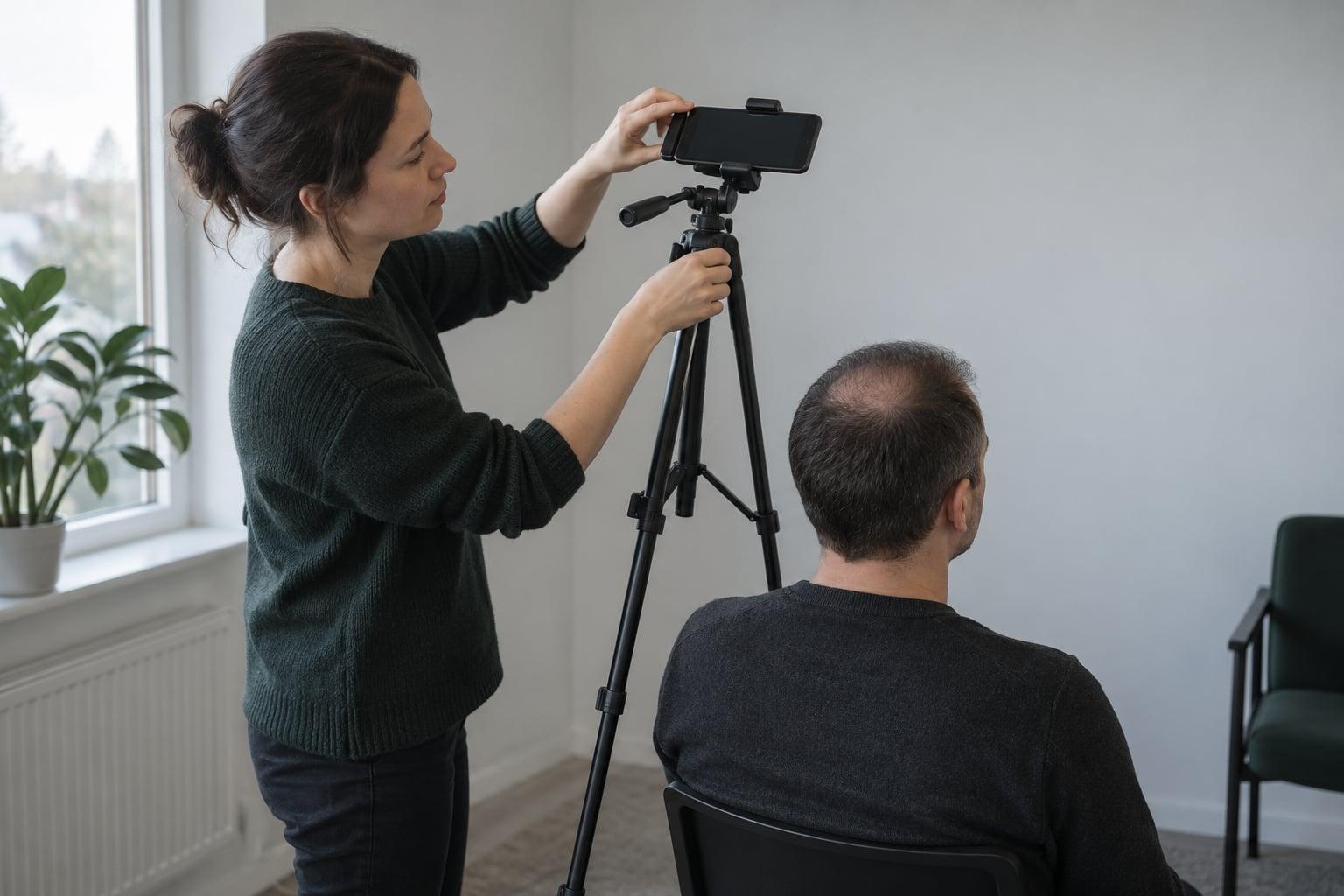
The photograph illustrates preparing a setup, not a change in hair. A close, dry, carefully styled view and a distant, wet-haired image are answering different visual questions. If the conditions differ, record that limitation rather than estimating a survival percentage from how much scalp is visible. Our suggested recording method is to keep the same front, top, crown and donor views where feasible, with dates and an unchanged setup.
What to ask about a result photograph
- Are these the same views with comparable lighting, hair length and styling?
- How long after surgery was the later image taken?
- Does it follow one session or several?
- What other hair-loss treatment was used during that period?
- Are the donor area and the whole treated region shown?
- Is this a typical result for similar patients or a selected example?
These are evidence-reading questions, not a test that proves a photograph is genuine or a result typical. The guide to choosing a transplant clinic places result examples alongside the operator, assessment and follow-up arrangements.
Does transplanted hair last forever?
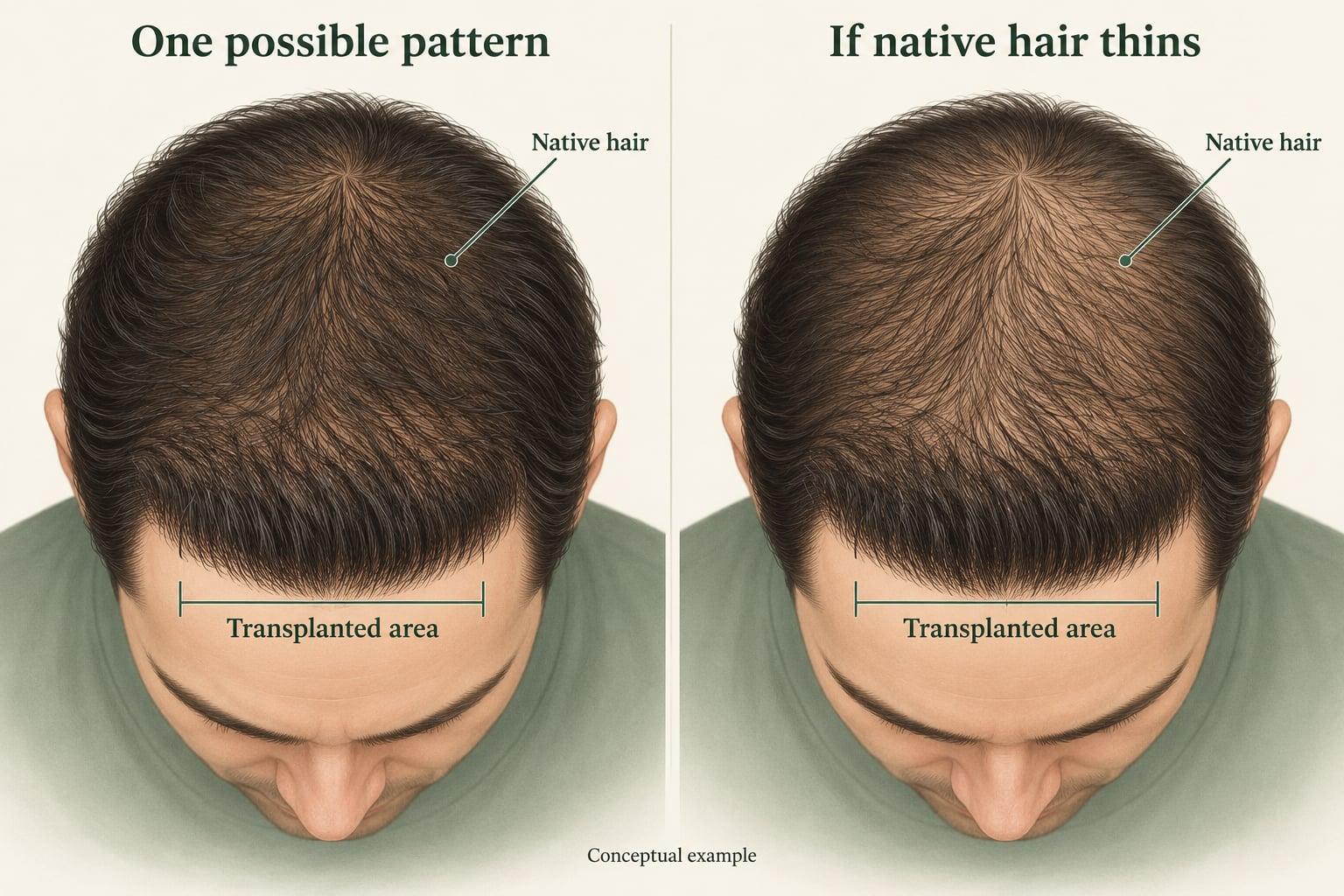
Transplanted hair can provide lasting growth, but unchanged lifelong density is not guaranteed. Donor selection matters: ISHRS guidance warns that hair collected outside an estimated safe donor area may be lost later. Native pattern loss can also progress around a transplant, altering the overall appearance even where transplanted hair remains useful. [1, 3]
Why the design still matters years later
A hairline is seen together with the hair behind it and at the temples. A crown is seen together with the surrounding scalp. If those native areas thin, the balance can change even without assuming that all the grafts have failed. ISHRS repair guidance describes this as one reason a previously adequate result can later look unnatural. [9]
This is why design is more than drawing the lowest possible line. The surgeon and patient need to connect the initial goal with the available donor supply and likely future loss. A larger first session can use hair that might otherwise remain for later work. The hairline and crown planning discussion explains the trade-off without prescribing one priority for everyone. [3, 2, 8]
What a four-year study can and cannot tell us
One small study illustrates why “permanent” needs care. Researchers compared photographs at years one and four in 112 men who had one strip FUT procedure for advanced pattern loss. At the later comparison, 31 were graded as having slightly reduced density, 62 moderately reduced density, nine greatly reduced density and ten no change. There was no direct count of individual surviving grafts. [6]
The study raises a reasonable counselling point: a good appearance at one year is not proof that density will remain identical indefinitely. It does not identify one cause for every later change. Its retrospective associations with minoxidil and finasteride were not statistically significant, which does not establish that either medicine has no value for surrounding native hair. [6]
The practical question is therefore broader than whether a follicle is called permanent. What donor hair was selected, what future pattern loss is plausible, and what will the whole scalp look like if the native hair thins further? Those are planning questions before surgery and reassessment questions afterwards. [3, 8]
Medicines can help the surrounding hair
A transplant does not stop the underlying pattern-loss process. Medicines may be discussed before or after surgery to preserve native hair and support the overall appearance. The AAD describes this as part of maintaining results, rather than a guarantee that medicine makes every graft survive. [1]
The relevant finasteride trial randomised 79 men with androgenetic alopecia to finasteride or placebo around transplantation. At 48 weeks after surgery, it reported better surrounding scalp hair with finasteride. This is evidence about native-hair maintenance in that study population; it is not a trial proving a universal graft-survival requirement. [7]
The original abstract and affiliations were available, but the full analysed participant flow and study-funding statement were not verified. Some authors had Merck affiliations. The small trial's numerical photographic response should therefore not be turned into a general survival percentage or a personal treatment timetable. [7]
The same distinction applies to minoxidil: general evidence for pattern loss is different from proving that an exact postoperative schedule improves graft survival. Washing and product use on a healing scalp belong in the surgeon's instructions. Adding several products does not make the cause of later improvement identifiable; the routine guide separates studied combinations from assumptions.
For women, the diagnosis, treatment options and suitability need their own discussion. The men's transplant finasteride trial does not supply that answer. The female pattern hair-loss guide is the appropriate starting point for that evidence.
Why another session may be part of the plan
A second operation does not automatically mean the first failed. Some people want more density in an already treated area; some have a planned second area to cover; others have lost more native hair. Repairing poor growth or an unnatural design is a separate reason. Each uses remaining donor capacity and deserves a fresh assessment. [2, 5, 8, 9]
Planned coverage or density
The first procedure had a defined scope. A further session may aim to add coverage within the remaining donor limits.Progression of native hair loss
The original grafted area may remain useful while thinning elsewhere changes the overall balance.Poor growth or a design problem
The cause and possible remedies need assessment before assuming that more grafts will solve it.
Different reasons can overlap. None makes another operation automatically appropriate. [2, 8, 9]
The financial plan should make this distinction clear too. A quote for one operation does not necessarily include future planned coverage, native-loss treatment or repair. The hair transplant cost guide explains which parts of the treatment and follow-up to clarify, without turning one country's price into a global estimate.
There is no single interval in the evidence reviewed here that clears everyone for a second operation. The decision needs an established understanding of the first result, scalp condition and donor reserve. A calendar date alone cannot answer whether more surgery is worthwhile. [3, 2, 8]
When the result is disappointing
Disappointment deserves an explanation before a solution is chosen. Poor growth, continuing native loss, a hairline that looks unnatural and a depleted donor area are different problems. ISHRS guidance recommends investigating possible unrecognised scalp or medical conditions when growth is poor before pursuing another procedure. [8, 9]
Make the concern specific before choosing a repair
| What to establish at review | Useful information to bring | |
|---|---|---|
| Coverage seems too low | Is growth still developing, was the first session limited by design, or is there unexpectedly poor growth? | Agreed treated area, timing, procedure details and comparable photos. |
| The outline looks unnatural | Does the concern involve hairline position, direction, distribution or native loss around it? | The original design and views showing both the grafted region and surrounding hair. |
| The donor area looks depleted | What harvesting, scars or other changes limit what remains? | Earlier donor photographs and records of all previous sessions. |
| The appearance changed later | Which areas changed, and does the cause need medical assessment? | A dated sequence, symptom history and medicine changes without assumptions about causation. |
Questions derived from professional guidance on poor growth, design problems and donor-limited repair. They organise a consultation; they do not diagnose the cause or establish that more surgery is possible. [3, 8, 9]
Repair may be possible, but it is constrained by donor supply, scars and the original design. The ISHRS repair guidance cautions that further surgery can add scarring or worsen the donor and recipient areas if poorly planned. Sometimes there is too little donor hair for a useful correction. Expert repair advice is not a promise that every unwanted result can be reversed. [9]
When another operation is unsuitable or unwanted, camouflage options may be discussed. Styling, cover-up products or scalp micropigmentation can change the impression of coverage without creating new follicles. Their purpose and trade-offs differ from restoring growing hair. [9]
For a review, our suggested preparation is the original plan, procedure details, dated photographs, treatment history and a concise description of what bothers you. “The hairline shape”, “the coverage over this area” and “the appearance of the donor scalp” give a clearer starting point than an undefined failure label.
Make the outcome claim specific
The most useful result discussion identifies the goal, measurement and time. It distinguishes how many grafts were placed from how many grew, how the hair looks from how satisfied someone feels, and a planned next stage from repair. That makes a claim more useful without pretending the available studies can predict one person's future.
Questions for a transplant consultationHow to examine the assessment, named surgical roles, result evidence and follow-up plan before deciding.If your immediate question is whether current shedding or discomfort fits recovery, return to healing and warning signs. If you are comparing methods, the FUE, FUT and DHI guide explains their different roles without treating a technique name as an outcome guarantee.