
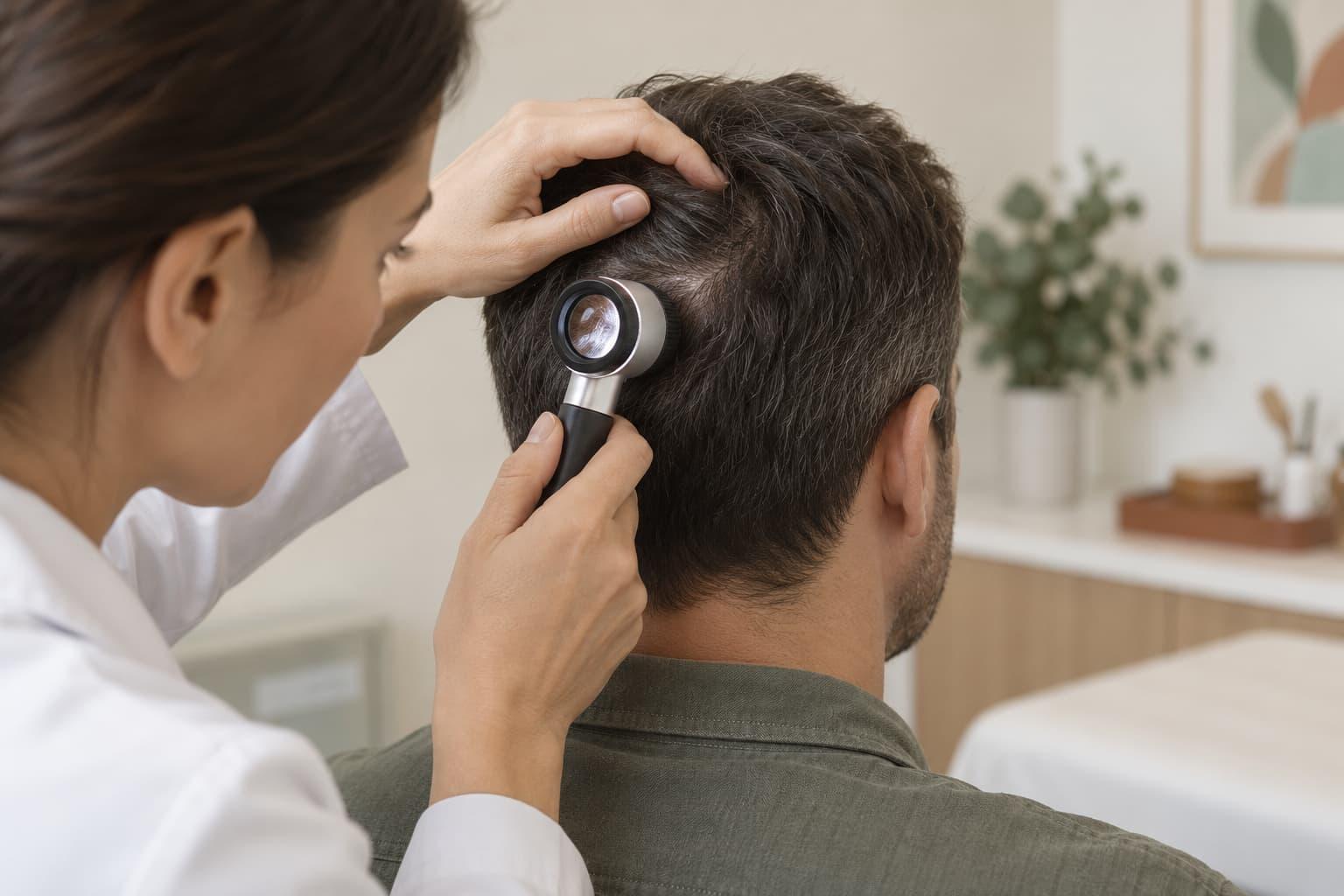
Suitability starts with the cause of hair loss
A hair transplant may help someone with diagnosed pattern hair loss, useful donor hair and an achievable cosmetic goal. It moves existing follicles into another part of the scalp; it does not treat every cause of shedding or create unlimited new hair. Suitability therefore depends on the whole scalp and the likely future pattern, not simply the size of today's thin patch. [1, 2, 3]
The donor area is where grafts are collected, usually at the back and sides. The recipient area is where they are placed. Native hair means hair left in its original position, which may continue thinning after surgery. The donor and recipient areas both need assessment before a proposed graft count becomes meaningful. [1, 2, 3]
- Diagnosis
- What is causing loss?Similar-looking thinning can have different causes and treatments.
- Supply
- Usable donor hairThe quality and stability of the proposed donor area set limits.
- Goal
- Achievable coverageThe plan needs to remain sensible if native hair keeps thinning.
These are clinical assessment questions, not a self-diagnosis score. [1, 2, 3]
This guide covers candidacy and donor planning for adult scalp surgery, including important differences in younger adults, women and people with diffuse or scarring loss. If the diagnosis is unclear, begin with hair-loss types and assessment. The transplant overview explains the operation and realistic outcomes; the FUE, FUT and DHI comparison explains method choices after suitability has been considered.
Grafts and hairs are different counts
A graft is a small piece of transplanted tissue. It commonly contains a follicular unit, a natural group of one or several hairs. A quote for 2,000 grafts is therefore not the same as a quote for 2,000 hairs, and there is no fixed multiplier that converts every person's graft count into a hair count. [3, 4]
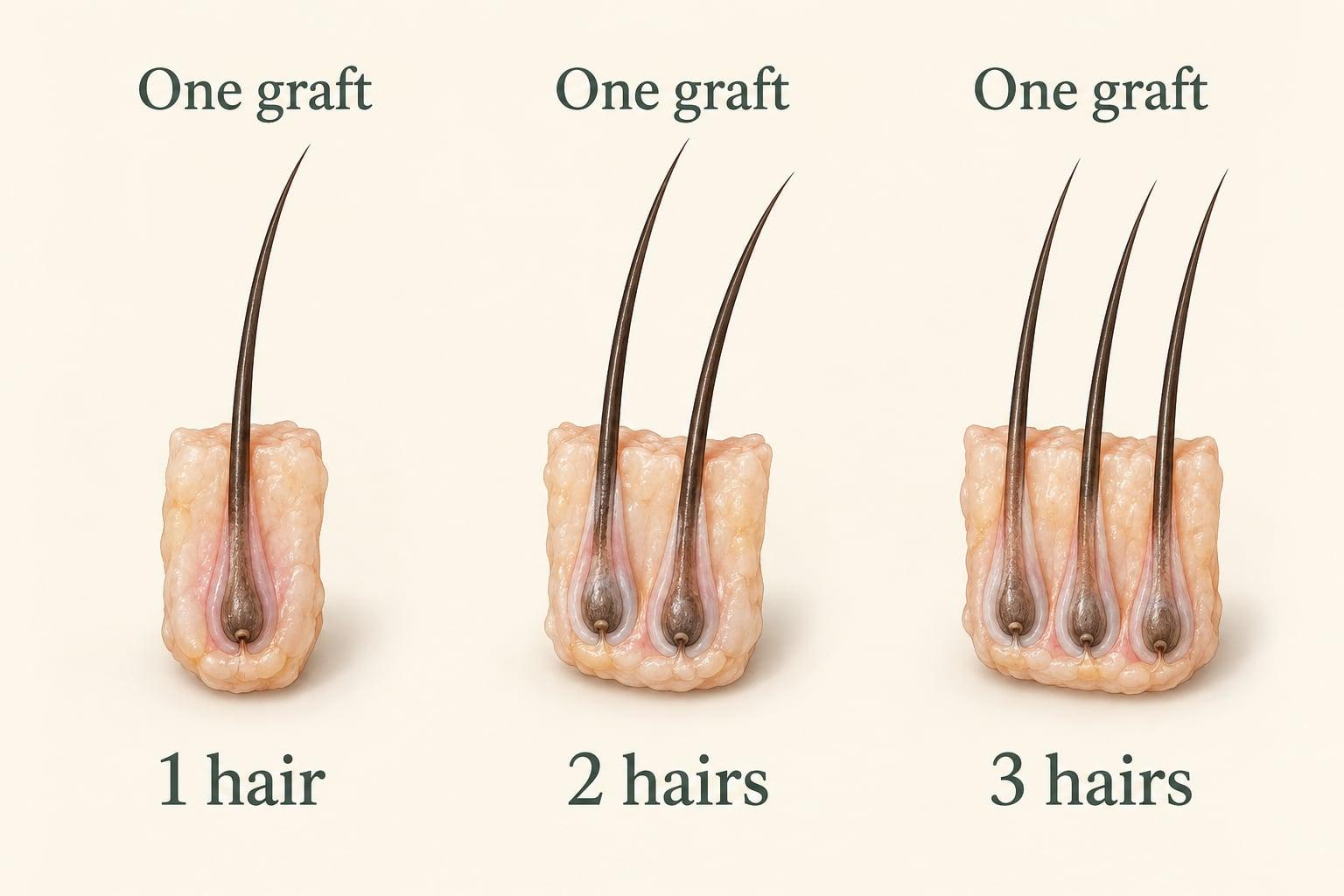
Read the drawing as a tissue count and a hair count. Each separate piece of tissue is a graft, while the shafts emerging from it contribute to the hair count. Counting the pieces alone does not tell you their combined hair content. Ask the clinic to keep those two figures separate in the planned and recorded operation. [3, 4]
The distinction also matters when looking at results. The number collected, the number placed, the number that later grows and the visual coverage achieved answer different questions. A higher number at one stage is not, by itself, a guarantee of a fuller final appearance. Hair characteristics and placement also affect that appearance. [2, 5, 3]
| Term in a consultation | What it describes | What to clarify |
|---|---|---|
| Grafts | Pieces of donor tissue being moved. | Is the figure an estimate, a target or a count actually implanted? |
| Hairs | Hair content within those grafts. | How many hairs per graft does the estimate assume? |
| Density | Units or hairs in a measured area. | Which unit, which scalp area and which point in time? |
| Coverage | How much scalp appears covered. | Which areas are prioritised, and what fullness is realistic? |
| Donor reserve | Suitable hair left for possible later use. | What remains after this session, considering future loss? |
These questions apply the definitions and planning principles in professional guidance. They are not a formula for calculating a personal graft requirement. [2, 5, 3] The cost guide shows how to compare quotation units, while the results guide explains why a count of implanted grafts is different from a later growth result.
Does the donor hair grow back after it is removed?
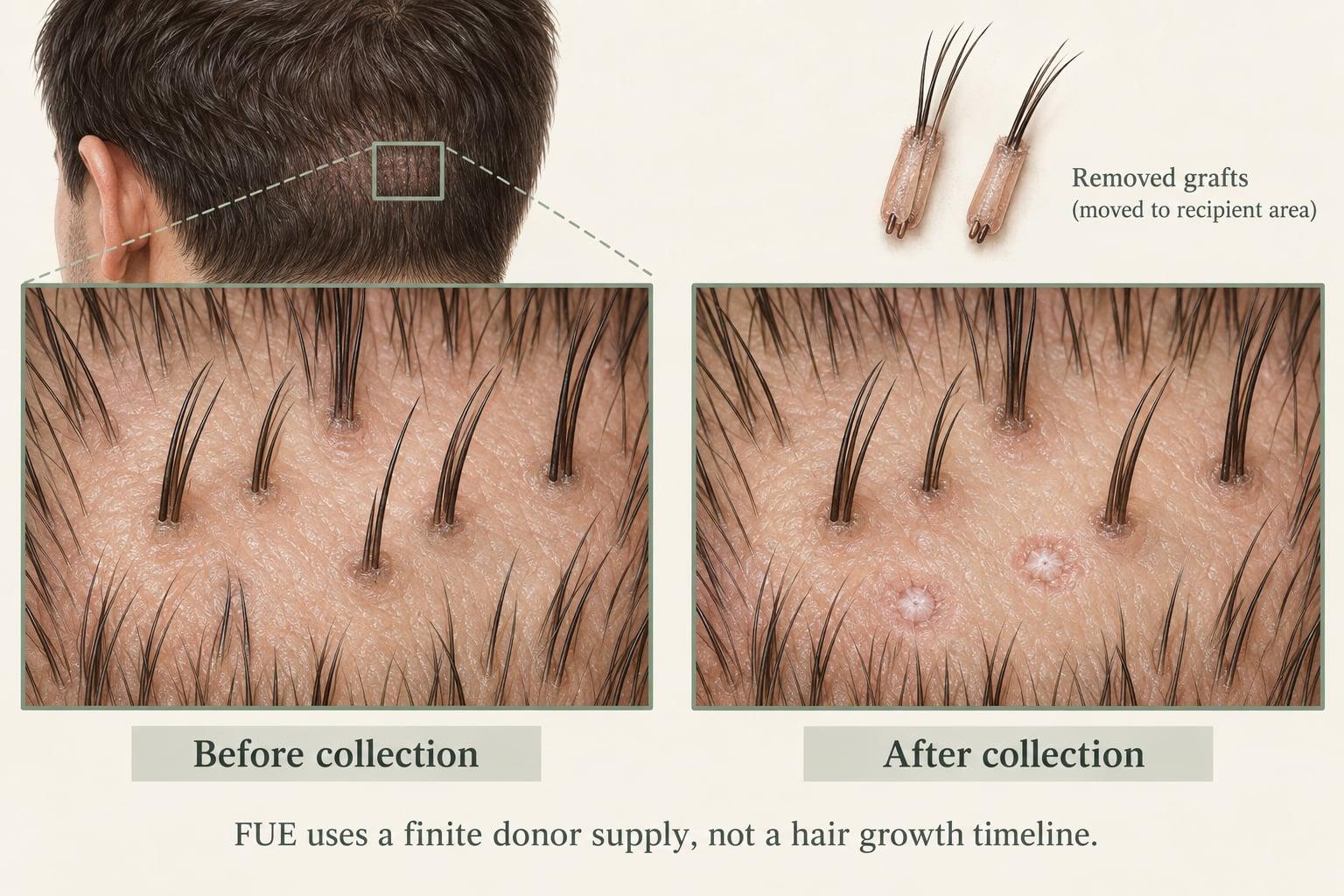
No: a follicle fully removed and transplanted elsewhere does not regrow at its original donor site. FUE uses part of a finite supply. The aim is to distribute harvesting so the remaining hair provides acceptable coverage and useful options for the future. Donor healing is not the same as donor replenishment. [4, 2]
This is different from temporarily shedding a shaft while its follicle remains in the scalp. Temporary shedding of native hair can occur after surgery. Regrowth from a retained follicle should not be confused with the creation of a replacement for a follicle that was physically removed. [4]
Strip FUT also uses existing donor follicles. It removes a strip of tissue and closes the wound, leaving a linear scar. It may preserve different options from FUE in a particular person, but it does not manufacture extra follicles either. Combining methods can sometimes form part of a longer-term plan; it cannot make the donor supply unlimited. [5]
The recovery and shedding guide explains the different reasons hair may look thinner after surgery, including shedding from follicles that remain in place.
What a useful donor assessment needs to establish
The back and sides should be examined, not assumed to be permanently reliable. The surgeon needs to estimate a safe donor area, meaning the region expected to provide hair that will remain useful over time. That estimate is particularly uncertain when someone is young or the loss pattern is still changing. [2]
Assessment includes density at different locations, hair thickness, curl, direction, colour contrast with the scalp and evidence of miniaturisation, where hairs become progressively finer. Previous extraction and scars can change what remains available. A single photograph or a generic online graft chart cannot provide that examination. [1, 2, 5]
What do the measurements mean?
Follicular units per square centimetre counts natural groups in a measured patch. Hairs per square centimetre counts the hairs within those groups. They describe different things, so a density figure without its unit is incomplete. FUE guidance recommends examining several donor locations because density varies across the scalp. [2]
| What is measured or assessed? | Why it changes the plan |
|---|---|
| Donor density at several locations | Shows how the available hair is distributed, rather than assuming one patch represents the whole donor zone. |
| Hair thickness and miniaturisation | Distinguishes a count of hairs from the quality and stability of that supply. |
| Previous extraction and scars | Establishes what has already been used and what limitations remain. |
| Recipient area and existing hair | Connects the proposed grafts to the actual area being treated. |
| Hair curl, direction and scalp contrast | Helps explain why the same numerical density can look different on different people. |
These are factors assessed together, not thresholds that automatically approve an operation. The point is to connect a measured supply with a visible goal. [2, 5]
Ask for the interpretation as well as the number: “Where was density measured, was that hairs or follicular units, and how does it change the proposed collection zone?” Measuring hair that exists is not the same as deciding how much of it can be removed while leaving acceptable coverage. [2]
How many grafts, and should the hairline or crown come first?
There is no universal graft count for a receding hairline, crown or baldness grade. The proposed number needs to connect the donor assessment with the area to be treated, the desired appearance and the supply left afterwards. A full head at the original density may be unrealistic even when a useful improvement is possible. [1, 2, 3]
The hairline and crown can represent different priorities for different people. The patient and surgeon should agree which areas the operation will cover rather than assume they mean the same thing by “restoration”. Society guidance specifically includes confirming the recipient areas and proposed hairline before surgery. [4]
| Planning choice | What needs an explicit answer |
|---|---|
| Hairline position and shape | How does the design fit the face and the expected future loss? |
| Frontal coverage | What appearance is the first session intended to achieve? |
| Crown coverage | How much of the available supply is being allocated here? |
| Wider coverage or greater density | What tradeoff is being made with the available grafts? |
| Another session | Is it a planned stage, an optional improvement or only a possibility? |
These are consultation questions, not a rule that one region must always come first. They translate the guidance on recipient planning and finite donor supply into a reviewable plan. [2, 3, 4]
Ask the surgeon to show the proposed areas on your scalp and describe what will remain untreated. This is a useful way to discover different expectations before surgery. A quotation that gives only a maximum package size leaves the actual coverage goal unclear.
For someone choosing between plans, the useful comparison is not simply which clinic offers more grafts. It is which proposal explains those tradeoffs clearly. The clinic consultation guide helps turn the proposed map into specific questions about responsibility, consent and follow-up.
Age and stability matter more than a birthday threshold
Younger adults need particular caution because their eventual loss pattern can be harder to predict. An early low hairline or ambitious coverage plan uses donor supply that may also be needed as more native hair thins. The AAD notes that men in their twenties may be advised to wait and start medical treatment. [1, 2]
Professional recommendations use different age and observation thresholds. The 2019 FUE guidance cautions against operating under 25; a 2023 international consensus recommends medical stabilisation before surgery particularly in people under 30. These are planning recommendations, not evidence that everyone becomes suitable at a particular birthday. [2, 6]
The consensus is expert guidance, not a trial proving a single waiting period. It was supported by DUCRAY/Pierre Fabre; disclosed interests included industry advisory or lecture relationships and one author's HairClone directorship and shareholding. [6]
For the non-surgical options that may be discussed while the pattern becomes clearer, see male pattern hair loss. Consistent progress photographs can make a follow-up discussion more useful, although photographs alone cannot determine suitability.
Women and diffuse thinning need a careful donor check
Women can be suitable candidates. The important questions are the cause of the thinning and whether there is a sufficiently healthy, dependable donor source. Different conditions can produce a similar widening part or diffuse appearance, so a diagnosis should precede the surgical proposal. [1, 2, 3]
Diffuse thinning over the top is not the same as diffuse thinning through the donor region. The first does not automatically exclude a transplant. The second may mean there is too little dependable donor hair, or that harvesting would leave visibly depleted coverage. FUE guidance describes diffuse unpatterned alopecia as a relative contraindication; FUT guidance also warns about general donor thinning. Switching harvesting methods does not remove that biological limitation. [2, 5]
Two patterns that should not be confused
| Thinning mainly on top | Thinning in the donor area too | |
|---|---|---|
| Main question | Is this a diagnosed pattern with a useful donor source? | Is there a reliable region from which hair can be moved? |
| Surgical implication | Selected people may be candidates after assessment. | The supply and remaining donor appearance may limit or rule out surgery. |
| What a photograph cannot settle | The diagnosis and follicle quality. | The extent and stability of donor miniaturisation. |
These are assessment distinctions, not diagnoses from an image. [1, 2, 5, 3]
The female pattern hair-loss guide covers investigation and treatment in more detail. There is no defensible single percentage of women who qualify for surgery in the sources reviewed here, and the male treatment ranking should not be substituted for an individual woman's assessment.
Scars, inflammation and other causes of loss
A stable scar from an injury or previous surgery is different from a scalp disorder that is actively damaging follicles. Some scars can be assessed for transplantation. In inflammatory or scarring alopecia, diagnosis and control of disease come first, with a careful discussion of how uncertain the result may be. [3, 6]
The international consensus recommends trichoscopy, an examination of the scalp under magnification, to look for subtle scarring disease and forms of alopecia areata. It also advises that inflammatory scalp conditions show no activity at the time of transplantation. Selected stable cases may be considered; a fixed number of quiet months cannot guarantee that disease will not return. [6]
A past history of alopecia areata also needs specialist discussion. The consensus requires an absence of clinical and trichoscopic activity before any consideration and counselling about possible relapse. This is not a general endorsement of transplanting an active patch. [6]
Health, medicines and expectations complete the assessment
Scalp findings are not the entire decision. General health, medicines, previous wound healing and abnormal scarring can change the risk and the suitable surgical approach. The consultation should also establish whether the expected appearance is achievable with the available supply. [1, 5, 6]
Maintenance treatment may be discussed to preserve native hair. That is different from saying every transplanted follicle requires finasteride to survive. If a person cannot tolerate or does not wish to use a medicine, the surgical plan needs to address likely future thinning and the remaining options. [1, 6]
Current treatments
Bring the medicines and supplements you use, including any previous adverse effects, into the planning discussion.Health and healing
Discuss medical conditions, previous surgery, wound problems and scarring history.Expected appearance
Agree what can change, what will remain thin and whether further treatment may be needed.
Topics for clinical review. Any instruction to stop or restart a medicine needs an individual plan from the treating team. [1, 5, 6]
The separate finasteride safety guide and minoxidil safety guide explain treatment considerations. Neither is a schedule for changing medicines around an operation.
Leave the consultation with a plan you can explain
A useful plan answers more than “am I eligible?” It connects the diagnosis, the donor reserve, the areas to be covered and the possibility of later loss. A careful surgeon may recommend a smaller treatment, a period of observation or no operation when those pieces do not fit. [1, 2, 4]
Questions worth taking to the consultation
- What is my diagnosis, and does anything need investigation before surgery?
- Is the donor area miniaturising, and how was it measured?
- What is the proposed donor zone, and why is it considered dependable?
- Is the quotation for grafts or hairs, and how are they being counted?
- Which areas get priority, and what appearance is realistic after one session?
- What should remain in the donor area afterwards?
- How does the design work if I lose more native hair or stop maintenance treatment?
- What would make you postpone or decline the operation?
With that assessment in place, the FUE, FUT and DHI guide helps compare the actual method being proposed. The transplant overview brings the results, risks and recovery questions back together.