
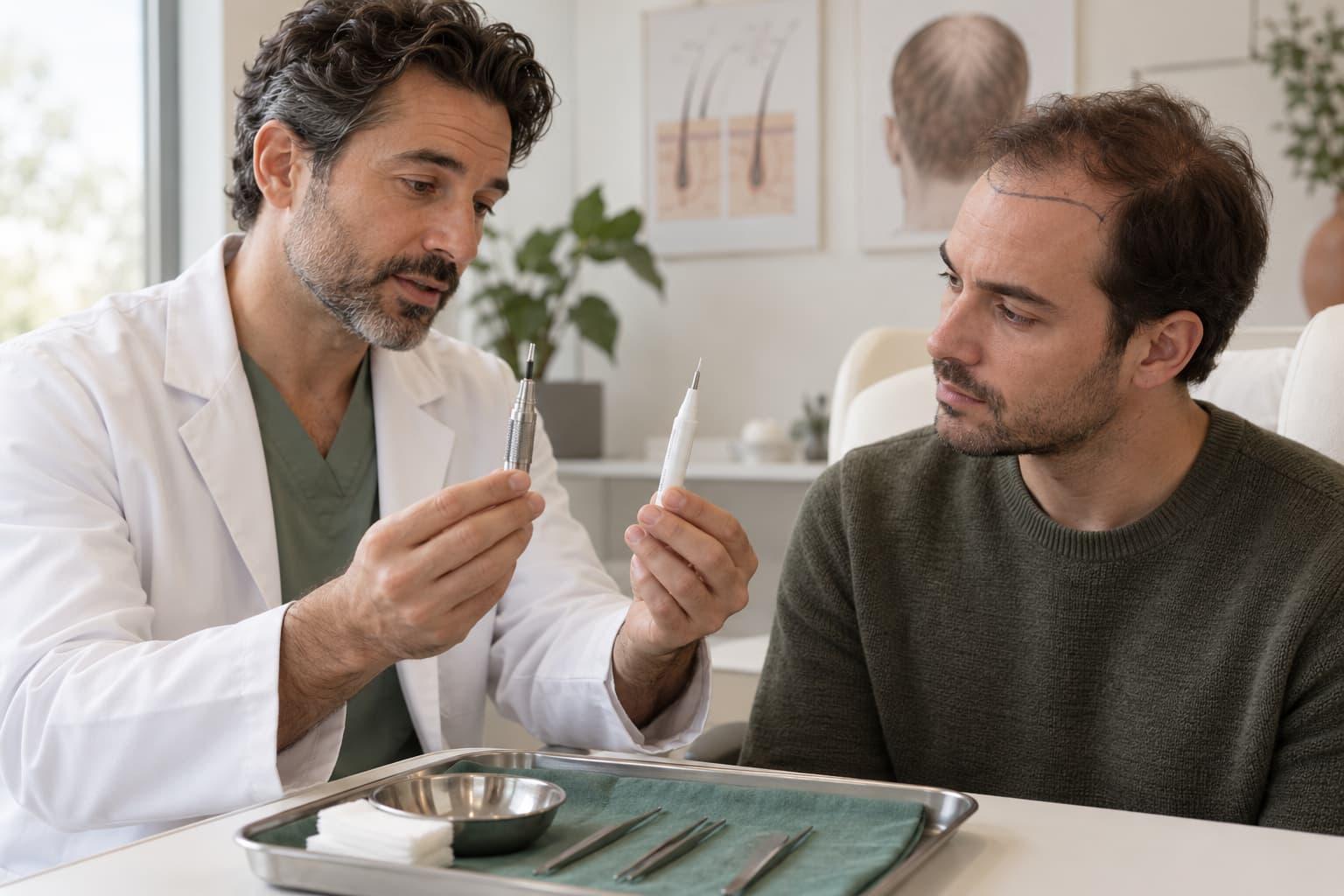
Start with two separate parts of the operation
FUE and strip FUT are ways to collect donor hair. DHI describes an approach to placing that hair in its new position. They are not three mutually exclusive operations: a transplant can use FUE to collect the grafts and an implanter technique advertised as DHI to place them. Understanding those two stages makes clinic quotations much easier to compare. [1, 2]
A follicle is the structure in the skin that produces a hair. Follicles naturally grow in small groups called follicular units. A graft is a small piece of transplanted tissue, commonly containing one such unit and therefore one or several hairs. The donor area supplies the grafts; the recipient area receives them. Neither harvesting method makes a new supply of follicles. [3, 4]
- 1
Assess and design
Establish the diagnosis, examine the donor area and agree the intended coverage.
- 2
Collect the grafts
Use FUE, strip harvesting or a planned combination.
- 3
Prepare and place
Protect the grafts and position them in recipient sites with the chosen instruments.
- 4
Follow healing and growth
Review the wounds first, then the developing appearance over the following months.
This guide compares methods used for adult scalp transplantation. For the broader decision about surgery, start with the hair-transplant overview. If the cause of thinning is uncertain, the guide to hair-loss types comes before choosing an instrument or package.
FUE and strip FUT change how the donor area is treated
FUE, or follicular unit excision, uses small circular punches to release individual follicular units. “Extraction” is still commonly used for the same abbreviation. Strip FUT removes a strip of hair-bearing scalp; the tissue is divided into follicular-unit grafts under magnification, and the donor wound is closed. Both are surgery. Both leave scars. [1, 2]
FUT can also mean follicular-unit transplantation more broadly. In this guide, it means the strip harvesting method, also called linear strip excision or follicular unit strip surgery. Modern strip surgery should not be confused with the conspicuous large plugs associated with older transplantation. The harvesting method and the size and placement of the finished grafts are separate questions. [6, 2]
What happens during FUE collection?
The punch releases a small piece of tissue containing a follicular unit, which is then removed for transplantation. The visible hair shaft is only the part above the skin; the operation needs the follicle beneath it. This is why FUE is different from plucking a hair. The graft still needs protection and later placement in a recipient site. [1, 5]
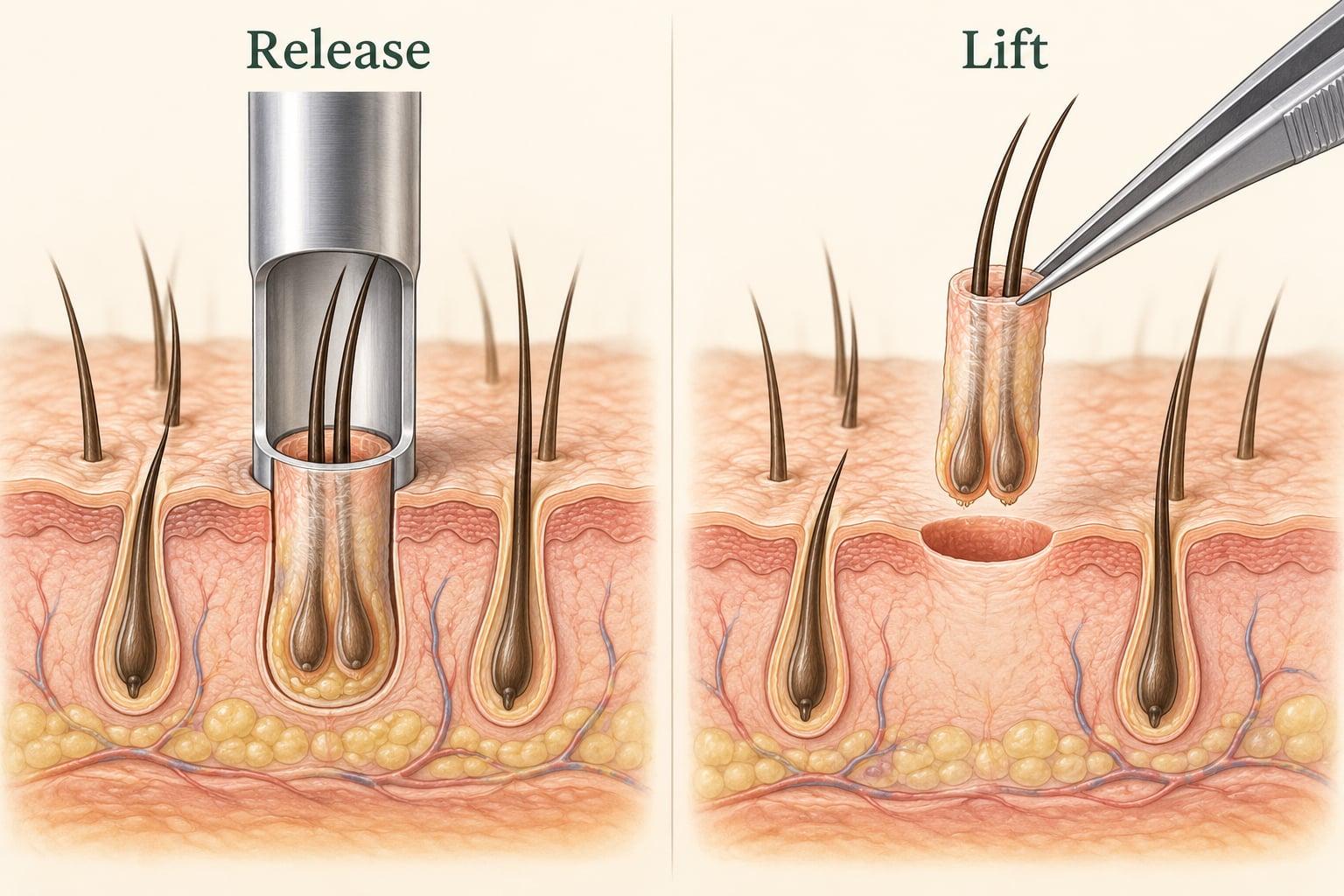
What this changes for you: there is no strip wound to close, but each removed unit uses donor supply and leaves a small wound. The surgeon needs to plan where collection occurs and what coverage will remain between the extraction sites. A large advertised session is not automatically a better use of that supply. [5]
What to ask: “Can you show me the proposed donor zone, explain how prior harvesting affects it, and describe what should remain at my usual haircut length?” The donor assessment guide explains the measurements behind that answer.
What happens during strip FUT collection?
The surgeon removes a strip of hair-bearing scalp and closes the donor wound. The removed tissue is then carefully divided under magnification into small follicular-unit grafts. The strip itself is not laid onto the bald area. Once prepared, those individual grafts still need to be placed into recipient sites, just as grafts collected by FUE do. [1, 2]
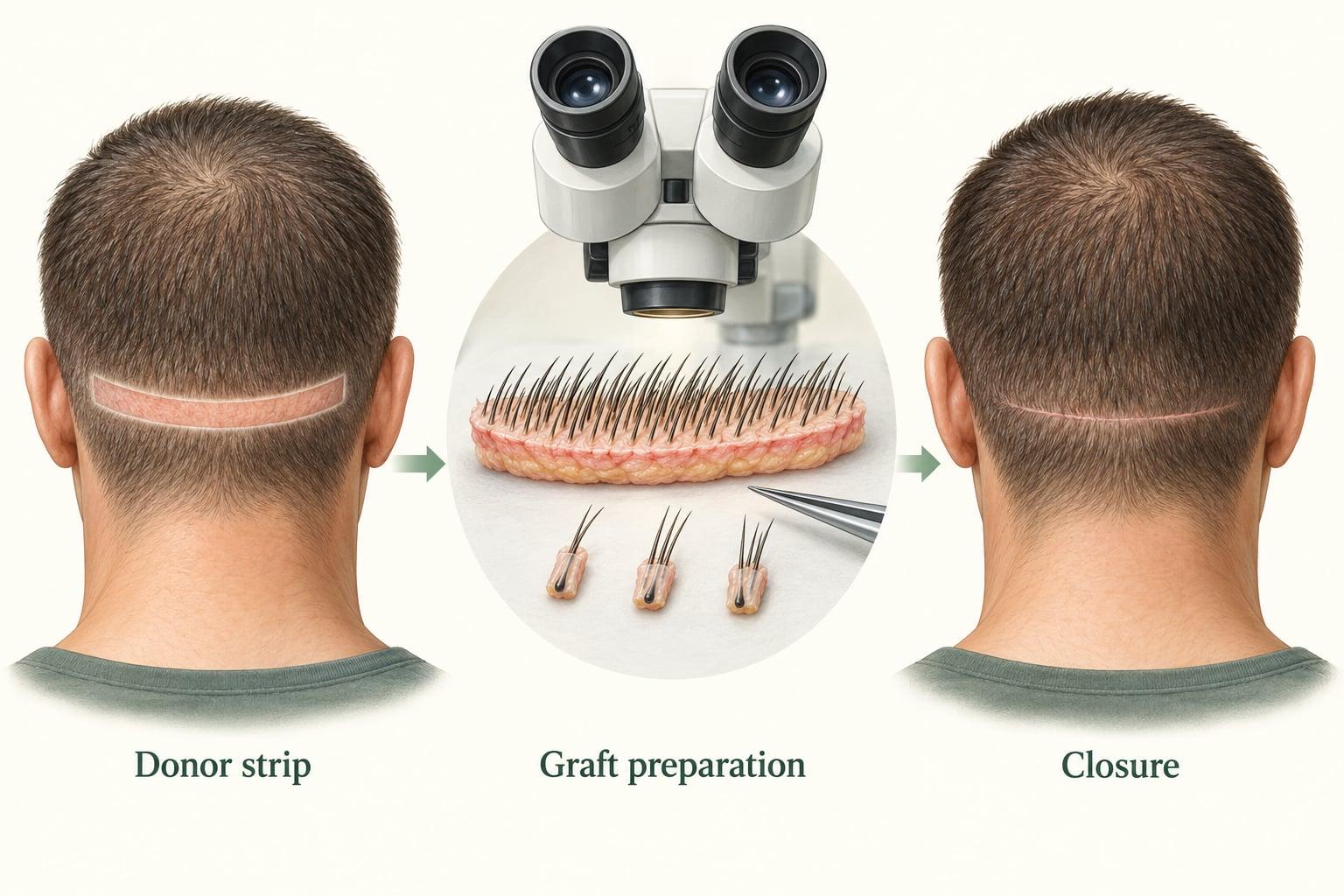
What this changes for you: scalp flexibility and closure tension matter, alongside where the strip is taken and how the eventual scar may be covered by your hair. The team's dissection and graft-handling work remain important even though the donor collection step differs from FUE. [2]
What to ask: “Why does strip harvesting suit my scalp and future donor needs, how would the scar fit my haircut, and what would another session involve?” A previous strip operation makes the old scar and remaining scalp flexibility part of that discussion. [2]
How do the donor tradeoffs compare?
| What differs? | FUE | Strip FUT |
|---|---|---|
| Donor collection | Individual units are released and removed across the planned donor area. | A strip is removed and divided into grafts. |
| Wound closure | Small extraction wounds generally heal without stitches. | The linear wound is closed with sutures or staples. |
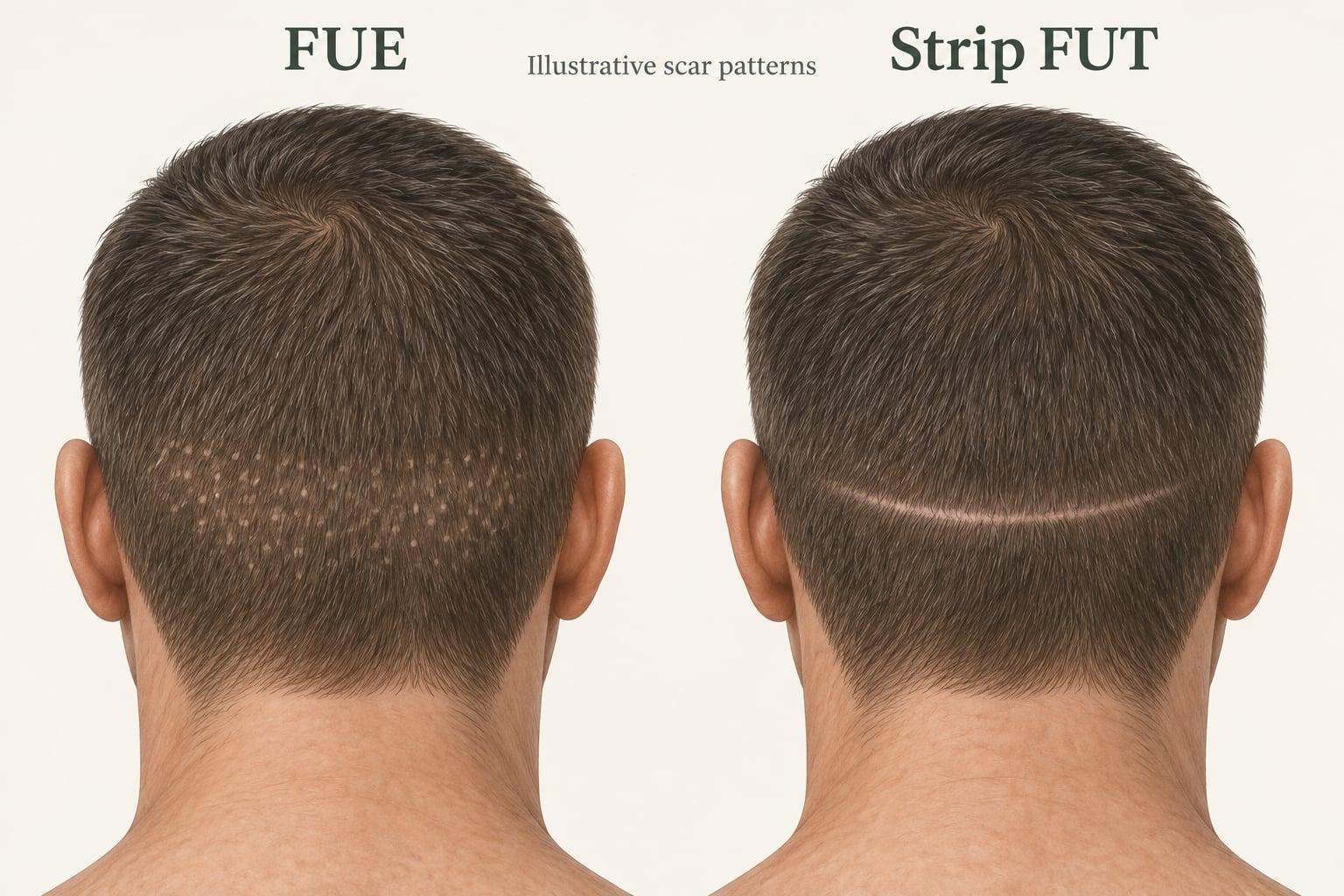
| Scar pattern | Small scattered scars, sometimes visible as pale dots. | A linear scar, which can widen. |
| Scalp flexibility | Can be considered when scalp laxity is limited. | Enough mobility and elasticity are important for closure. |
| Shaving | Common, although selected unshaven approaches exist. | Broad donor shaving may be avoidable. |
| Main donor concern | Removing too much, too unevenly or beyond a dependable donor zone. | Strip position, closure tension and the supply available for later surgery. |
These are planning tradeoffs drawn from society guidance, not a ranking of graft survival. The 2024 ISHRS strip guidelines regard both methods as current options and acknowledge the lack of large randomised studies. [5, 2]
Scars, haircuts and the plan for future surgery
A preference for short hair is a reason to discuss FUE, but it does not make FUE scarless. Its scattered scars and any thinning of the donor area can become easier to see at a very short length. A strip scar may be well concealed by longer hair, yet visibility depends on the eventual scar and the haircut, not simply the name of the procedure. [1, 5, 2]
Previous operations also matter. A surgeon assessing another strip procedure needs to consider the old scar, scalp elasticity and the previous experience of healing. Someone who has already had FUE needs a fresh assessment of remaining density and extraction patterns. A second session cannot be planned as though the first one used no donor supply. [5, 2]
Some people may have strip surgery and FUE across their lifetime, or in a planned combined approach. That possibility is worth discussing when donor supply is a major constraint. It is not permission to extract a standard extra number of grafts: the individual's anatomy, previous harvesting and likely future loss still set the limits. [5, 2]
Does avoiding a shave mean avoiding visible recovery?
No. Shaving and surgical healing are separate questions. Selected unshaven FUE approaches exist, while strip harvesting may avoid broad donor shaving. Ask separately what will be trimmed in the donor and recipient areas, what surrounding hair may conceal, and which wounds will still need care. A “no-shave” label does not promise immediate regrowth or an invisible operation. [5, 2]
The recovery guide separates early healing, temporary shedding and later growth. The treating team should connect those stages to your work, hairstyle and individual aftercare plan.
What DHI and an implanter pen actually change
DHI usually refers to the implantation stage, but clinics use the term differently. It may describe placing a graft soon after collection, or using a sharp implanter that creates the recipient opening and inserts the graft in the same movement. The useful question is what the clinic actually does, rather than whether its brochure includes those three letters. [1]
What does the pen do?
An implanter is loaded with a graft collected earlier. Its channel holds the graft, and a plunger moves it into the recipient skin. In the sharp version illustrated below, the tip makes the opening as the graft is placed. A blunt implanter needs an opening made beforehand. The instrument is therefore a placement tool, not a source of new follicles or a replacement for donor collection. [1]
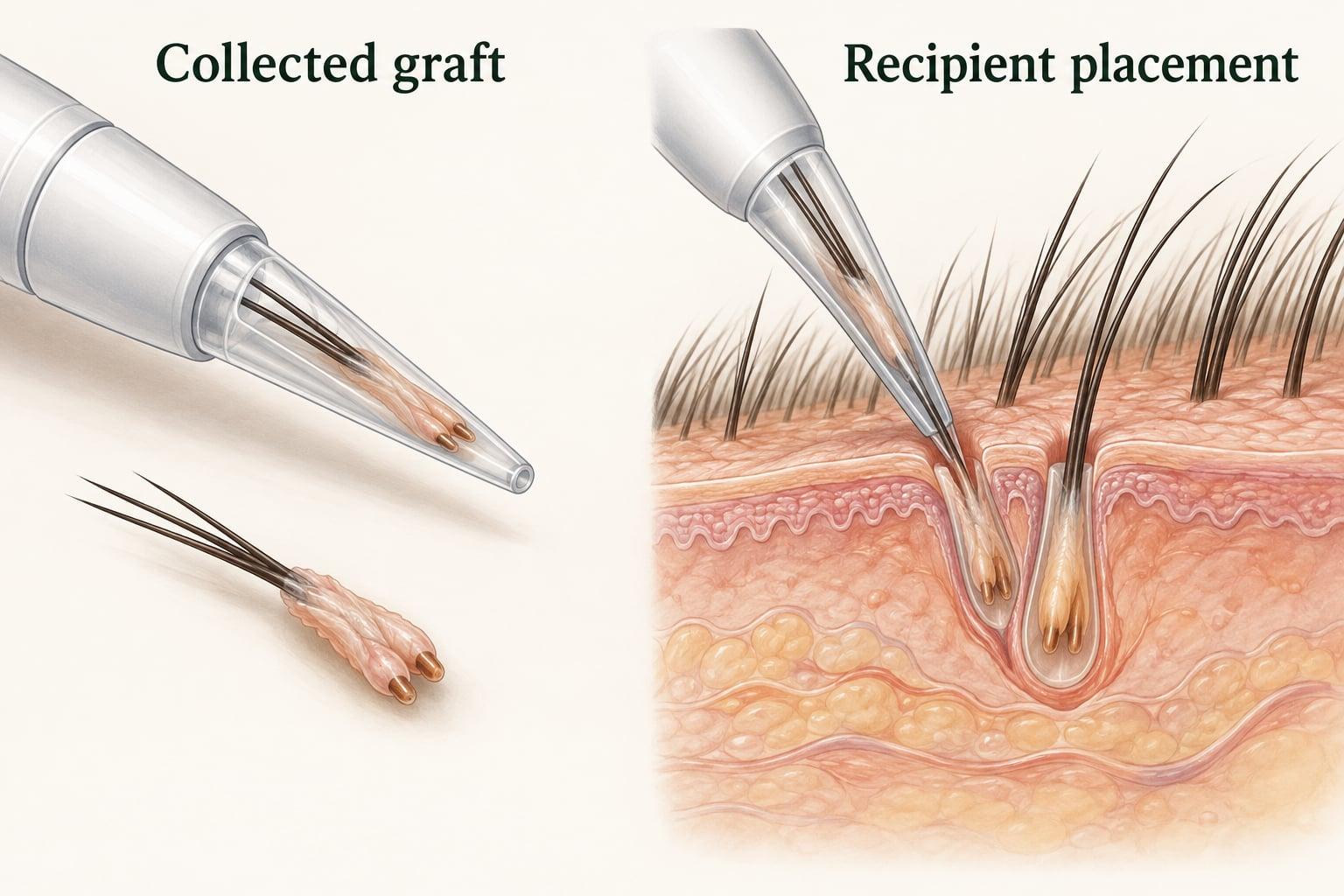
What this changes for you: the team must load and place grafts carefully, and the person using a sharp implanter is making surgical incisions. Ask which instrument is proposed, whether openings are made in advance and who performs each step. The clinic-selection guide explains how to clarify those roles under local rules. [1, 7]
| Placement approach | How it works | What the name does not establish |
|---|---|---|
| Forceps | The graft is placed into a prepared opening, either after multiple sites are made or one site at a time. | That handling is rough, or that the method necessarily produces poorer growth. |
| Blunt implanter | The loaded instrument places the graft into an opening made beforehand. | That the procedure involves no incisions. |
| Sharp implanter | The instrument makes an opening and places the graft. | That donor collection is different, or that final density will be higher. |
These distinctions come from the ISHRS description of implantation. An implanter can reduce direct handling of delicate parts of the graft, but the team still has to load and use it properly. The tool's design does not remove the importance of handling, placement or operator experience. [1, 2]
What has actually been compared?
A 2025 report compared forceps with an implanter in small forehead areas in two men. It reported less early shedding on the implanter sides at around one month. The authors explicitly said that the observation could not establish a definite conclusion or connect early shedding to graft survival. They reported no funding and no relevant conflict. [8]
An implanter may be the right tool for a particular team and plan. A fair explanation should describe that practical reason without converting it into a guaranteed survival percentage.
Does sapphire FUE produce a better result?
“Sapphire” generally refers to the blade used to make recipient sites. It does not describe a new way of generating donor hair. The ISHRS does not recognise sapphire FUE as a separate transplant technique. That naming point does not prove that all blade designs perform identically; it means the material alone is an incomplete description of the operation. [1, 9]
A recent observational paper reported favourable sapphire outcomes. However, its comparison also considered implantation technique, coverage and staging. Its final published full text was not accessible in our October 2026 check. A publicly posted manuscript draft described non-random allocation and a six-month assessment, but contained inconsistent participant totals and results. We could not verify that it matched the final article or resolve its funding and follow-up accounting. [9]
This leaves a clear practical answer: consider the complete plan and the team's results. A sapphire label alone is not enough to establish that paying more buys better coverage. The cost and quotation guide helps separate a technique premium from differences in the actual surgery, staffing and included care.
What robotic assistance can and cannot settle
A robot assists defined steps within a surgeon's plan. In FUE, a device may help identify and collect follicular units. The exact system, software, hair characteristics and operator remain relevant; “robotic” is not a result measured in a trial. [10]
In a 2024 split-scalp pilot, 13 men had robotic collection on one donor side and powered hand-held FUE on the other. The specific robot version was always used first by the experienced surgeon. At 12 months, the study found no significant difference in regrowth or satisfaction. That small comparison cannot establish equivalence, universal robot superiority or the frequency of rare complications. It received Shanghai public research and hospital support, and the authors declared no conflicts. [10]
- Device
- Name and versionWhich system is being used, and what does it do?
- Human role
- Named operatorWho plans, makes incisions and supervises each surgical step?
- Outcome
- Mature resultsAre the claims about collected grafts or about hair growing later?
Questions prompted by the device-specific study and surgical-qualification guidance. [10, 7]
A separate 2025 Chinese comparison reported 55 completers and improvement with both approaches at nine months. Only its original abstract was available for our review; funding and complete participant flow were unverified. It does not turn the word “robotic” into a general promise of better growth. [11]
The details that matter across every method
The result depends on the full operation: selecting reliable donor hair, avoiding excessive harvesting, protecting grafts and designing recipient sites. Hair calibre, curl and colour contrast affect apparent coverage; direction and angle affect the naturalness of placement. These factors make a single package number a poor comparison on its own. [5, 2, 3]
Curly or tightly curled hair should be part of the individual assessment and the discussion of the surgeon's relevant experience. The guidance asks clinicians to assess these characteristics; it does not justify declaring one harvesting method best for everyone with a particular hair texture. [5]
Donor planning
How much can be moved while leaving acceptable coverage and future options?Graft handling
How will the team protect the grafts between collection and placement?Recipient design
How will the hairline, angles and distribution fit the agreed goal?Continuing loss
How will the appearance work if surrounding native hair keeps thinning?
Shared planning questions from professional guidance. [6, 5, 2, 3]
Maintenance medicine addresses a different part of that plan. It may help preserve hair left in place, rather than supplying more grafts. The male pattern-loss guide, female pattern-loss guide and minoxidil versus finasteride comparison explain those separate treatment questions. A technique label does not answer whether a particular medicine suits you. [6, 12]
Compare a written plan, not just the package name
A useful consultation should leave you able to explain why the proposed approach fits your donor area, intended haircut and longer-term goals. The society's surgical qualifications position also makes the operator's role relevant, although local licensing and delegation rules differ by country. [5, 2, 7]
| Question to ask | What a useful answer should clarify |
|---|---|
| Why FUE or strip FUT for my scalp? | The anatomy, donor supply and scar tradeoffs behind the choice. |
| What does DHI mean in this quotation? | Collection method, implantation tool and who creates the sites. |
| What does the robot or sapphire blade add? | A specific task or supported advantage, with the limits of the evidence. |
| How many grafts and how many hairs? | The unit being quoted and the coverage planned. |
| Who performs each surgical step? | Named people, roles, licensing and supervision. |
| What happens if I lose more native hair? | The future design, reserve and maintenance discussion. |
| Which results can I review? | Mature photographs of comparable cases, including donor areas and consistent views. |
The clinic-selection guide helps check the named surgeon, operating roles and follow-up arrangements. The photography and tracking guide helps explain why lighting and angles can change an apparent result. The candidacy and donor guide is the next step when the unanswered question is whether there is enough suitable hair to achieve your aim.