

Start with the surgeon and the plan
A hair-transplant clinic should be able to explain who is responsible for your operation, why surgery is suitable and how it will provide care afterwards. The name of a package, an impressive gallery or an attractive hotel does not answer those questions. The International Society of Hair Restoration Surgery, or ISHRS, recommends asking about the clinician's training, surgical roles, options, scars and likely treatment course. [1]
A transplant moves your own living hair follicles into a thinning area. A graft is a small piece of tissue that can contain several hairs. Donor hair, usually from the back and sides of the scalp, is finite: deciding how much to move also means deciding what coverage to leave behind. [2, 3] The hair-transplant guide explains the operation and its limitations.
This page concerns adults considering scalp transplantation, locally or abroad. It offers a way to organise checks and questions. It does not rank clinics or establish anyone's suitability from a photograph.
- Identity
- Named clinicianKnow who will assess you and take responsibility for surgery.
- Surgical plan
- Your donor hairThe proposed coverage needs a reason and a plan for further loss.
- Continuity
- Aftercare contactKnow who reviews healing and manages concerns after you leave.
Registration, certification and membership mean different things
A licence or registration, an additional certification and society membership answer different questions. Check each claim with the organisation that actually issues it, using the clinician's full name rather than the clinic's logo. None predicts your result. [6, 7, 8]
| Claim | What to verify | What the claim does not settle |
|---|---|---|
| Registered or licensed doctor | The relevant regulator's current record and the exact professional status | Experience with your operation, or the quality of a proposed plan |
| Additional hair-restoration certification | The exact awarding body, its requirements and its own directory | The clinician's legal authority in every country or an outcome guarantee |
| Member of a professional society | The membership claim with that society | A substitute for regulator checks |
| Registered or accredited facility | The organisation, site and service the listing covers | Guaranteed surgical results or freedom from complications |
These are different checks, not interchangeable badges. The ABHRS describes its own written and oral certification examinations; the GMC maintains UK registration information; the CDC cautions that accreditation does not guarantee a good outcome. [6, 7, 8]
A UK example, rather than a worldwide rule
The NHS hair-transplant page directs readers in England to check the clinic with the Care Quality Commission, or CQC, and the doctor with the General Medical Council, or GMC. The CQC is England's care regulator; it is not the facility register for every country. The GMC's public register is a UK doctor-verification example. [9, 7]
For another destination, the equivalent question is which local authority regulates the professional and the facility. An international society directory can help identify a name to investigate, but it should not replace those local checks. [10, 8]
Find out who performs each part of surgery
The responsible surgeon and the people performing surgical steps should be identified before consent. “Our medical team” leaves too much unanswered. ISHRS regards scalp incisions and graft-removal incisions as surgical acts, including with robotic assistance, while acknowledging that permitted professional roles depend on local law. [10]
The following is a worksheet to complete with the clinic, not a universal statement about who may legally perform each step:
| Stage | What to ask the clinic to record |
|---|---|
| Assessment and treatment recommendation | Name and qualification of the person making the clinical decision |
| Hairline and donor planning | Who agrees the design, donor boundaries and intended coverage |
| Anaesthetic and monitoring | Who provides and supervises this care |
| Donor graft removal | Who makes the incisions and removes the grafts, and under what authority |
| Recipient openings and placement | Who makes openings, who places grafts and how supervision works |
| Healing and later growth review | Named responsible clinician, contact route and review arrangements |
The role questions follow ISHRS patient advice and its surgical qualifications position. Ask what happens if the proposed surgeon changes before the operation. A machine or method name does not establish who is accountable. [1, 10] For the surgical terminology, see how the hair-transplant methods differ.
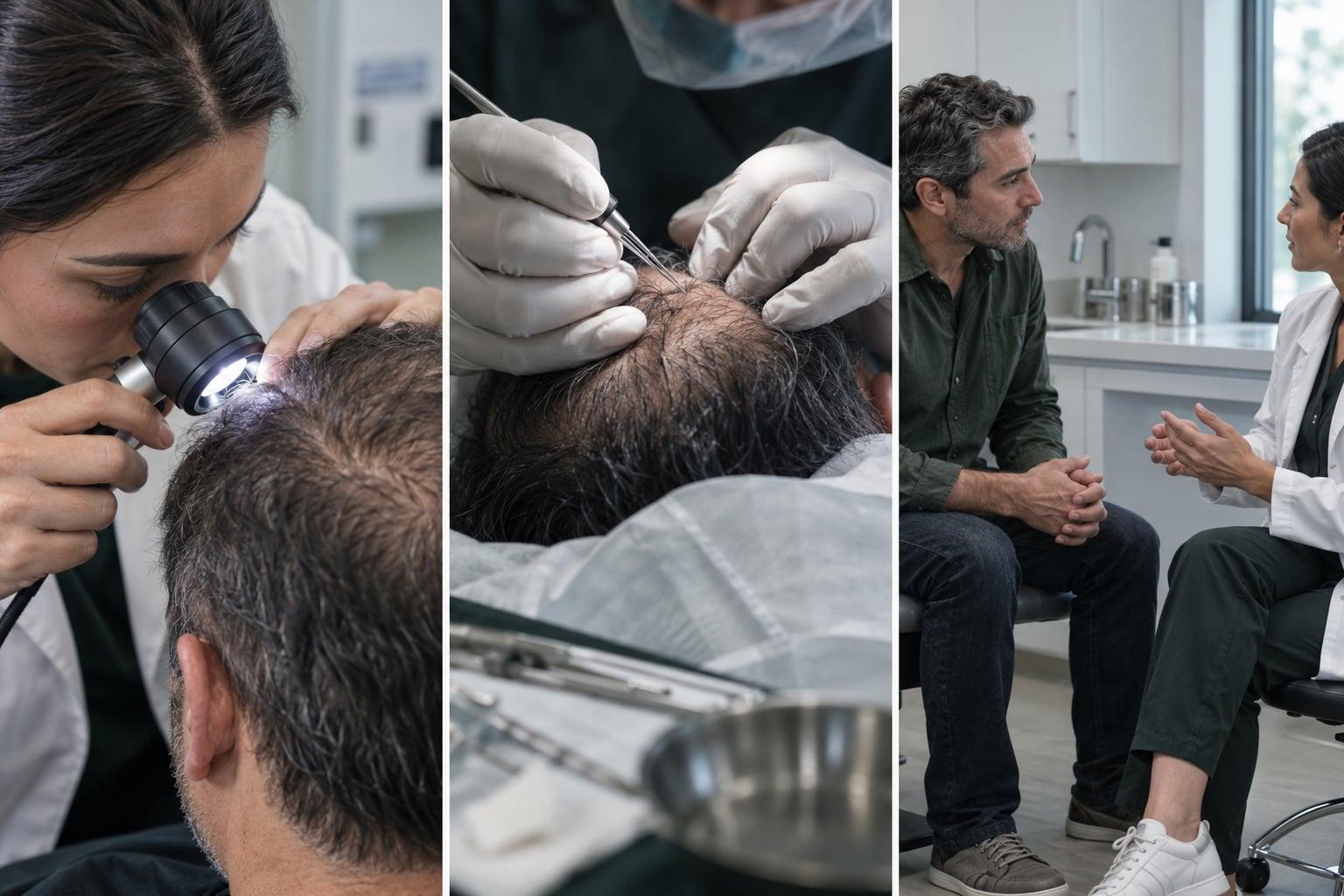
- Assessment
- Surgery
- Follow-up
A useful consultation explains the limits of the plan
The consultation should explain the diagnosis, available donor hair and realistic coverage, including what further loss could mean. Women can be candidates, but diffuse donor thinning, active disease or an uncertain cause of loss can change the decision. The female pattern hair-loss guide and types of hair loss explain those assessment boundaries. [11, 12, 3]
Donor supply
What was examined, what can be moved and what coverage should remain at the back and sides?Design and expectations
Which areas are included, what visible coverage is the goal and which wishes cannot reasonably be met?Future loss
What happens if native hair continues to thin, and are further sessions planned?Alternatives
Why this approach, what are the alternatives and what would waiting or choosing no surgery mean?
Questions based on clinical selection guidance and ISHRS consultation advice, not a candidacy test. [11, 12, 3, 1]
The donor and candidacy guide explains what the assessment needs to establish. To make the conversation concrete, a useful question is: “Can you show me which areas this operation would cover, what donor coverage should remain and what you would preserve for possible future loss?” A graft number without that explanation is an incomplete description of the plan.
If medicines are part of the proposed plan, the consultation should distinguish preservation of existing hair from transplantation itself. The finasteride profile and its side-effect guide explain the medicine decision; they do not prescribe a surgical aftercare schedule. [11]
Read photographs and reviews for what they can show
Photographs can help explain a surgeon's work, but a gallery cannot give your personal probability of success. The NHS advises asking to see the surgeon's own previous patients and results. For a comparison to be interpretable, note the elapsed time, areas shown, lighting, angles and hair length. Our hair-growth photography guide explains how to make comparisons more consistent. [5]
Useful questions about a displayed case include:
- Was this the work of the clinician who will operate on me?
- Are both the recipient area and donor area shown?
- How long after surgery was the result photographed?
- Was it one operation or a planned series?
- Were medicines or other treatments used alongside surgery?
- Is the starting pattern reasonably comparable to mine?
These are questions for interpreting a case, not a validated gallery score. A favourable selected photograph does not measure graft survival, the experience of everyone treated or the need for further surgery. The results guide separates those outcomes.
Consent needs time and clear terms
The decision should follow a clinical explanation of options and risks, with time to reflect. UK GMC guidance requires an appropriate consent discussion and makes clear that someone can change their mind. It also addresses clear charges and continuity of care. Those are UK professional requirements; this page does not assert a worldwide cancellation period. [4]
The NHS treatment-abroad checklist flags pressure to book and missing information as reasons to investigate further. A deadline discount should not take the place of answers about the operation. An additional qualified opinion can help when the suitability or plan remains unclear. [13]
- 1
Discuss the clinical plan
Meet the responsible clinician and understand the reason for surgery and its limits.
- 2
Get the terms in writing
Record the operation, roles, charges, aftercare and what happens if the plan changes.
- 3
Allow time to decide
Resolve missing answers before treating a deposit or travel booking as your decision.
Costs need their own written comparison. A high price does not establish good care, and a low price alone does not establish an unsafe operation. The ISHRS cost discussion explains that operating costs differ between settings; it is not a comparative safety or price study. [14]
The quote-comparison worksheet makes those terms easier to compare. One specific question is: “If the surgical plan changes after examination, what happens to my consent, quoted price and deposit?” The answer should come from the clinical plan and written terms, not an assumed cancellation rule.
Travel abroad adds an aftercare decision
Travelling for surgery means arranging care beyond the procedure day. The NHS and CDC recommend checking qualifications, planning follow-up and complication care, considering insurance and keeping medical records. Their travel advice is general: it does not rank countries or establish a hair-transplant complication rate. [5, 8, 13]
| Before booking | Clarify in writing |
|---|---|
| Communication | Who explains consent and aftercare in a language you understand |
| Before leaving the destination | Which review occurs, who decides you are ready to travel and whom to contact if plans change |
| Back at home | Whether follow-up is remote or in person, and who can examine a concern locally |
| Unexpected care | Who arranges treatment, what the clinic pays and what remains your responsibility |
| Insurance | What the actual policy covers for planned treatment and related complications |
| Records | How to obtain the operation details, medicines and care plan for another clinician |
| Extra stay or return trip | Who pays and whether the quoted package includes it |
This checklist adapts official travel-planning questions. Coverage depends on the policy and circumstances; it must be confirmed rather than assumed. Accreditation is one check, not an assurance against complications. [5, 8, 13]
Ask for a handover you can use: the operation summary, medicines and aftercare instructions, scheduled reviews, treating clinician's contact and the agreed route for an examination at home. Official guidance supports obtaining medical records and arranging continuity; this is an organising list to discuss, rather than a legally required document bundle everywhere. [8, 13]
For remote follow-up, useful wording is: “If I send a photograph and you think I need an examination, who can see me, how is it arranged and what cost is mine?” Keep that answer with the travel and care budget. A messaging contact alone does not describe an examination or who pays for it.
There is no universal fly-home day in the sources used here for scalp transplantation. Generic intervals for other cosmetic operations should not be imported. Travel and activity decisions belong in the treating team's individual plan. [5, 8] The recovery guide distinguishes healing from growth.

When an answer needs clarifying before you decide
An unresolved question should lead to a specific request for information. It need not become a score against a clinic. The following decision checklist draws together the checks above and the NHS advice on pressure and missing information. [13]
| What remains unclear | A useful next question |
|---|---|
| The actual surgeon is not named | “Who is responsible for my operation, and when can I discuss the plan with them?” |
| Only a membership logo is provided | “What is the clinician's local regulator record, and which body issued each additional credential?” |
| A technique or graft count replaces an assessment | “What examination supports this plan, and how does it account for my donor hair and future loss?” |
| A guarantee does not define the outcome | “Does this refer to growth, appearance or another session, and what are the written limits?” |
| “Aftercare included” has no service description | “Which reviews and treatments are included, who provides them and what happens after I return?” |
| A deadline arrives before the answers | “Can I have the complete clinical plan and terms, with time to consider them?” |
If the donor explanation remains uncertain, use the candidacy questions to identify what has not been established. If the guarantee is the problem, the guide to specific outcome claims explains how to separate survival, satisfaction and appearance. An additional qualified opinion can help clarify unresolved suitability or planning questions. [13]
Keep a record of answers and unresolved questions
A useful shortlist is a record of what you have verified and what remains unanswered. Keep the clinician's name, regulator record, dated treatment plan, quotation, consent information and aftercare contacts together. Official travel guidance recommends accessible medical records and a clear continuity plan. [8, 13]
For each answer, record the named person, what was agreed, the date and the document or contact that confirms it. Mark verbal answers that still need written confirmation. This is an editorial way to organise the consultation, not a clinical scoring system. It helps you distinguish a question already answered from one that still needs a decision.
An empty field is a question to resolve, not a reason to give the clinic an automatic score. The general transplant guide helps check the clinical explanations. For nonsurgical alternatives, the Hair options provide a broader starting point. Once the plans are clear, use the cost and quote worksheet to compare included care, extras and travel in a consistent way.
Understand the operation before comparing clinicsReview donor limitations, methods, realistic results and the continuing-loss plan alongside the clinic's proposal.